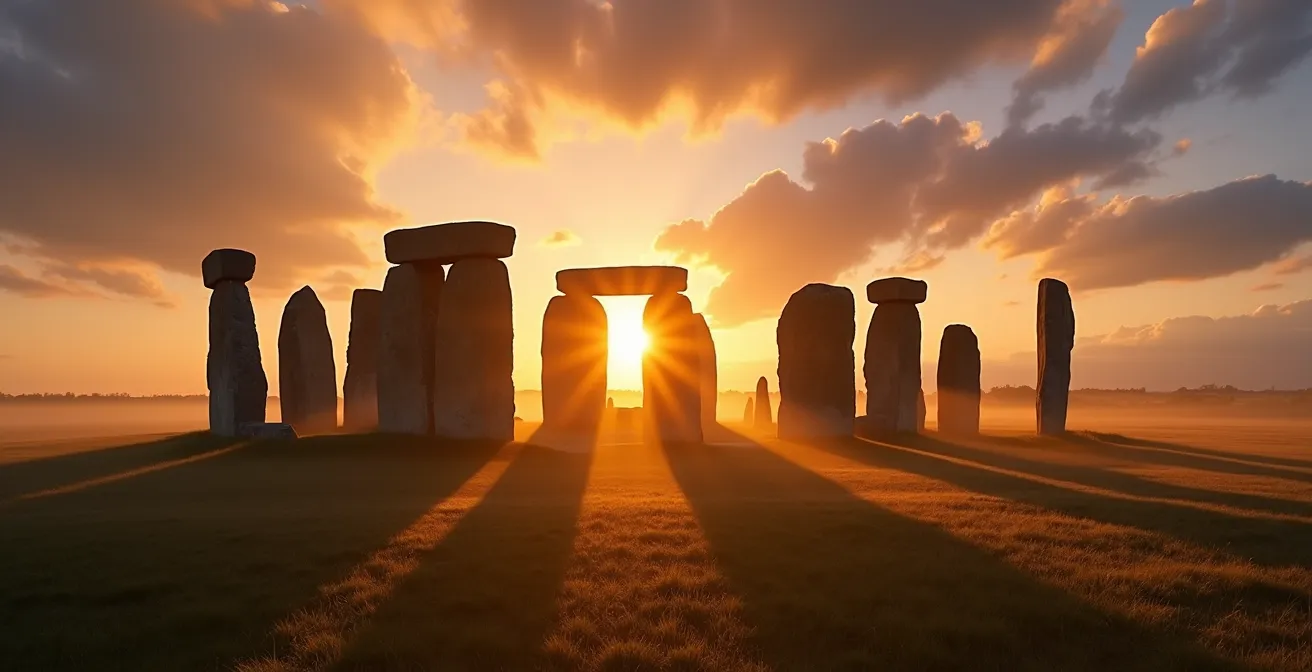
The frustration of finding a barrier between you and an ancient monument like Stonehenge is understandable. However, these restrictions are not arbitrary denials; they are a form of essential risk management. This guide explains that by understanding the ‘why’—the need to protect sites with a finite lifespan from the cumulative impact of millions of visitors—you can unlock a deeper appreciation and discover alternative, often more meaningful, ways to connect with our shared heritage.
The first time many people visit Stonehenge, they feel a pang of disappointment. You’ve travelled all this way, perhaps dreamed of this moment for years, only to be met by a rope barrier keeping you at a distance. The natural human instinct is to want to connect, to reach out and touch the ancient, colossal stones. It’s a feeling we, as heritage managers, see and understand every single day. The common explanation you’ll hear is simple: “It’s for conservation.” While true, this phrase hardly captures the complex reality we face.
The challenge isn’t about stopping one person from touching a stone; it’s about managing the cumulative impact of millions of touches, footsteps, and breaths over decades. Every great monument has a finite lifespan, and our primary role is one of stewardship—a profound obligation to ensure these irreplaceable wonders survive for future generations to experience. This isn’t just about Stonehenge; it’s a principle that applies to clock towers under repair, fragile ancient ruins, and even crowded museum galleries across the United Kingdom and beyond.
But what if the barrier isn’t the end of the story? What if understanding the reasons behind these rules could open up new, more intimate ways of experiencing these sites? This guide is an inside look from a heritage manager’s perspective. We will explore the delicate balance between access and preservation, moving beyond the simple “no” to explain the “why.” We’ll show you how this careful management allows for special access opportunities, ensures visitor safety, and ultimately protects the very essence of the places we all love.
In the following sections, we will delve into the specific challenges and solutions at various iconic sites. From booking exclusive access at Stonehenge to understanding the rules at other world-famous landmarks, this is your guide to navigating the realities of modern heritage tourism and becoming a partner in preservation.
Summary: Why You Can No Longer Touch Stonehenge and How to Get Closer Access
- Inner circle access: How to book the sunrise tour at Stonehenge?
- How to check if Big Ben is covered before you book your trip?
- Steps and stamina: Is the climb up the Duomo safe for seniors?
- Why high heels are banned at ancient Greek sites?
- Knives and tripods: What is confiscated at the Eiffel Tower entrance?
- Caravaggio’s masterpiece: When is the best time to view it quietly?
- The error of ‘off-roading’ that destroys protected peatlands
- The UNESCO premium: Does World Heritage status just mean double the price?
Inner circle access: How to book the sunrise tour at Stonehenge?
While the main path keeps visitors at a distance to protect the fragile archaeology and prevent soil erosion, it doesn’t mean getting closer is impossible. We’ve developed a system of calibrated access that allows for a much more intimate experience without compromising the site’s integrity. The most sought-after of these is the Stone Circle Experience, which grants a small group of people access inside the circle itself, outside of normal opening hours.
This isn’t a free-for-all. These visits are strictly managed to minimise impact. According to English Heritage, each session is limited to a maximum of 52 people and costs around £70 for adults. This fee directly contributes to the enormous cost of conserving the site. The experience is offered at sunrise or sunset, times chosen not just for their atmospheric beauty, but also because the low light and cooler temperatures are less stressful for the monument’s delicate lichen and stonework.
Booking these tickets requires planning, as they are incredibly popular and often sell out months in advance. You must book directly through the English Heritage website or via a licensed tour operator. Arriving at the visitor centre well before your allotted time is crucial. This managed approach is our solution to the core dilemma: it satisfies that deep human desire for proximity while upholding our primary duty of care. It transforms the visitor from a passive observer into a privileged guest, aware that their special access is part of a wider conservation effort.
How to check if Big Ben is covered before you book your trip?
There are few disappointments for a London visitor greater than arriving to find the iconic Elizabeth Tower (home of Big Ben) shrouded in scaffolding. We understand this frustration. Major conservation projects, like the one recently completed on the tower, are essential for the long-term survival of these structures. They are planned years in advance and are absolutely necessary to address issues like weather damage, structural decay, and the need to modernise facilities.
Before booking a trip where a specific landmark is your priority, a quick check of the official venue website is crucial. For parliamentary estate buildings like the Elizabeth Tower, the UK Parliament website (parliament.uk) is the definitive source for information on closures, restoration work, and tour availability. While the tower itself was closed, visitor information shows that tours of the Houses of Parliament often continued, offering a different but equally fascinating perspective.
When a primary landmark is unavailable, it can also be an opportunity to discover other hidden gems. London is full of magnificent and often-overlooked public clocks with their own rich history.
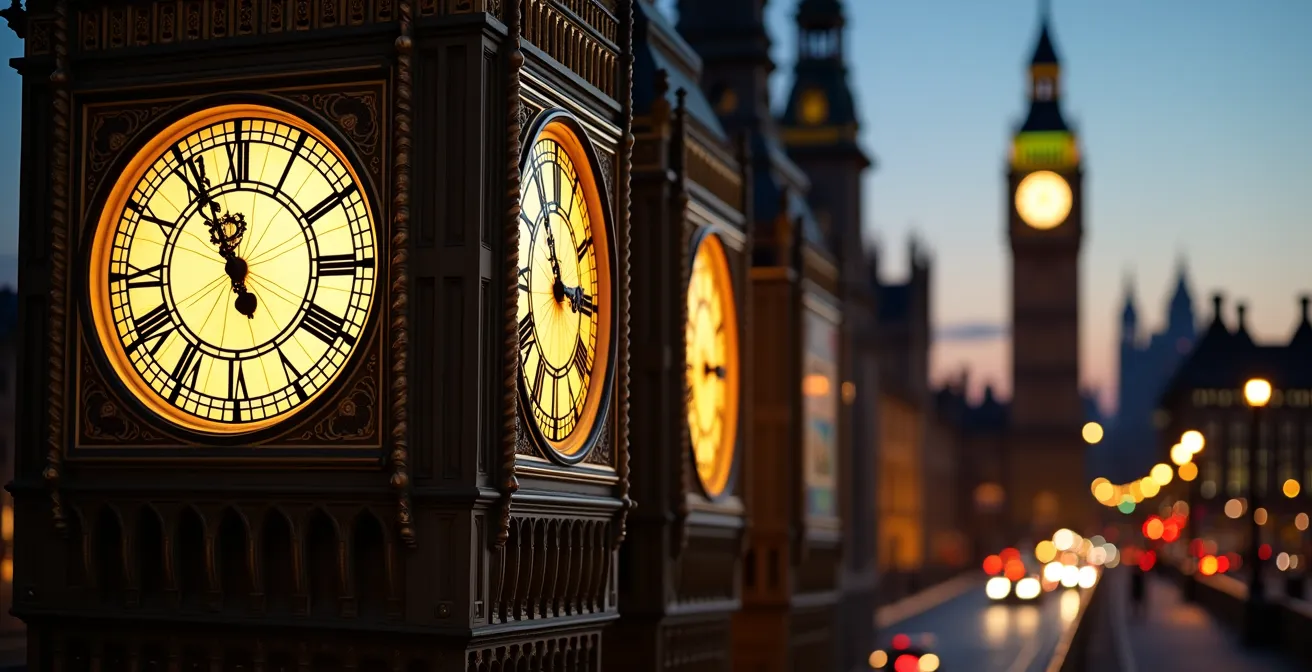
As this collection of timepieces shows, from the Tudor-style clock at Liberty London to the grand Art Deco face on Shell Mex House, the city offers a wealth of architectural beauty beyond the most famous sights. A restoration project, while temporarily disappointing, can be a prompt to explore the city with fresh eyes and discover a new favourite landmark.
Steps and stamina: Is the climb up the Duomo safe for seniors?
The restrictions we implement are not always about protecting the monument from people; often, they are about protecting people from the monument. Historic structures were not built to modern safety standards, and climbing the 463 steps of Florence’s Duomo, or the 528 steps to the dome of St Paul’s Cathedral in London, presents genuine physical challenges.
These are not modern, evenly spaced staircases. They are often narrow, winding, and uneven, with worn stone steps and poor lighting. There are no lifts or rest stops. For this reason, we strongly advise visitors, particularly seniors or those with mobility, heart, or respiratory conditions, to honestly assess their physical fitness. It’s not a matter of age, but of health and stamina. Can you climb several flights of stairs without becoming breathless? Are you comfortable in tight, enclosed spaces? The responsibility for this assessment ultimately lies with the visitor.
This is a perfect example of balancing a thrilling experience with visitor safety. For those for whom such a climb would be unsafe or unpleasant, London offers fantastic, fully accessible alternatives. The viewing platforms at The Shard or the Sky Garden provide breathtaking panoramic views of the city via high-speed lifts, ensuring that the experience of seeing a skyline from above is available to everyone, without the strenuous and potentially hazardous climb of a centuries-old monument.
Why high heels are banned at ancient Greek sites?
A rule banning high heels at the Acropolis might seem trivial or even sexist, but it is rooted in a fundamental principle of conservation: preventing cumulative damage. Ancient marble and stone surfaces are far more fragile than they appear. As conservation experts note that monuments have endured over 2,000 years of weathering, their surfaces have become porous and susceptible to damage.
The problem with a stiletto heel is the immense pressure it concentrates on a tiny point. This pressure can chip, crack, or puncture ancient floors and walkways that have survived millennia. Furthermore, walking on uneven, ancient paths in high heels is a significant safety risk, leading to twisted ankles and falls. The ban protects both the monument and the visitor. It’s the same logic that prevents the use of pointed walking sticks or camera tripods on delicate mosaic floors. It’s not one person that causes the problem; it’s the potential for thousands of small, damaging impacts every single day.
This illustrates the ‘precautionary principle’ in heritage management. We must proactively prevent damage before it occurs. As the official guidelines from one of the UK’s leading conservation bodies state, the goal is to minimise all forms of disturbance.
A good general rule with archaeological sites is that the less disturbance of the ground, the better.
– Historic England, Scheduled Monuments Guidelines
This simple rule governs many of the regulations you encounter, from roped-off areas to footwear restrictions. Every rule, no matter how small it seems, is part of a larger strategy to ensure the site’s survival.
Knives and tripods: What is confiscated at the Eiffel Tower entrance?
Security measures at major tourist sites can often feel intrusive. The confiscation of items like pocket knives, large bags, or even professional camera tripods at the Eiffel Tower entrance is a common source of frustration. However, these rules are rarely unique to a single landmark. They are part of a global standard for public safety and site management in a world of heightened security concerns and high visitor numbers.
As the table below shows, the restrictions at a major Paris landmark are remarkably similar to those you would find at large venues in the UK, like Wembley Stadium or The O2 Arena. Items that can be considered weapons are prohibited, and large bags are banned to speed up security checks and reduce hazards. The rules are not there to inconvenience you, but to ensure a safe environment for everyone.
The following table, sourced from public information on UK venue restrictions and Eiffel Tower policies, highlights these similarities.
| Item Category | Eiffel Tower | UK Venues (Wembley/O2) |
|---|---|---|
| Large bags/backpacks | Prohibited | Prohibited |
| Sharp objects/knives | Confiscated | Confiscated |
| Professional tripods | Banned (trip hazard) | Venue-specific |
| Selfie sticks/monopods | Usually tolerated | Often allowed |
| Drones | Strictly forbidden | Prohibited without permission |
The ban on professional tripods is a perfect example of risk management. In a crowded space, a tripod’s wide legs create a significant trip hazard. A monopod, however, has a much smaller footprint and is generally considered less of a risk.

This visual distinction between a monopod and a tripod demonstrates the thinking behind the rules. It’s not an attack on photography; it’s a practical measure to manage crowd flow and prevent accidents. Understanding this helps reframe the rule from a frustrating restriction to a sensible safety precaution.
Caravaggio’s masterpiece: When is the best time to view it quietly?
Some barriers are not made of rope or metal, but of people. Trying to have a quiet moment with a world-famous masterpiece like a Caravaggio in Rome can feel impossible amidst a sea of smartphones and tour groups. This ‘human barrier’ is one of the most difficult challenges in visitor management. We cannot simply turn people away, but we can provide strategies to help you find those precious moments of quiet contemplation.
The principles for avoiding crowds are universal. Take, for example, the Crown Jewels at the Tower of London. This is the UK’s most popular indoor attraction, and queues can be immense. The best viewing times are always first thing in the morning on a weekday, or during the deep off-season (late January to early March), avoiding all school holidays. The same logic applies to any major museum or gallery in the world. You need to think like a contrarian: when everyone else goes, go somewhere else. When everyone else is at lunch, head to the main attraction.
By planning strategically, you can significantly enhance your experience. Late evening openings, often on a Friday, are a fantastic opportunity, as many day-trippers have already gone home. Entering through a less-common entrance or starting your tour at the end of the exhibition and working backwards can also help you move against the main flow of traffic. It requires a little bit of research, but the payoff—a relatively private viewing of a masterpiece—is immeasurable.
Your Action Plan: A Strategy for Quiet Museum Viewing
- Book the first entry slot of the day (usually 9:00-9:30am) as soon as online booking opens.
- Target the UK off-season: late January through early March, making sure to avoid half-term breaks.
- Plan your visit for a weekday, especially Tuesday through Thursday, when tourist traffic is lowest.
- Use less popular entrances if available and work your way through the museum against the typical tour route.
- Take advantage of late opening hours, common on Fridays, when many museums in London stay open until 8 or 9pm.
The error of ‘off-roading’ that destroys protected peatlands
The concept of stewardship extends far beyond the walls of a castle or the stones of a monument. It covers vast landscapes, including fragile ecosystems like the UK’s peatlands, which are often part of a wider archaeological area. The impulse to ‘go off-roading’ or wander off the marked path in these wild-seeming places can cause irreversible damage. This isn’t public parkland; it’s a protected heritage asset.
Peatland ecosystems are vital carbon sinks, and the ground is often waterlogged and easily disturbed. A single vehicle or even repeated footfall can compress the soil, destroy delicate vegetation, and disrupt the hydrology that took centuries to form. More importantly, these landscapes frequently contain hidden archaeological remains just below the surface. In the UK, our legal framework for protecting such areas is robust. The Ancient Monuments and Archaeological Areas Act 1979 provides the legal basis for this protection.
This single piece of legislation is the backbone of our work. Under this act, there are over 20,000 scheduled monuments protected under UK law, ranging from prehistoric earthworks to Roman forts and industrial remains. Damaging a scheduled monument, whether intentionally or through negligence, is a criminal offence. The marked paths and access guidelines in these areas are not suggestions; they are legal requirements designed to protect a fragile, non-renewable resource. Sticking to the path is the simplest and most effective act of conservation any visitor can perform.
Key Takeaways
- Visitor restrictions are not arbitrary; they are a necessary tool for managing the ‘cumulative impact’ of millions of visitors on sites with a finite lifespan.
- Understanding the ‘why’ behind a rule (e.g., safety, security, conservation) can transform a frustrating experience into an appreciation for the site’s stewardship.
- Calibrated access, such as timed tickets or special tours, is a key strategy for balancing high demand with the need for preservation, often providing a more meaningful experience.
The UNESCO premium: Does World Heritage status just mean double the price?
It’s a common perception that as soon as a site receives a UNESCO World Heritage designation, prices soar and access becomes more complicated. While there can be an economic impact, the idea of a simple “UNESCO tax” is a misunderstanding of what the designation means. It is not a commercial award; it is a profound conservation commitment. A site’s inscription on the World Heritage List signifies that it has ‘Outstanding Universal Value’ and places a solemn duty on the host nation to protect it for all humanity.
In the UK, the management of our 33 UNESCO sites is complex, and pricing is not uniform. As the Liverpool waterfront’s delisting in 2021 demonstrated, the obligations are taken very seriously and can even clash with development goals. Many of our sites are managed by independent charities like English Heritage (Stonehenge) or Historic Royal Palaces (Tower of London), which receive little to no state funding. The admission fees they charge are the primary source of income for the colossal costs of expert conservation, research, and visitor services.
Conversely, many other UNESCO sites in the UK are completely free to access. The pricing depends on the nature of the site and its management structure, not the UNESCO badge itself.
This table, based on data from various UK heritage bodies like those tracking UK landmarks, shows the diversity of access models.
| UNESCO Site | Access Type | Cost | Management |
|---|---|---|---|
| Stonehenge | Paid | c. £30 adult | English Heritage (charity) |
| Tower of London | Paid | c. £30 adult | Historic Royal Palaces (charity) |
| Jurassic Coast | Free | £0 | Public landscape |
| Hadrian’s Wall (most sections) | Free | £0 | National Trail |
| City of Bath | Free | £0 | Public spaces |
The price of a ticket is not a premium; it is an investment. It is your direct contribution to the stewardship of a place deemed worthy of protection for all time. When you pay for entry, you are not just a consumer, you are becoming a partner in the preservation of our shared global heritage.
By shifting your perspective from that of a tourist to that of a temporary guardian, you can find a deeper meaning in your visit. We invite you to see the rules, the prices, and the barriers not as obstacles, but as part of the incredible, ongoing story of keeping our history alive for the next generation.