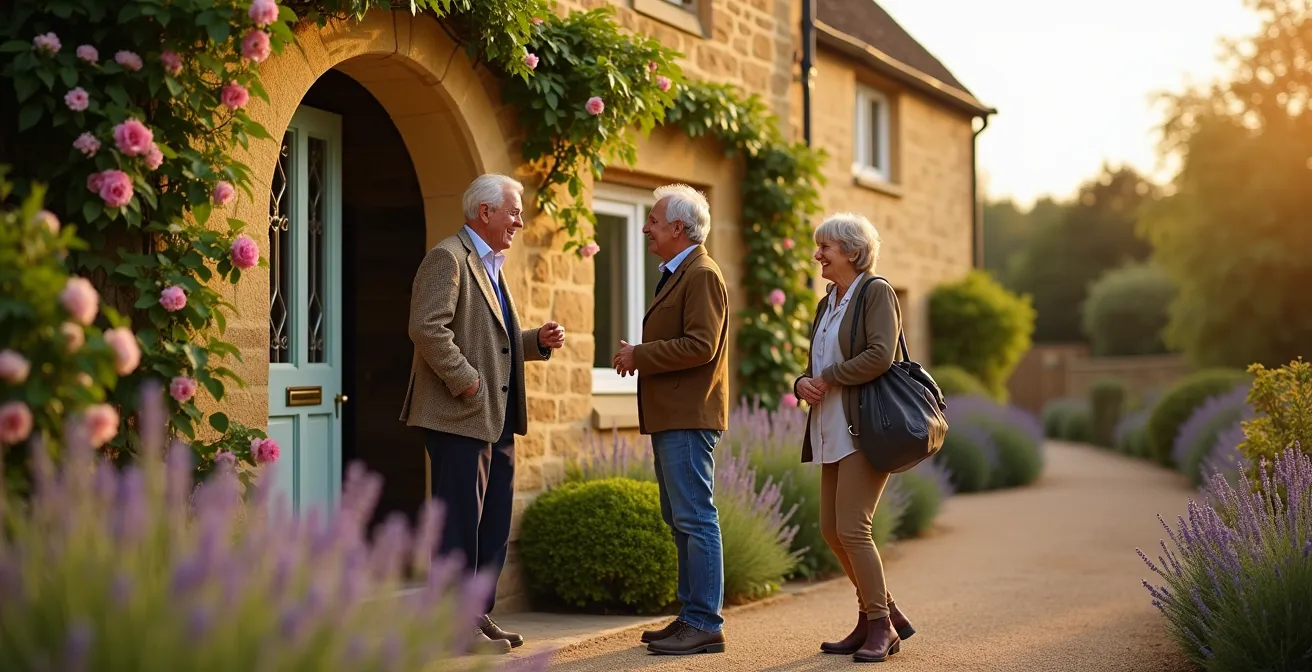
Choosing a host over an empty rental isn’t just a different type of accommodation; it’s choosing to be an active participant in a living culture, not just a passive observer.
- Hosts provide “Living Knowledge”—personal, contextual insights that algorithms miss, turning your trip into a journey of curated discoveries.
- Your stay becomes an act of “Community Stewardship,” directly funding the preservation of England’s unique local and heritage properties.
Recommendation: For a truly immersive trip, prioritise the genuine human connection that only a dedicated and welcoming host can provide.
The travel landscape has changed. In an age of key-code entries and automated check-in messages, it’s easy to feel like a ghost in a new city. You arrive in a clinically clean, yet soulless, apartment and the promise of “living like a local” rings hollow. You’re physically present, but disconnected from the pulse of the community around you. The standard advice often circles back to transactional benefits: choose a Bed & Breakfast for the included breakfast or for a quaint aesthetic. But this misses the fundamental point.
What if the choice wasn’t just about convenience, but about connection? What if your stay could be an act of co-creation, a chance to be woven into the fabric of a place rather than just observing it from a distance? In a world of increasing anonymity, the true value of travel lies in genuine human interaction. As a community, we believe that the presence of a host is the single most powerful catalyst for transforming a simple holiday into a memorable, meaningful experience. In fact, with an estimated 25,000 B&Bs in Britain, a world of authentic hospitality is waiting.
This guide moves beyond the surface-level perks. We’ll explore the tangible and intangible ways a host elevates your journey. We will delve into the art of navigating social moments, understand the modern realities of guest house etiquette, and discover how your choice directly contributes to preserving the heritage that makes England so special. It’s time to rediscover the human touch.
Contents: The Art of Hosted Travel in England
- Communal tables: How to handle morning conversation if you are shy?
- Curfews and keys: Do guest houses still lock the front door at 11pm?
- The etiquette of shared bathrooms in historic B&Bs
- How your stay keeps heritage properties alive in the Cotswolds?
- Why a host’s map is better than Google Maps for local walks?
- What to bring when invited to a local’s home for dinner?
- The 2pm lunch rule: Why you will starve in Spain if you stick to UK hours?
- How to spot a ‘tourist trap’ restaurant within 30 seconds?
Communal Tables: How to Handle Morning Conversation if You Are Shy?
The thought of a communal breakfast table can fill even the most seasoned traveller with a touch of social anxiety. What do you say? What if you’re not a morning person? This fear is common, but it overlooks a host’s greatest skill: creating social comfort. A good host is an expert at reading their guests and fostering a warm, low-pressure environment. They are not expecting you to perform; they simply want you to feel at home.
Their goal is to create a space where conversation can flow naturally if it wishes, but where quiet contemplation over a cup of tea is equally welcome. Experiences at places like Vallum Lodge on the Hadrian’s Wall Path show how hosts thoughtfully create comfortable environments, even for more introverted guests. The focus is always on making you feel at ease. Remember, you’re not at a networking event; you’re in a home. A simple smile and a “good morning” is often all that’s needed to start.
To feel more prepared, however, having a few gentle conversation starters in your back pocket can turn apprehension into pleasant anticipation. The goal isn’t deep, personal discussion but light, friendly connection. The following plan provides a simple toolkit for navigating the morning with grace.
Your Action Plan: The Shy Guest’s B&B Conversation Kit
- Master the weather opening: Begin with “Lovely morning, isn’t it?” or “A bit grey today.” This is a universally safe and quintessentially British icebreaker.
- Ask about the breakfast: A simple “Are those eggs from local farms?” shows genuine interest in the food and the area without getting personal.
- Request local recommendations: Asking “What’s your favourite walk nearby?” smoothly shifts the focus from you to the host’s expertise and passion for their home.
- Comment on the property: A question like “How long have you been running this lovely place?” invites the host to share their story and passion for their home.
- Use the tea ritual: Offering to pour tea for others or simply asking where the milk is creates a small, shared moment of connection without the need for extensive chat.
Curfews and Keys: Do Guest Houses Still Lock the Front Door at 11pm?
The image of a stern B&B owner locking the doors at a specific hour is a persistent, yet largely outdated, stereotype. While a guest house is indeed a private home, the modern reality is built on flexibility, communication, and trust. The days of a strict, non-negotiable curfew are virtually a thing of the past in reputable establishments across England. Hosts understand that their guests are there to explore, which might include a late dinner, a theatre show in the West End, or simply a spontaneous evening stroll.
The key difference from an anonymous hotel is that hosts live on-site. As the travel specialists at Absolute Escapes note, this means “guests are warmly welcomed and made to feel right at home.” This personal investment changes the dynamic entirely. Instead of rigid rules enforced by a faceless corporation, you have a relationship based on mutual respect. Upon arrival, the vast majority of hosts will provide you with your own set of keys and explain how to come and go as you please. They trust you to be considerate, just as you trust them to provide a safe and comfortable stay.
The only “rule” is good communication. If you anticipate being particularly late, a quick message to your host is a courteous gesture, not a requirement for permission. It’s about being a considerate guest in someone’s home, the same courtesy you’d extend to a friend. This approach fosters a sense of reciprocal hospitality, making you feel less like a temporary tenant and more like a welcome visitor.
The Etiquette of Shared Bathrooms in Historic B&Bs
Let’s address a common concern for travellers exploring England’s charming heritage properties: the shared bathroom. First, it’s important to put this into perspective. A clear trend in UK hospitality means that a majority of B&Bs in the UK now have en suite facilities. The shared bathroom is becoming the exception, typically found only in historically significant or listed buildings where structural alterations are difficult or undesirable. So, the chances of encountering one are lower than you might think.
When you do find one, don’t think of it as a downgrade. See it as an authentic feature of a character-filled property. These are not hostel-style facilities; they are often beautifully maintained, spacious, and spotlessly clean, reflecting the host’s pride in their home. The key to navigating this shared space is simple, unspoken consideration.
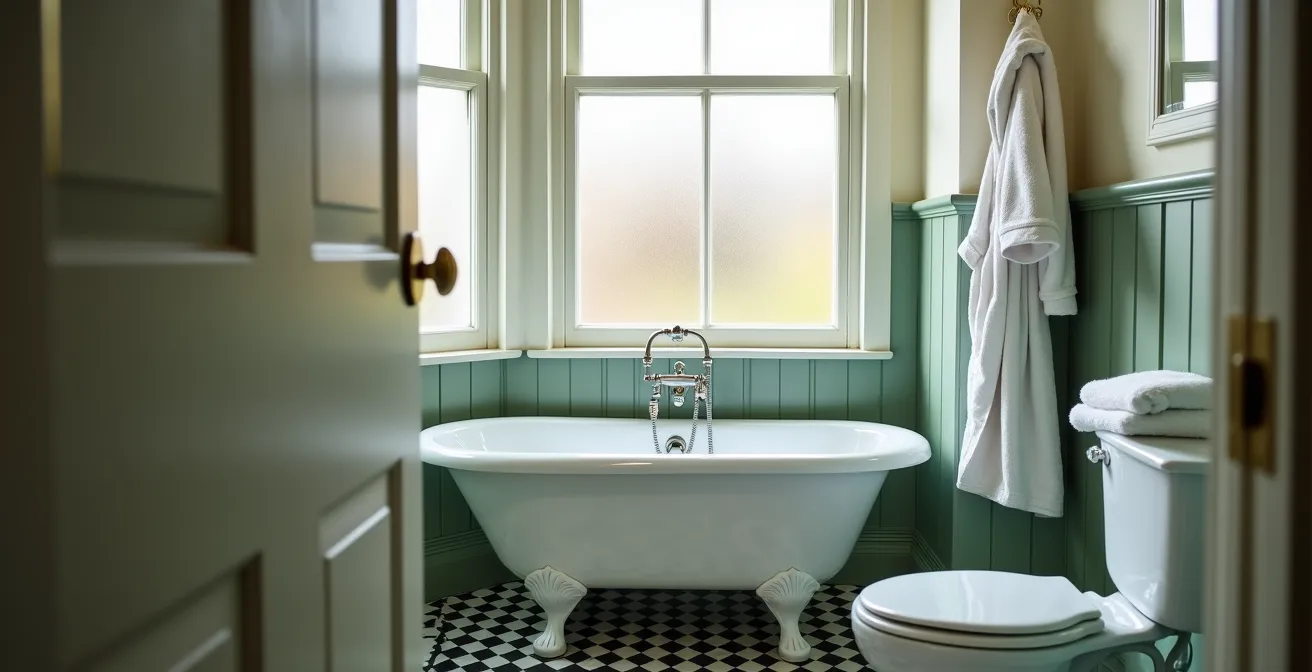
As the image suggests, these spaces are designed for comfort and civility. The essential etiquette is straightforward: keep your time in the bathroom reasonable, especially during peak morning hours. Tidy up after yourself, leaving the space as pristine as you found it. Most hosts will provide dressing gowns, a thoughtful touch that underscores the expected decorum. By following these simple courtesies, the shared bathroom becomes a non-issue, a minor quirk in an otherwise enriching experience of staying in a property with a story to tell.
How Your Stay Keeps Heritage Properties Alive in the Cotswolds?
When you choose to stay in a B&B in a region like the Cotswolds, you are doing far more than simply booking a room. You are becoming an active participant in the preservation of England’s architectural soul. This is the concept of community stewardship in action. The Cotswolds, an Area of Outstanding Natural Beauty, is protected by very strict planning restrictions. This means that new construction is severely limited to preserve the area’s unique, historic character. As a result, the magnificent stone farmhouses, Georgian townhouses, and thatched cottages cannot be easily replicated.
The economic reality is that maintaining these centuries-old buildings is a significant undertaking. From repairing dry-stone walls to re-thatching a roof, the costs are substantial. Your stay provides a vital stream of income that is funnelled directly into the upkeep of the property. Unlike a large hotel chain where profits may be diverted elsewhere, your money supports a family and enables them to continue their role as custodians of a piece of local history. This is especially critical in a high-demand area where, for instance, U.S. buyers now account for 25% of high-end sales, underscoring the immense value placed on these properties.
By choosing a hosted stay in an existing heritage building, you help ensure its viability for future generations. You are voting with your wallet for preservation over new development. An empty rental in a modern block contributes little to this ecosystem. Your presence in a historic B&B, however, is a direct investment in the living, breathing history of the Cotswolds.
Why a Host’s Map is Better Than Google Maps for Local Walks?
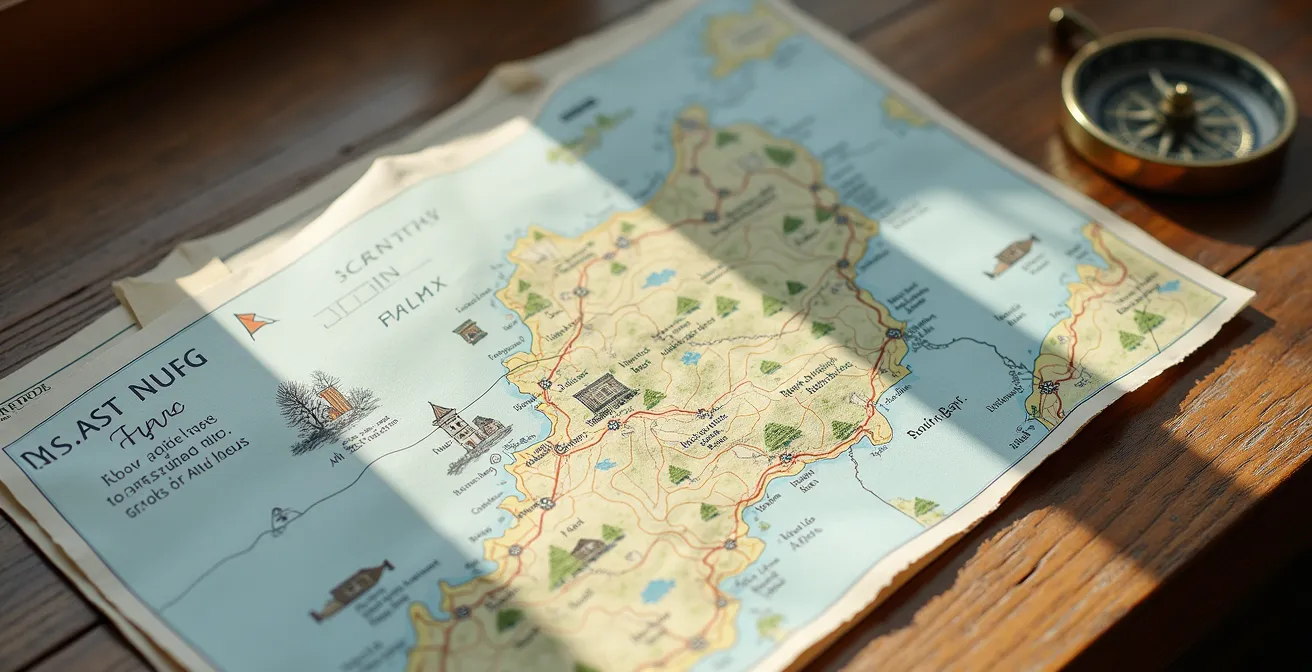
In our hyper-connected world, we instinctively reach for our phones for directions. Google Maps is a powerful tool, but it offers data without context, efficiency without emotion. It can tell you the fastest route from A to B, but it can’t tell you about the secret bluebell wood that only appears for two weeks in May, the stile with the best sunset view, or the pub where the landlord keeps a special ale not listed on the menu. This is where a host’s “Living Knowledge” becomes an invaluable, irreplaceable asset.
A host doesn’t just give you a map; they share a piece of their world. Their recommendations are not generated by an algorithm but curated over years of personal experience, seasonal changes, and feedback from other guests. They know the path that’s too muddy after a rainy day and the alternative scenic route that a GPS would never suggest. This philosophy is perfectly captured by the experts at Alpine Exploratory:
One of our goals at Alpine Exploratory when inspecting places is to distinguish… those who are motivated more by perfection in the abstract even at the expense of warmth, and those who are warmth-first but who manage to be extremely comfy too. We place a lot of weight on friendly welcomes.
– Alpine Exploratory, Staying in B&Bs in the UK Guide
This “warmth-first” approach is everything. A host’s advice is an act of care. They want you to have the best possible experience, not just the most efficient one. They offer curated serendipity—the opportunity to stumble upon moments of unexpected beauty that you would have otherwise missed.
What to Bring When Invited to a Local’s Home for Dinner?
Receiving an invitation to dine with your host or a local they introduce you to is one of the most rewarding experiences travel can offer. It’s a sign that you’ve moved beyond a simple guest-host transaction into the realm of genuine human connection. As one guest in a London B&B remarked about their host, “The woman has a heart of gold… she provided us with good advice and engaged us in interesting discussions.” These are the moments that create lasting memories. When such an opportunity for reciprocal hospitality arises, the question of what to bring as a thank-you gift is a natural one.
In British culture, arriving empty-handed is a faux pas, but there’s no need for extravagant expense. The gesture is more important than the gift itself. It’s a small token of appreciation for their generosity in opening their home to you. The aim is to bring something that is thoughtful but doesn’t create pressure or obligation. A simple, well-chosen item is always best.
To navigate this with confidence, here are some culturally appropriate suggestions for showing your gratitude:
- A mid-range bottle of wine (£10-15) or quality chocolates: This is the classic, can’t-go-wrong choice. Opt for something from a good high-street chocolatier or a decent bottle of wine.
- Something from your home country: A small, non-perishable local speciality from your hometown is an excellent conversation starter and a wonderfully personal touch.
- Sincere compliments: Throughout the evening, be sure to offer genuine compliments on their home, their garden, or the food. This verbal appreciation is highly valued.
- Offer to help: A polite offer to “give a hand with the washing up” at the end of the meal is standard British etiquette. Don’t be offended if it’s declined, but the offer itself is what counts.
- Punctuality: In a unique cultural quirk, it is considered polite to arrive 5-10 minutes *after* the stated time. Arriving exactly on time, or early, can be seen as slightly too eager.
Key Takeaways
- A host offers “Living Knowledge,” turning a simple trip into a journey of curated, personal discoveries that algorithms can’t replicate.
- Choosing a hosted stay is an act of “Community Stewardship,” directly supporting the preservation of England’s unique heritage properties.
- The experience is about “Reciprocal Hospitality,” where genuine human connection, not anonymous transaction, defines your stay.
The 2pm Lunch Rule: Why You Will Starve in Spain if You Stick to UK Hours?
The provocative title about Spanish meal times highlights a universal travel truth: local rhythms matter. Adhering to your home country’s schedule in a new place can lead to missed opportunities and closed kitchen doors. While Spain is a classic example, this principle is just as relevant within the UK, where regional traditions and timings can surprise the unprepared visitor. An empty rental leaves you to figure this out on your own, often after finding your desired pub has stopped serving lunch. A host, however, is your personal guide to the local tempo.
They’ll let you know that a “Full English Breakfast” is a hearty, foundational meal served at a specific time, and that you’ll be asked exactly how you like your eggs. This is more than just food; it’s a cultural ritual. As Alpine Exploratory’s guide details, regional pride is on the plate, from a “Full Yorkshire Breakfast” with local sausages to a “Full Scottish” that might include haggis. This is a perfect example of a host’s Living Knowledge in action.
This guidance extends throughout the day. Your host can explain the subtle but crucial differences in meal timings and types, ensuring you’re always in the right place at the right time. The following table illustrates just how varied the UK’s culinary clock can be.
| Meal Type | UK Timing | Description | Key Consideration |
|---|---|---|---|
| Full English Breakfast | 7-9 AM | Cooked breakfast with eggs, bacon, beans | B&Bs typically ask preferred time at check-in |
| Sunday Roast | 12-3 PM | Traditional roast dinner | Many pubs stop serving by 3-4 PM |
| Afternoon Tea | 3-5 PM | Light snack with scones and cakes | Not a meal replacement |
| High Tea | 5-6 PM | Substantial early evening meal | More common in Northern England |
How to Spot a ‘Tourist Trap’ Restaurant Within 30 Seconds?
There is no greater travel disappointment than an overpriced, mediocre meal at a “tourist trap” restaurant. An empty rental leaves you at the mercy of online reviews, which can be easily manipulated. A host, however, is your ultimate ally. Their reputation is built on the quality of their guests’ experiences, so their recommendations are unbiased and born from a genuine desire for you to eat well. Their advice is the most reliable tool in your arsenal.
The single most effective way to avoid a tourist trap is to ask your host a specific question: “Is there anywhere near [popular tourist site] that you would actually go to yourself?” Their answer, and even their hesitation, will tell you everything you need to know. Beyond this golden rule, you can train your eye to spot the warning signs yourself. These red flags are often visible from the street, allowing you to make a snap judgment before you even step inside.
Keep these quick detection methods in mind as you explore:
- Laminated picture menus: A menu with glossy photos of the food, especially if displayed outside, is the number one red flag for an inauthentic, mass-market establishment in the UK.
- The “chain pub” disguise: Many large chains (like Wetherspoons or Greene King) occupy historic-looking buildings. A genuine local pub will proudly state it’s a “Free House,” meaning it’s not tied to one brewery.
- The clientele ratio: Peer inside. If the bar is filled exclusively with other tourists and you can’t spot a single local enjoying a quiet pint, it’s a strong sign you’re in a trap.
- The “All Day Breakfast” sign at 7 PM: Authentic pubs and restaurants have specific meal services. A place offering a Full English Breakfast at dinnertime is catering to tourist expectations, not local tastes.
On your next journey through England, we invite you to look beyond the convenience of an anonymous rental. Choose connection. Choose to be part of a story. Explore the rich, diverse community of hosted stays and discover a home that is truly waiting to welcome you.