
Navigating travel jabs on a budget means understanding that timing and risk assessment are more important than just knowing which vaccines are free.
- Some essential travel vaccines are provided free by the NHS, but many require a private prescription.
- Booking your GP appointment at least 6-8 weeks before your trip is the single most effective way to avoid high private clinic fees.
Recommendation: Use this guide to prepare for your GP consultation, focusing on your specific travel activities to get the right protection without overpaying.
The excitement of booking a trip abroad is often followed by the slightly less thrilling task of organising travel health. For budget-conscious travellers in England, the main question is always about cost: what can I get for free, and what will I have to pay for? The NHS does provide a core set of travel vaccinations at no charge because they protect against diseases considered a significant public health risk. These typically include the combined Diphtheria, Polio and Tetanus booster, Typhoid, Hepatitis A, and Cholera. This is the straightforward part.
However, many travellers mistakenly believe this is the end of the story. They assume that if a vaccine isn’t on the free list, it’s not important, or they leave it to the last minute, only to face unexpected costs and a rush to find a private clinic. The key to managing your travel health on a budget isn’t just knowing the free list; it’s about understanding the system. It’s about a proper, early risk-based assessment that looks at your destination, your planned activities, and your personal health history. Thinking like a practice nurse means focusing on prevention and strategic planning.
But what if the real secret to safe and affordable travel health wasn’t just in the injections themselves, but in the timing, the choice of anti-malarials, and a holistic view of your well-being? This guide will walk you through the crucial considerations beyond the basic list. We will explore why some vaccines carry legal weight, the critical timing window for booking your jabs, how to manage side effects, and how to make informed decisions about everything from malaria tablets to altitude sickness, ensuring your health is protected without breaking the bank.
To help you navigate these important health decisions, this article breaks down the most common questions and concerns travellers face. The following sections provide detailed, practical advice on everything from legally required vaccines to managing your health at high altitudes, all from a UK public health perspective.
Summary: A Practical Guide to NHS Travel Vaccinations
- Why is Yellow Fever the only vaccine legally required for entry?
- The mistake of booking jabs 1 week before flying to Asia
- How to handle mild fever from typhoid jabs before your flight?
- Malarone vs Doxycycline: Which anti-malarial has fewer side effects?
- At what age can babies safely receive Hepatitis A vaccines?
- When to trust local water sources: The bottle vs tap dilemma
- Diamox vs Descent: How to react when a headache starts at 3000m?
- Benefits of a digital detox retreat for burnt-out professionals
Why is Yellow Fever the only vaccine legally required for entry?
While your GP will recommend vaccines based on the health risks of your destination, Yellow Fever is unique. It’s the only vaccination that can be legally required for entry into certain countries under the World Health Organization’s International Health Regulations. This isn’t just about your personal health; it’s a global public health measure to prevent the international spread of the disease. Countries with the mosquito that transmits Yellow Fever want to ensure travellers don’t introduce the virus. This is why you must carry an International Certificate of Vaccination or Prophylaxis (ICVP) as proof.
Unlike the vaccines on the NHS free list, Yellow Fever vaccination is not available at all GP practices. You must attend a designated Yellow Fever Vaccination Centre. Furthermore, this vaccine is not free on the NHS. The cost can vary, but you can expect to pay a fee for the vaccination and the certificate. For budget travellers, this is a non-negotiable cost if your itinerary includes a high-risk country. Going through private clinics can be even more expensive, reinforcing the need for careful planning.
Obtaining the vaccine and its vital certificate involves a clear process. It’s not something that can be done at the last minute, as the certificate only becomes valid 10 days after you receive the injection. This legal requirement underscores the importance of a thorough risk-based assessment well in advance of your travels.
Your action plan: Getting the Yellow Fever vaccine and certificate
- Contact a designated Yellow Fever vaccination centre – remember, not all GP practices provide this service. You can find a list on the NaTHNaC (National Travel Health Network and Centre) website.
- Book your appointment at least 8 weeks before your travel date. This allows ample time for the vaccine to become effective and for any potential side effects to resolve.
- Receive the vaccination and the all-important International Certificate of Vaccination (ICVP) from the centre.
- Keep the certificate with your passport when travelling. You may be required to show it at border control for entry or exit.
- Note that the certificate becomes valid 10 days after vaccination and is now generally considered valid for life.
Forgetting this can, in the worst-case scenario, lead to you being denied entry to a country or being quarantined at your own expense. It’s a costly and stressful mistake to make for the sake of a single piece of paper.
The mistake of booking jabs 1 week before flying to Asia
One of the most common and costly errors a traveller can make is leaving vaccinations to the last minute. A spontaneous trip to Southeast Asia sounds fantastic, but booking your GP appointment a week before you fly is a recipe for stress and unnecessary expense. Many vaccines require multiple doses spaced out over several weeks, and your body needs time to build immunity. A last-minute approach simply doesn’t work for travel health.
From a clinical perspective, there is a crucial ‘timing window’ for travel health planning. To ensure you have access to free NHS vaccines and allow enough time for all courses to be completed, the NHS recommends seeing a GP or travel clinic at least 6 to 8 weeks before you’re due to travel. This timeframe allows your practice nurse to perform a proper risk assessment, order any necessary vaccines, and administer them on a schedule that provides you with maximum protection by the time you depart.
If you miss this window, your GP practice may not be able to help you. NHS services are structured around planned care, not last-minute emergencies. For instance, some local health boards have even stricter cut-off points. A clear example is that NHS Borders can only accept requests received at least 10 weeks before the departure date. If you’re travelling sooner, their official advice is to contact a private travel clinic. This is where the costs add up quickly, turning what could have been a free or low-cost service into a significant pre-trip expense, something every budget traveller wants to avoid.
Ultimately, early planning is your best tool for accessing NHS services and keeping your travel health costs to a minimum. An appointment booked two months out is an investment in both your health and your wallet.
How to handle mild fever from typhoid jabs before your flight?
Receiving a vaccination is an important step in protecting your health, but it’s also common to experience mild side effects as your immune system gets to work. For the Typhoid jab, which is free on the NHS for travellers heading to at-risk areas, it’s not unusual to experience symptoms like a mild fever, headache, or soreness at the injection site. While these are usually short-lived, having them flare up just before a long-haul flight can be a source of anxiety.
The key is not to panic. These reactions are a sign that your body is building protection. The most important thing is to manage the symptoms calmly and effectively so you can travel comfortably. Simple measures are often all that’s needed. Rest is paramount; avoid any strenuous activity like a last-minute gym session or heavy lifting in the 24-48 hours after your jab. Staying well-hydrated by drinking plenty of water also helps your body manage the immune response. For fever and aches, over-the-counter painkillers are your first line of defence.
This image captures the ideal post-vaccination environment: a calm space to rest and recover, allowing your body to build immunity effectively before you travel.

It’s also wise to carry your vaccination documentation with you. In the unlikely event that you’re still feeling feverish at the airport, showing this to airline staff can provide context and reassurance. If your symptoms are severe or persist for more than 48 hours, you should always seek medical advice by contacting NHS 111.
Checklist: Managing post-vaccination side effects before travel
- Take paracetamol or ibuprofen to manage mild fever, headache, and discomfort. Always follow the dosage instructions on the packet.
- Rest and avoid strenuous activity for at least 24-48 hours after your vaccination to give your body a chance to recover.
- Stay hydrated by maintaining a regular intake of fluids, primarily water. Avoid alcohol, which can cause dehydration.
- Carry your vaccination documentation (e.g., your GP record or vaccine card) to show airline staff if questioned about your symptoms.
- Contact NHS 111 for advice if your fever persists beyond 48 hours, gets significantly worse, or you develop other concerning symptoms.
By anticipating and managing these minor and temporary side effects, you ensure they are a small footnote in your travel preparations, not a major pre-flight drama.
Malarone vs Doxycycline: Which anti-malarial has fewer side effects?
Protecting yourself from malaria is just as critical as getting vaccinated, but it’s a more complex area of travel health. There is no vaccine for malaria, so prevention relies on a combination of bite avoidance (using insect repellent and nets) and taking antimalarial tablets. A common point of confusion for travellers is choosing the right medication. This decision is not one to make alone; it requires a consultation with your GP or practice nurse, who will conduct a risk assessment based on your specific destination, trip duration, and medical history.
It’s important to know that antimalarials are not available for free on the NHS. You will be given a private prescription which you then take to a pharmacy to purchase. The costs can vary significantly, which is a key consideration for budget travellers. As the NHS Forum Health Centre notes, a practice nurse can provide crucial advice on this matter. They explain:
The practice nurse may also be able to give you general advice about travel vaccinations and travel health, such as protecting yourself from malaria
– NHS Forum Health Centre, Travel Vaccinations Guide
The three most common options prescribed in the UK are Malarone, Doxycycline, and Mefloquine (Lariam). Each has a different cost, dosing schedule, and side-effect profile. Malarone is often preferred as it’s generally well-tolerated, but it’s also the most expensive. Doxycycline is a cheaper alternative but can increase your skin’s sensitivity to the sun, which requires diligence with sun cream. Mefloquine is taken weekly, which some find convenient, but it is associated with a higher risk of neuropsychiatric side effects, including vivid dreams and anxiety. The best choice is always a personal one, made in consultation with a healthcare professional who can weigh the pros and cons for your situation.
To help clarify the options, this table compares the most common antimalarial medications available in the UK. The information is based on general guidance, and as noted by private travel clinics, vaccine and medication costs can range from £50 to £150 depending on the type and number of doses required.
| Medication | Cost Status | Common Side Effects | Dosing Schedule |
|---|---|---|---|
| Malarone | Private prescription required – expensive option | Nausea, headache, stomach upset | Daily during travel + 7 days after |
| Doxycycline | Private prescription – cheaper alternative | Sun sensitivity, nausea, yeast infections | Daily during travel + 28 days after |
| Mefloquine (Lariam) | Private prescription – cost-effective weekly | Neuropsychiatric effects, vivid dreams | Weekly dosing |
Never buy antimalarials online without a prescription or from a non-reputable source. The risk of receiving counterfeit medication is high and could leave you unprotected. Your health is not the place to cut corners.
At what age can babies safely receive Hepatitis A vaccines?
Travelling with young children, especially infants, adds another layer to health planning. While you might be ready for any adventure, a baby’s immune system is still developing, which changes the rules for vaccinations. Hepatitis A is a disease spread through contaminated food and water, making it a risk in many parts of the world with substandard sanitation. For adults and older children, the vaccine is a straightforward and effective preventative measure.
The Hepatitis A vaccine is one of the travel jabs provided free on the NHS when a risk assessment indicates it is necessary for your trip. However, there is a specific age restriction. The vaccine is licensed for use in children from the age of one. An analysis of travel requirements confirms that for infants, the recommended age to start the Hepatitis A vaccination course is from 12 months onwards. This means a baby under one year old cannot receive the standard vaccine.
So, what about families travelling with a baby younger than 12 months to a high-risk area? In this situation, waiting until they are old enough is not an option. A healthcare professional may recommend an alternative form of short-term protection. This usually involves an injection of Human Normal Immunoglobulin (HNIG). HNIG provides “passive immunity” by giving the baby a dose of ready-made antibodies, offering protection for up to three months. It’s a temporary solution but a vital one for protecting the most vulnerable travellers. This decision would only be made after a careful risk assessment by your GP or travel clinic.
For any family travel, discussing your plans in detail with your practice nurse is non-negotiable. They can provide the most accurate, up-to-date advice tailored to the youngest members of your travel party, ensuring everyone stays safe.
When to trust local water sources: The bottle vs tap dilemma
Beyond vaccinations, one of the most fundamental aspects of staying healthy abroad is ensuring you drink safe water. Diseases like Typhoid, Cholera, and Hepatitis A are often transmitted through contaminated water. The default advice for travellers is simple: “don’t drink the tap water.” While this is a safe rule of thumb, it can lead to a heavy reliance on single-use plastic bottles, which is neither budget-friendly nor environmentally conscious.
The “bottle vs. tap” dilemma requires a more nuanced approach. In some major international cities, tap water may be perfectly safe to drink, whereas in rural areas of the same country, it could be a significant health risk. A holistic travel health approach involves learning how to assess the situation for yourself. Observing local habits is a good starting point: do residents drink directly from the tap, or do they boil or filter their water first? This can provide valuable clues about water quality.
A better strategy for the prepared traveller is to invest in a reliable water purification method. This gives you the power to make water safe wherever you are, reducing plastic waste and saving money. The options range from simple purification tablets to advanced filter bottles that can remove bacteria, protozoa, and even viruses.
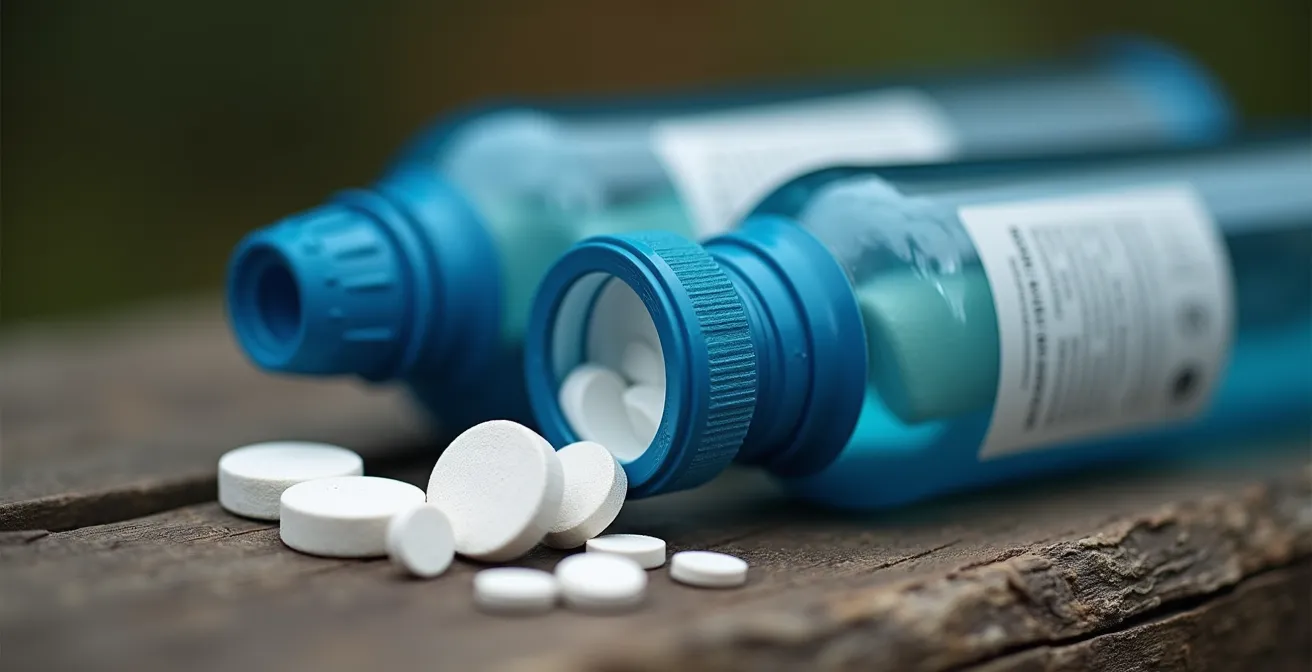
Remember that unsafe water isn’t just about what you drink. It also affects ice in your drinks, the water used to wash salads and fruits, and even what you use to brush your teeth. Being mindful of all these potential sources of contamination is crucial.
Your water safety assessment checklist
- Before you go, check the NHS Fit for Travel or NaTHNaC websites for country-specific advice on water safety for your destination.
- Once there, observe local behaviour. Do people in cafes and homes drink tap water, or do they stick to bottled or treated water?
- Consider your location. Water infrastructure in major, modern cities is generally more reliable than in remote, rural areas.
- Be mindful of hidden water sources: ice cubes in drinks, washed salads, and the water you use for brushing your teeth can all pose a risk.
- Invest in a good quality water purification system, such as a filtering bottle or purification tablets, as a reliable and eco-friendly alternative to buying plastic bottles.
By taking control of your water supply, you not only protect yourself from a host of unpleasant illnesses but also travel more sustainably and affordably.
Diamox vs Descent: How to react when a headache starts at 3000m?
For adventurous travellers heading to destinations like the Andes or the Himalayas, altitude sickness, or Acute Mountain Sickness (AMS), is a serious health concern. It’s caused by ascending to a high altitude too quickly, not giving your body enough time to acclimatise to the reduced oxygen levels. The first symptom is often a headache, which can be accompanied by nausea, dizziness, and fatigue. According to the NHS, symptoms typically begin 6 to 10 hours after reaching an altitude of over 2,500 metres (around 8,000 feet).
Ignoring these early signs is dangerous, as AMS can progress to life-threatening conditions. The most important rule when a headache starts at altitude is simple and absolute: do not ascend any higher. The best and only guaranteed treatment for AMS is descent. Going down by as little as 300 to 500 metres can often resolve symptoms completely. Rest, hydration, and simple painkillers like paracetamol or ibuprofen can help manage a mild headache, but they are not a cure. They must never be used to mask symptoms in order to continue ascending.
You may have heard of a medication called Acetazolamide (brand name Diamox) used for altitude sickness. It is thought to help speed up the acclimatisation process and can be used for both prevention and treatment. However, it’s crucial for UK travellers to understand its availability. As expert guidance points out, Acetazolamide should not be provided by NHS GPs for this purpose. It is typically only available from private travel clinics after a consultation. This is another area where planning ahead is essential; you cannot expect to get a last-minute NHS prescription for Diamox before your trekking trip.
While medication can play a role, it is never a substitute for gradual acclimatisation and listening to your body. Your mountain adventure should be memorable for the views, not for a preventable medical emergency.
Key takeaways
- Plan ahead: Contact your GP practice 6-10 weeks before travel to access free NHS vaccines and avoid costly private fees.
- It’s more than jabs: Holistic travel health includes malaria prevention, water safety, altitude planning, and managing side effects.
- Cost vs. Benefit: The cheapest option (e.g., for anti-malarials) isn’t always the best for you. Discuss side effects and dosing schedules with a professional.
Benefits of a digital detox retreat for burnt-out professionals
So far, we have focused on the essential medical preparations for travel: vaccinations, malaria prevention, and managing physical risks. This is the foundation of a safe trip. However, a truly healthy journey considers well-being in its entirety. In our hyper-connected world, the stress of being “always on” can lead to burnout, and a holiday may not feel like a real break if you’re still tethered to your work emails and social media notifications. This is where the concept of a digital detox comes in.
A digital detox retreat is a trip planned specifically to disconnect from technology and reconnect with yourself and your surroundings. This goes beyond simply not checking your phone; it’s an intentional practice of mindfulness and presence. The benefits for burnt-out professionals are significant. It can help reduce stress and anxiety, improve sleep quality, and increase focus and creativity. By removing the constant digital stimulation, you give your brain the space it needs to rest and recharge, something a typical holiday might not achieve.
This links back to a core principle of travel health. As health advisors often state, medical precautions are just one piece of the puzzle. A general travel health risk assessment is crucial because, as noted by NHS Inform, vaccines or anti-malarial tablets will not protect against all travel health risks, and extra steps are needed to protect your health. This includes mental and emotional well-being. A digital detox can be one of those “extra steps,” particularly for those whose professional lives are a source of chronic stress.
By taking a comprehensive approach to your travel health—from vaccinations to mental rest—you ensure your journey is not only safe from disease but is also genuinely restorative. To begin crafting your personal travel health plan, book a consultation with your practice nurse to discuss your itinerary and needs.
Frequently asked questions about travel vaccinations
Can babies under 12 months receive any protection against Hepatitis A?
Babies under 12 months cannot receive the Hepatitis A vaccine but may be given Human Normal Immunoglobulin (HNIG) for short-term passive immunity in high-risk situations. This would be determined by a healthcare professional after a risk assessment.
How many doses of Hepatitis A vaccine does a child need?
For long-term protection, children typically need two doses of the Hepatitis A vaccine. This includes an initial dose followed by a booster dose 6 to 12 months later.
Is the Hepatitis A vaccine free for children on the NHS?
Yes, when a risk assessment shows it is medically indicated for travel to a high-risk country, the Hepatitis A vaccine is provided free on the NHS for both adults and children.