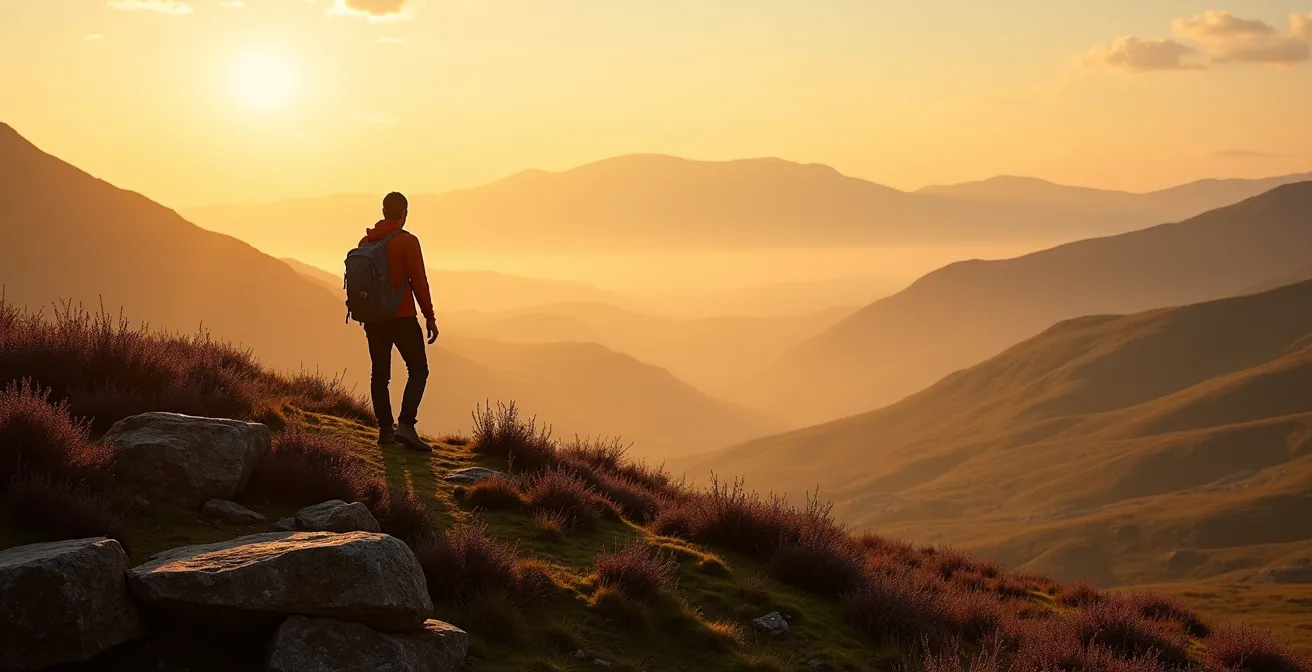
Escaping the city for a real adventure is not about having more time or a car; it’s about having the right playbook.
- Unlock genuine wilderness using just your Oyster card and smart train booking hacks.
- Swap crowded hotspots for stunning, quiet alternatives that deliver a bigger sense of discovery.
Recommendation: Pick one tactical trip from this guide, book the train this week, and prove to yourself that adventure is closer than you think.
The Sunday evening feeling hits hard. Another week looms, and the memory of Friday’s freedom is already fading. You scroll through photos of epic mountains and remote coastlines, thinking “one day.” For the Londoner trapped in the 9-5 cycle, that “one day” can feel impossibly far away. The common advice is to take a day trip to the Cotswolds or brave the crowds at Brighton, but these often feel like trading one type of congestion for another, barely scratching the adventure itch.
But what if the key to breaking the monotony wasn’t a bigger holiday, but a smarter weekend? What if you could access genuine, soul-reviving wilderness with the same logistical effort it takes to plan a night out? This is not another generic list of pretty places. This is your tactical guide to executing short, sharp, high-impact micro-adventures from London—no car required. We’re moving beyond the ‘what’ and diving deep into the ‘how’.
Forget what you think is possible in 48 hours. We’re going to explore the logistical hacks to make travel cheap and easy, the insider knowledge to find solitude even on a bank holiday, and the mindset to turn your city limits into the start of your next great story. This guide is designed to get you out of your flat and into the wild, this weekend.
This article provides a complete playbook for your next escape. Discover the secrets of legal wild camping, learn how to safely forage for your own food, find the darkest skies for stargazing, and master the art of booking crowd-free adventures on a budget. Get ready to transform your weekends.
Summary: Your Blueprint for Weekend Escapes from London
- Where can you legally wild camp in England vs Scotland?
- The danger of picking mushrooms without a guide
- Brecon Beacons or Northumberland: Which has the darkest skies?
- The benefits of cold water shock: How to start safely in October?
- How to reach the Peak District by train for a Saturday hike?
- Zone 1 vs Zone 2:Where to find crowds-free landscapes in Europe during August?
- The 12-week rule: When is the absolute cheapest time to book Eurostar?
- Where to find crowds-free landscapes in Europe during August?
Where can you legally wild camp in England vs Scotland?
Let’s bust the biggest myth first: the idea that sleeping under the stars is forbidden. The truth is more nuanced and empowering. While England and Wales have restrictive laws, Scotland is a wild camping paradise. A recent analysis of UK camping laws confirmed that you can legally wild camp on nearly 99% of Scotland’s landmass, thanks to the Land Reform Act of 2003. This isn’t a legal grey area; it’s a right. For the Londoner, a sleeper train to the Highlands means waking up in a landscape you can legally call home for the night.
This paragraph introduces a concept complex. To really grasp it, it’s helpful to see it in action. The image below captures the essence of a successful wild camp: minimal impact, maximum immersion.
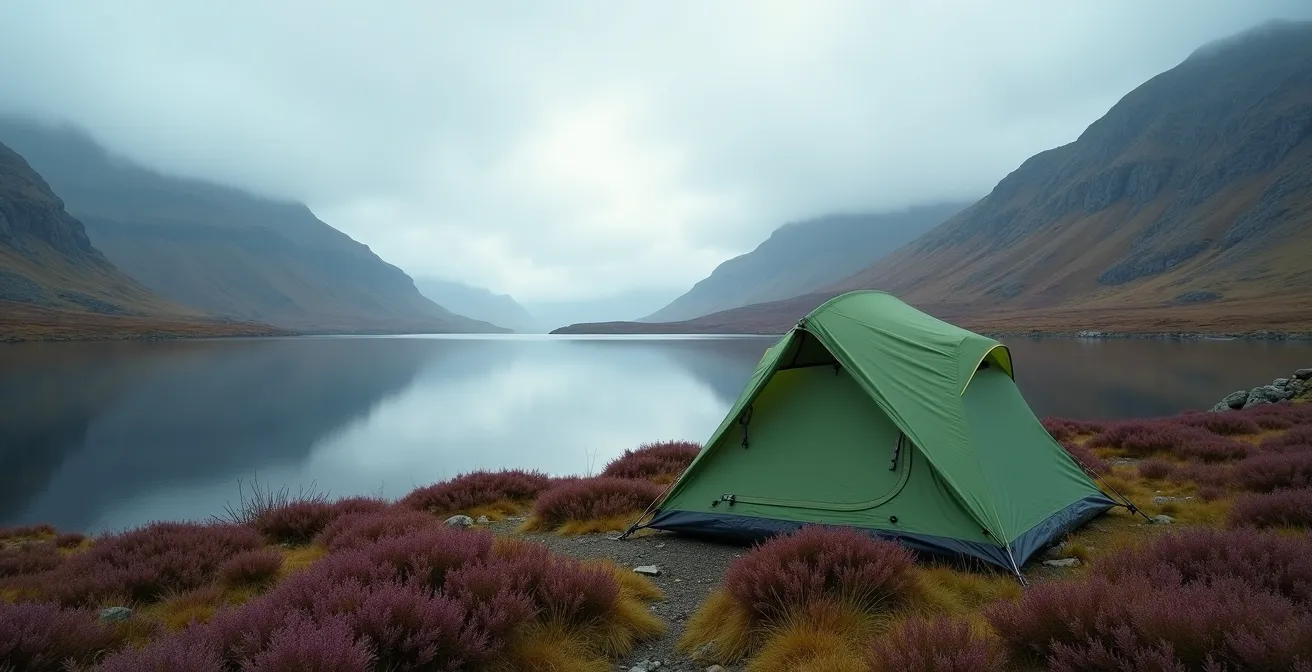
As you can see, the goal is to become a temporary part of the landscape. In England, the rules are different but not impossible. While most land is off-limits without landowner permission, Dartmoor National Park is a glorious exception, allowing ‘backpack camping’ in designated areas. The key is understanding the code. This isn’t about pitching a festival tent; it’s about a lightweight, leave-no-trace approach. Arrive late, leave early, and carry everything out. This ‘calculated risk’—knowing the rules to bend them respectfully—is the heart of true adventure.
The danger of picking mushrooms without a guide
Imagine frying up mushrooms you foraged yourself, the earthy scent filling your campsite. This is a peak adventure experience, connecting you directly to the land. But here, the concept of calculated risk is paramount. Nature’s larder is generous, but it’s also unforgiving. Misidentifying a mushroom isn’t just a culinary mistake; it can be a life-threatening one. Every year, people end up in A&E from eating poisonous lookalikes of delicious edible fungi. This isn’t to scare you off, but to empower you with the right approach: learn before you eat.
Joining a guided foraging course, especially in fungi-rich areas like the New Forest or Surrey Hills, is the single best investment you can make. An expert guide doesn’t just show you what’s safe; they teach you the *process* of identification—looking at the cap, gills, stem, and spore print. They build your knowledge, turning fear into confidence. To get you started, understanding the most common and easily identifiable edible mushrooms in southern England is a great first step.
This table, based on expert guidance, outlines the ‘big four’ you might encounter on an autumn walk. Use it not as a field guide for eating, but as a field guide for learning what to look for on a guided course, as highlighted in a National Geographic guide to UK adventures.
| Mushroom | Peak Season | Habitat | Key ID Features |
|---|---|---|---|
| Chanterelle | July-October | Oak/Beech woods | Golden yellow, funnel shape |
| Porcini (Cep) | August-November | Under trees | Brown cap, white pores |
| Parasol | July-November | Open grassland | Large, scaled cap |
| Puffball | August-October | Fields/lawns | White sphere, no stem |
Your micro-adventure challenge is not to eat a wild mushroom, but to successfully identify one. Take a photo, consult a book, and confirm it with an expert. The reward is the knowledge itself, a skill that will last a lifetime.
Brecon Beacons or Northumberland: Which has the darkest skies?
One of the most profound escapes from the city is simply looking up. Escaping London’s light pollution to witness a truly dark, star-filled sky is a reset for the soul. Two of the UK’s premier stargazing spots accessible from London are the Brecon Beacons in Wales and Northumberland National Park in England. But which one offers the best effort-to-reward ratio for a weekend trip? Both are certified International Dark Sky Reserves, but the logistics differ significantly.
Northumberland boasts Kielder Observatory and Europe’s largest area of protected night sky, but the journey from London is longer and typically more expensive. The Brecon Beacons, on the other hand, are quicker to reach by train, offering a more compressed and efficient micro-adventure. Your choice depends on your priority: the absolute darkest sky (Northumberland) or the most accessible dark sky (Brecon Beacons).
The following comparison breaks down the key logistics for a car-free Londoner, based on data from sources like official National Park transport guides.
| Factor | Brecon Beacons | Northumberland (Kielder) |
|---|---|---|
| Travel from London | Paddington to Abergavenny: 2.5 hours | King’s Cross to Alnmouth: 3.5 hours |
| Total Cost (return) | £45-80 | £60-120 |
| Dark Sky Status | International Dark Sky Reserve | Europe’s largest Dark Sky Park |
| Observatory | Brecon Beacons Visitor Centre | Kielder Observatory (book sessions) |
| Extra Activities | Waterfalls, mountain hiking | Hadrian’s Wall, coastal castles |
To make a trip like this happen without a car, you need a solid plan. It’s about more than just the train; it’s about the small details that make the journey smooth and stress-free.
Your No-Car Dark Sky Weekend Blueprint
- Book train tickets exactly 12 weeks in advance to get the cheapest ‘Advance’ fares.
- Pre-arrange a local taxi from your arrival station to your accommodation (£20-£30 estimate). Don’t expect to find one waiting.
- Download stargazing apps like Stellarium or Sky Guide while you have Wi-Fi; they work offline using your phone’s GPS.
- Pack a red-light head torch. White light ruins your night vision for 20-30 minutes; red light preserves it.
- Check the moon phase calendar before booking. The week of the new moon offers the darkest skies and the best view of the Milky Way.
The benefits of cold water shock: How to start safely in October?
Plunging into cold water might sound more like a punishment than a pleasure, but it’s one of the most powerful micro-adventures available. The initial ‘cold shock’ response—that gasp and racing heart—is intense, but what follows is a wave of euphoria. This isn’t just anecdotal; it’s science. The shock triggers a massive release of mood-boosting neurotransmitters, including dopamine. The feeling of pure, buzzing energy after a 2-minute dip can last for hours, completely resetting a stressed-out mind.
This paragraph introduces the powerful effects of cold water immersion. The supporting illustration captures the serene and empowering moment of embracing the cold.

As the image suggests, it’s a moment of quiet focus and strength. The health benefits are profound. Research is continuously uncovering just how beneficial it is, particularly for mental well-being and managing inflammatory responses. October is the perfect time to start: the water is cooling down but not yet brutally cold, allowing your body to acclimatise gradually. The key is, once again, calculated risk. You don’t just jump in. You enter slowly, control your breathing, and understand your limits.
UCL Study: A Natural Prescription for Well-being
A landmark study from University College London surveyed over 1,100 women who practice cold water swimming. For those experiencing menopausal symptoms, the results were remarkable. The research highlighted a significant 46.9% reduction in anxiety, along with major improvements in mood swings and hot flushes. A staggering 63.3% of the women swam specifically to alleviate their symptoms, demonstrating the swim’s power as a natural therapy.
To start safely: never swim alone. Go with a friend or join a local group. Wear a bright cap to be visible. Enter the water slowly, focusing on exhaling to control the gasp reflex. Stay in for just 1-2 minutes for your first time. The goal is not endurance; it’s about safely triggering that incredible hormonal reset. Get out, wrap up warm immediately, and have a hot drink ready. That post-swim glow is your reward.
How to reach the Peak District by train for a Saturday hike?
The Peak District feels like a world away from London, but it’s surprisingly accessible for a car-free day trip or weekend. This is logistical hacking at its finest. The secret is the Hope Valley Line, a railway running between Sheffield and Manchester that acts as a direct artery into the heart of the park’s most stunning landscapes. Forget expensive taxis or complicated bus routes; this line drops you right at the trailhead.
From London St Pancras, a fast train gets you to Sheffield in around 2 hours. From there, it’s a short hop on the local train to stations that are household names for hikers. The key is to see the train map not as a transport system, but as a menu of adventures. Each station offers a different flavour of the Peak District, from epic ridges to gentle riverside strolls.
The Hope Valley Line: Your Trailhead Taxi
This railway line is a game-changer for non-drivers. As the experts at Peak District by Train highlight, five of its stations are located directly inside the National Park boundary: Grindleford, Hathersage, Bamford, Hope, and Edale. This means you can step off the train and be on a world-class trail in minutes. It completely removes the ‘last mile’ problem that plagues so many car-free adventures.
Your blueprint is simple: book an early train to Sheffield. Once there, buy a ticket for one of these key stations, depending on the hike you’ve chosen. Here’s a quick guide to what each station unlocks:
- Edale: The official start of the Pennine Way and the classic ascent of Kinder Scout. A true epic.
- Hathersage: Your gateway to the iconic gritstone cliffs of Stanage Edge, popular with climbers and hikers alike.
- Bamford: The starting point for a stunning walk up to Win Hill, offering panoramic views over Ladybower Reservoir.
- Hope: The best access point for the ‘Great Ridge’ walk over Mam Tor, one of the most famous and breathtaking hikes in the UK.
Before you go, download your hike route onto a mapping app like OS Maps or AllTrails for offline use, as phone signal is notoriously patchy. This simple piece of logistical planning is your ticket to a seamless, stress-free day of epic views.
Zone 1 vs Zone 2:Where to find crowds-free landscapes in Europe during August?
The title is a trick question. While everyone else is battling airport queues to find a patch of crowded beach in Europe, the smartest Londoners are applying a different “zoning” strategy. Forget Zone 1 vs Zone 2 on a European map; think about it in terms of your Oyster card. The real secret to finding crowd-free landscapes in August is to embrace the “Zone 9 Mindset.” It’s the realisation that the London transport network extends deep into real, untamed countryside.
Your Oyster or contactless card isn’t just for commuting; it’s a passport to adventure. The further you travel from Zone 1, the more the landscape opens up and the thinner the crowds become. The Metropolitan line, for instance, doesn’t just end in a suburb; it stops at Amersham in Zone 9, on the very edge of the Chilterns National Landscape. From the station, a ten-minute walk has you on trails winding through ancient woodlands and alongside rare chalk streams, clear enough to spot trout.
This isn’t a second-rate alternative to a “proper” holiday; it’s a superior strategy. You get all the mental and physical benefits of a day in nature with zero airport stress and minimal cost. The key is to re-imagine the TfL map as a trail map. Here are a few ideas to get you started:
- Zone 6 – Epping Forest: Take the Central Line to its terminus at Epping and step out into 6,000 acres of ancient woodland, a former royal forest perfect for long, meandering walks.
- Zone 9 – The Chilterns: As mentioned, the Metropolitan Line to Amersham or Chesham puts you in a designated National Landscape, with rolling hills and picturesque villages.
- Tottenham Hale – Lee Valley: The Victoria Line connects you to this huge regional park, a network of wetlands, rivers, and paths perfect for walking or cycling.
These are genuine adventures that start on your doorstep. Pack a lunch, fill a water bottle, tap your card, and go. It’s that simple.
The 12-week rule: When is the absolute cheapest time to book Eurostar?
While the ’12-week rule’ is famously associated with scoring cheap Eurostar tickets, the real gold for UK micro-adventurers lies in applying this exact same principle to domestic train travel. This is the single most important piece of logistical hacking you need to master. National Rail operators release their cheapest ‘Advance’ single tickets approximately 12 weeks before the travel date. Missing this window is the difference between a £30 return to the Peak District and a £150 one.
Think of it like a starting gun. At 12 weeks out, a batch of incredibly cheap, fixed-time tickets goes on sale. They are sold on a first-come, first-served basis, and when they’re gone, they’re gone. Setting a calendar reminder for the Saturday you want to travel is a non-negotiable step for any budget-conscious adventurer. This isn’t a vague tip; it’s a hard-and-fast rule that will save you hundreds of pounds a year.
But the hacking doesn’t stop there. Here are more advanced tactics to stack on top of the 12-week rule:
- Always Buy Two Singles: For reasons known only to the train gods, booking two advance single tickets (one for the outbound journey, one for the return) is frequently 30-50% cheaper than buying a standard return ticket. Always compare.
- Use Fare Alerts: Services like Trainline allow you to set an alert for a specific route (e.g., London to Windermere). It will email you the moment the cheap advance tickets for your date are released.
- Try Split-Ticketing: For longer journeys, check if buying separate tickets for different legs of the journey is cheaper. For example, London-Birmingham and Birmingham-Manchester might be cheaper than a single London-Manchester ticket on the same train. Apps can calculate this for you.
- Avoid Peak Times: This is obvious, but the price difference is staggering. Avoid travelling after 4pm on a Friday or between 3pm and 7pm on a Sunday. An earlier train can literally cut your fare in half.
Mastering these rules transforms epic adventures from expensive dreams into affordable, repeatable realities.
Key Takeaways
- Adventure is accessible: The biggest barrier isn’t time or money, but knowledge of the logistical hacks to make it happen.
- Go against the grain: Actively avoid the famous ‘honeypot’ sites on peak weekends and choose the stunning, quieter alternatives. Your reward is solitude.
- Think like a guide: Understand and respect the risks (weather, navigation, safety) not to be afraid, but to be prepared, confident, and self-sufficient.
Where to find crowds-free landscapes in Europe during August?
Stop. The answer isn’t in Europe. The real question is: why would you want to join the August crush in Europe when the UK has vast, beautiful landscapes that are virtually empty, even during the bank holiday? The ultimate adventure strategy is crowd-swerving: zigging while everyone else zags. While the masses descend on the Lake District or Cornwall, making the trails feel as busy as the Central Line, you can be enjoying spectacular scenery in blissful solitude.
A prime example of this strategy in action is choosing the Shropshire Hills AONB (Area of Outstanding Natural Beauty) over the Lake District in August. The Lakes are world-famous and magnificent, but in summer, that fame comes at the cost of packed car parks, booked-out pubs, and crowded trails. The Shropshire Hills, easily reached by a direct train from London to Church Stretton, offer equally dramatic scenery—the ancient, heather-clad ridges of the Long Mynd have been nicknamed ‘Little Switzerland’—but with a fraction of the visitors.
The experience is qualitatively different. Instead of queueing for a photo, you’ll have viewpoints to yourself. Instead of struggling to find a pub table, you’ll be welcomed into a quiet local. This isn’t about compromising on beauty; it’s about being smarter in your pursuit of it. The “effort-to-reward ratio” is off the charts. For a similar travel time, you get a wilder, more authentic, and more relaxing experience for significantly less money and stress.
This crowd-swerving mindset is a muscle. Train it by looking at a map and questioning the obvious choices. Is there a less famous National Park nearby? A different stretch of coastline? A quieter range of hills? The answer is almost always yes. Your best adventure is often the one no one else is having.
The playbook is in your hands. The trains are running, the trails are waiting, and the quiet corners of the UK are ready to be discovered. Your next micro-adventure doesn’t need a week of planning or a lottery win. It just needs a decision. Pick a trail, book a ticket using the 12-week rule, and go. Start building your own stories of escape, this weekend.