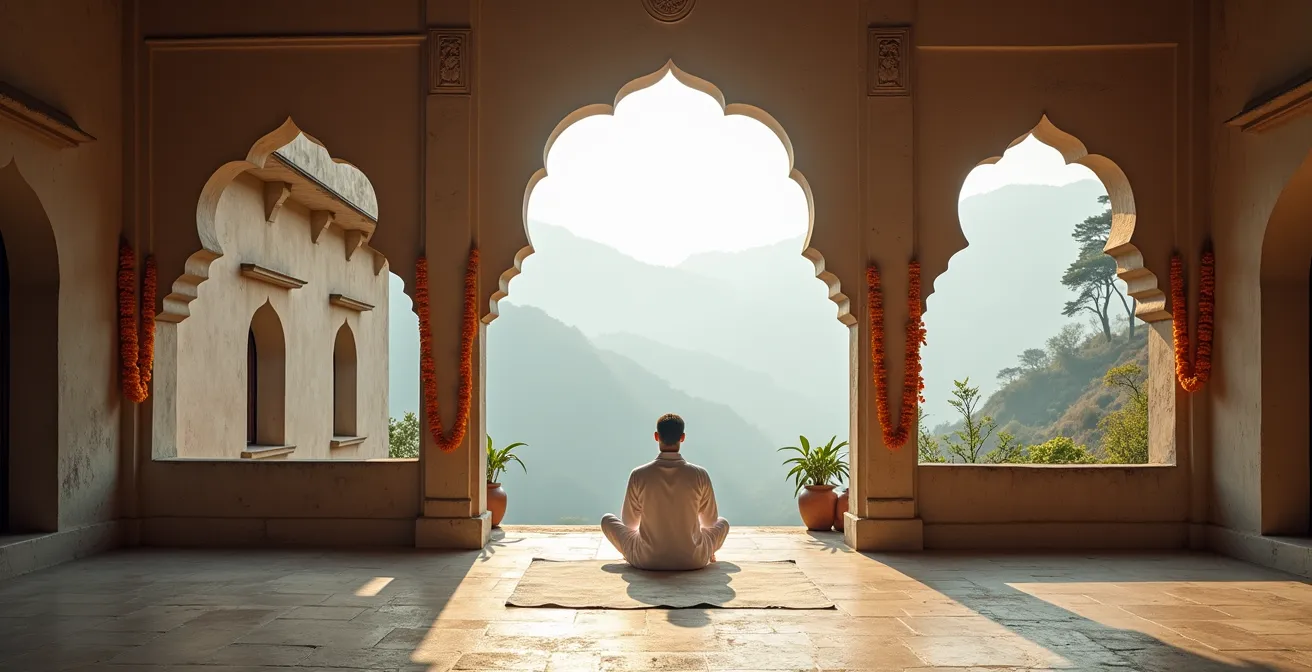
The real choice isn’t about comfort versus authenticity; it’s about consciously selecting the right ‘spiritual container’ for your transformation.
- A traditional ashram’s structure (silence, simplicity) is a powerful, intentional tool designed to dismantle the ego and deepen your practice.
- A resort, built for comfort and service, risks turning a spiritual quest into ‘spiritual consumerism’, keeping the ego intact and entertained.
Recommendation: Choose an ashram if you seek profound, lasting change and are ready for inner work. Choose a resort if you need a restorative holiday with yoga as a component.
For any serious yoga practitioner, the call to journey to the source in Rishikesh is a powerful one. Yet, upon arrival, a fundamental choice presents itself: should you immerse yourself in a traditional ashram or opt for the comfort of a modern yoga resort? Many articles frame this as a simple trade-off between authenticity and amenities, or discipline and decadence. They’ll tell you that ashrams are basic and resorts are luxurious, leaving you to decide based on your budget and tolerance for cold showers. This perspective, however, completely misses the point.
The decision is not about external comfort; it’s about the internal journey you are ready to undertake. What if the very structure of a traditional ashram—its rules, its simplicity, its ‘intentional discomforts’—is not a drawback but the most potent tool for spiritual growth? The true question is not “What can I tolerate?” but “What kind of transformation am I seeking?” A resort is designed to serve the ego, to make you feel comfortable and catered to. An ashram is designed to dismantle it. This guide is for the practitioner who suspects there is more to yoga than a beautiful vinyasa flow with a view. We will explore the practicalities of this choice from a UK perspective, but always through the lens of a deeper purpose: finding the right spiritual container for your practice.
This article will guide you through the critical considerations, from the visa you’ll need to the clothes you should pack, and the very nature of the inner work you can expect. It’s a journey into what it truly means to deepen your practice at its source.
Summary: The Yogi’s Crossroads: Choosing a Rishikesh Ashram Over a Resort
- Tourist visa vs Student visa for a 1-month yoga course?
- Why silence rules are strictly enforced in traditional schools?
- Leggings or loose cotton: What is appropriate wear in Rishikesh?
- Raw salads and street juice: What to absolutely avoid during your training?
- Train travel tips: Which class is safest for solo female travelers?
- Silent retreat or activity-based: Which works better for anxiety?
- Kerala vs Sri Lanka: Which offers better value for Ayurveda?
- Ayurveda in Sri Lanka: What to expect from a Panchakarma cure
Tourist visa vs Student visa for a 1-month yoga course?
Before you can even think about your practice, there’s the crucial first step of bureaucracy. For UK citizens planning a month-long yoga course in India, the visa question can seem confusing. The primary options are the e-Tourist Visa and the e-Student Visa, and the right choice depends on the nature of your course and your long-term plans. For most intensive, one-month yoga teacher trainings or retreats, an e-Tourist Visa is typically sufficient and significantly easier to obtain. These are processed quickly and are designed for short-term tourism, which includes wellness and yoga retreats.
A Student Visa, on the other hand, is intended for formal, long-term academic programmes at recognised institutions. It involves a more complex application process, often requiring an official letter of admission from the school. Unless your chosen ashram is a government-accredited university and explicitly requires a Student Visa, the tourist route is the path of least resistance. The one-year e-Tourist visa is particularly valuable, offering flexibility for multiple entries should you fall in love with India and wish to return.
The table below, based on current information for UK citizens, breaks down the key differences to help you make an informed decision. As you can see, the cost and processing time for tourist options are far more favourable for a short-term spiritual seeker.
| Visa Type | Cost (GBP) | Validity | Processing Time | Best For |
|---|---|---|---|---|
| e-Tourist (30 days) | £35-40 | 30 days, double entry | 4 days | Short yoga retreats |
| e-Tourist (1 year) | £70-80 | 365 days, multiple entry | 4-7 days | Multiple visits |
| e-Student Visa | £95-110 | Course duration | 5-10 days | Formal certified courses |
Why silence rules are strictly enforced in traditional schools?
One of the most confronting aspects of a traditional ashram for a Westerner is the practice of Mauna, or sacred silence. Far from being a mere rule for quiet, it is a foundational technique for the dismantling of the ego. In our daily lives, we constantly construct and reinforce our identity through speech—our opinions, our stories, our reactions. Silence starves the ego of its primary fuel. When you cannot speak, you are forced to simply observe the relentless chatter of your own mind. This is the first, and often most challenging, step towards deeper awareness.
Resorts may offer “digital detoxes” or quiet zones, but this is a pale imitation. In an ashram, silence is not an optional add-on; it is woven into the fabric of the day. It creates a powerful communal spiritual container where everyone’s energy is directed inward, rather than being dissipated through social chatter. This collective focus amplifies the transformative potential for everyone. You stop performing an identity for others and begin the real work of discovering who you are when no one is listening.
This isn’t just spiritual theory; it’s backed by neuroscience. The constant external stimulation and internal dialogue of modern life keep the brain in a state of high alert. Silence provides a profound respite, allowing the nervous system to down-regulate. As the Pacific Neuroscience Institute explains in their work on mindfulness, this process is key to mental well-being:
When the brain is not engaged in higher order thinking processess it activates the mind’s default mode network (DMN) which can be conceptualized as the brain involved in self-related thinking and mind wandering. Excess time in the default mode network has been connected to lower mental health outcomes…
– Pacific Neuroscience Institute, Meditation & Mindfulness for Stress Reduction
This intentional practice of silence helps to quiet the DMN, reducing the cycle of anxiety and self-referential thought, making space for a deeper connection to the present moment. It is a powerful form of medicine for the modern mind.
Leggings or loose cotton: What is appropriate wear in Rishikesh?
Your choice of clothing in Rishikesh goes far beyond fashion; it’s a direct expression of your intention and respect for the local culture. While leggings and modern yoga wear are ubiquitous in UK studios, they are largely inappropriate for a traditional ashram setting in India. The emphasis here is on modesty, comfort, and non-distraction. The goal is to blend in, not to stand out. This is another form of ego dismantling: letting go of your attachment to personal style and brand identity in favour of a simpler, more communal uniform.
The guiding principle is to wear loose-fitting, natural-fibre clothing that covers the shoulders, midriff, and knees. Think light cotton or linen trousers (often called ‘pajamas’ locally), long skirts, and kurtas (long, tunic-style shirts). These clothes are not only culturally respectful but also practical for the climate and for sitting in meditation for long periods. They allow the skin to breathe and don’t restrict movement or blood flow. Bright colours and loud patterns are generally discouraged in favour of simple, light, or white garments, which are believed to have a calming effect on the mind.
A shawl or scarf is an indispensable item. It can be used for extra warmth during early morning meditation, for added modesty when walking through town, or to cover your head when entering a temple. It’s wise to pack a basic starter set from the UK, but one of the best tips is to purchase some of your clothing locally. Rishikesh markets are full of shops selling affordable and perfectly appropriate ashram wear, and doing so supports the local economy.
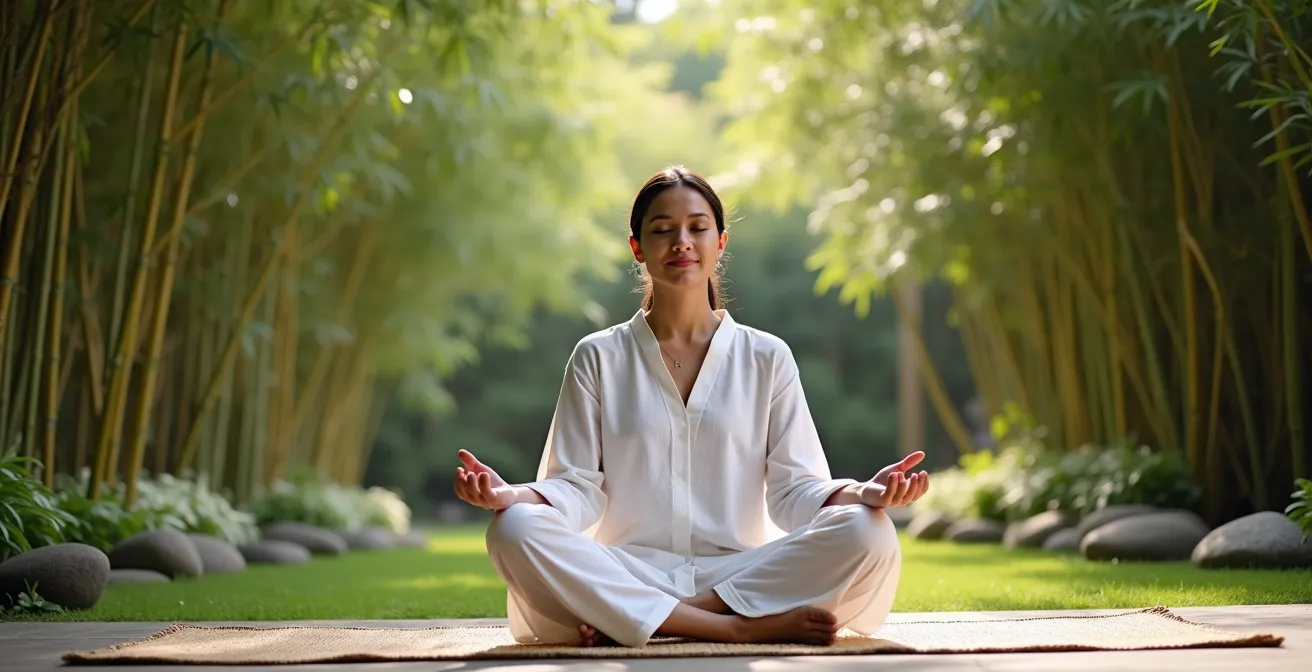
As this image illustrates, the focus is on a state of being, not on a brand of clothing. The attire is functional, facilitating a peaceful and focused inner state. This shift in dress code is a physical manifestation of the inner shift you are seeking—from external appearance to internal experience.
Raw salads and street juice: What to absolutely avoid during your training?
Maintaining physical health is paramount during a yoga training; you cannot progress spiritually if your body is fighting a bacterial infection. The Western digestive system is often not accustomed to the microbes present in India, and what locals can handle with ease can leave a UK traveller bedridden for days. This is an area where discipline and caution are not optional. In an ashram, you will typically be served a sattvic diet—a simple, pure, vegetarian diet designed to calm the mind and be easy on the digestion. It consists of freshly cooked vegetables, grains, lentils, and some dairy.
The single most important rule is to avoid raw, unpeeled foods and untreated water. This includes the tempting fresh salads, fruit platters, and colourful juices sold by street vendors. The risk of contamination from the water used to wash the produce or from the ice in the juice is simply too high. Even in seemingly clean restaurants, it’s a gamble not worth taking. Your best defence is to stick to food that has been thoroughly cooked and served hot.
Fruits with thick skins that you peel yourself, like bananas and mangoes, are generally safe. When it comes to hydration, only drink sealed, bottled water and always check that the seal is intact before you open it. Hot chai from a busy stall is usually a safe bet as the milk and water are boiled, but be wary of lassi or other drinks that may use unpasteurised dairy or contaminated ice. Following these rules isn’t about being paranoid; it’s about safeguarding your ‘practice integrity’ by keeping your physical vessel strong and healthy.
Your Essential Food Safety Checklist: Eating Safely in Rishikesh
- Avoid all raw vegetables and salads, even in upscale restaurants, as you cannot verify the water source used for washing.
- Skip fresh fruit juices from street vendors due to the high risk of contaminated water or ice.
- Choose thoroughly cooked vegetables and only eat thick-skinned fruits (like bananas or oranges) that you peel yourself.
- Opt for hot, boiled beverages like chai over cold ones like lassi to avoid risks from unpasteurized dairy or ice.
- Stick exclusively to sealed bottled water for drinking and brushing your teeth, and always verify the seal is intact before opening.
Train travel tips: Which class is safest for solo female travelers?
Travelling through India by train is an experience in itself, offering a vibrant glimpse into the heart of the country. However, for a solo female traveller from the UK, safety and security are primary concerns. The Indian railway system is vast and has numerous classes, which can be confusing. Choosing the right class is the single most important decision you can make to ensure a safe and comfortable journey. For long, overnight journeys, it is strongly recommended to book a ticket in an air-conditioned (AC) class.
The AC classes (AC1, AC2, AC3) are significantly more secure, cleaner, and less crowded than the non-AC Sleeper Class. An attendant is assigned to each carriage, access is restricted to ticketed passengers, and the presence of families and professional co-travellers creates a safer environment. AC1 (First Class) offers the highest level of security with private, lockable two or four-berth cabins. AC2 (2-Tier) is an excellent and popular choice, offering berths in bays of four, with curtains for privacy and a wider aisle. AC3 (3-Tier) is more crowded with six berths per bay and no privacy curtains, but is still a secure option.
Sleeper Class, while incredibly cheap, is not recommended for a first-time solo female traveller. The carriages are non-AC, extremely crowded, and the windows are barred but open, posing potential security risks. The small price difference for an AC3 or AC2 ticket is a worthwhile investment in your peace of mind.

This table compares the main classes from a UK traveller’s perspective to help demystify the options.
| Class | UK Equivalent | Safety Rating | Price Range | Features |
|---|---|---|---|---|
| AC1 | First Class Sleeper | Excellent | £80-120 | Private cabin with lock, bedding provided |
| AC2 | Caledonian Sleeper shared | Very Good | £40-60 | Curtained berths, secure, mixed travelers |
| AC3 | Basic couchette | Good | £20-30 | Open berths, families present |
| Sleeper | No UK equivalent | Use caution | £8-15 | Non-AC, crowded, basic facilities |
Silent retreat or activity-based: Which works better for anxiety?
For those struggling with anxiety, the idea of a silent retreat can seem either like a perfect cure or a personal hell. The mind, accustomed to constant distraction, rebels against the void. An activity-based retreat—filled with workshops, group excursions, and social meals—can feel safer and more manageable. However, from a yogic and neurological perspective, true healing from anxiety often requires facing the silence, not running from it. This is a classic example of choosing ‘intentional discomfort’ over temporary relief.
Activity-based retreats can provide a wonderful distraction and a sense of community, which can temporarily alleviate anxious feelings. But they often fail to address the root cause: the hyperactive, self-referential part of the brain known as the Default Mode Network (DMN). This is the part of your mind that replays worries, constructs negative scenarios, and obsesses over the self. An activity-based retreat simply gives the DMN new material to work with. A silent retreat, by contrast, starves it.
The initial period of a silent retreat can indeed heighten anxiety as the mind thrashes against its new constraints. But with persistence and the guidance of a good teacher, this is where the breakthrough happens. By observing the mind’s patterns without reacting, you begin to uncouple from them. You realize you are not your thoughts. This is a profoundly liberating experience that structured activities cannot replicate. Scientific research supports this ancient wisdom.
The Shamatha Project: Scientific Proof of Transformation
The Shamatha Project at the University of California, Davis, studied individuals on a 3-month meditation retreat. The findings were remarkable. The study showed that individuals whose mindfulness scores increased showed a decrease in cortisol, the primary stress hormone. Beyond just stress reduction, the retreat had measurable positive effects on sustained attention, emotional well-being, and even the activity of telomerase, an enzyme crucial for cellular health. This provides powerful evidence that the deep, sustained, and often silent practice fostered in a retreat setting creates real, biological changes that counter the effects of anxiety.
Kerala vs Sri Lanka: Which offers better value for Ayurveda?
Once you have deepened your yoga practice, you may feel called to explore its sister science, Ayurveda. This ancient system of medicine offers profound healing and rejuvenation, often through a cleansing process called Panchakarma. Two of the world’s premier destinations for authentic Ayurveda are Kerala in Southern India and Sri Lanka. For a UK traveller, choosing between them involves weighing factors of authenticity, cost, comfort, and travel logistics.
Kerala is widely considered the cradle of academic Ayurveda. The tradition here is deeply rooted, with a more clinical and less-frills approach. You are more likely to find yourself in a rustic, hospital-like setting run by generations of Ayurvedic doctors. The focus is purely on the treatment, and the standard of accommodation can be basic. It offers unparalleled authenticity for the purist who is willing to forego creature comforts for a deep, traditional cure.
Sri Lanka, by contrast, has perfected the art of the Ayurvedic resort. The treatments are authentic and administered by qualified practitioners, but the environment is geared towards the comfort of international visitors. You can expect higher standards of accommodation, beautiful surroundings, and a more holistic ‘wellness’ package that blends treatment with relaxation. It offers a gentler introduction to Ayurveda and can feel less intimidating for a first-timer. While flights from the UK might be slightly more expensive, the on-the-ground costs for high-quality treatment and lodging can sometimes offer better overall value, especially when factoring in the lower visa cost for UK citizens.
This comparative table highlights the key differences to help you decide which destination aligns best with your personal needs and budget.
| Factor | Kerala | Sri Lanka |
|---|---|---|
| Flight from London | £450-600 | £500-650 |
| Daily Treatment Cost | £80-150 | £60-120 |
| Authenticity | Traditional, academic | Resort-style, comfortable |
| Visa (UK citizens) | e-Visa £70 | ETA £25 |
| Accommodation Standard | Basic to moderate | Higher comfort level |
| Post-treatment travel | Backwaters, tea estates | Beaches, cultural sites |
Key Takeaways
- The structure of a traditional ashram is a deliberate tool for inner work, not a punishment to be endured.
- For a one-month course in India, an e-Tourist visa is often sufficient, cheaper, and easier for UK citizens to obtain than a Student Visa.
- Prioritise health and safety: stick to sattvic, cooked food, sealed water, and choose AC1/AC2 train classes for solo travel.
- True transformation often requires ‘intentional discomfort’; embracing practices like silence is more effective for anxiety than constant distraction.
Ayurveda in Sri Lanka: What to expect from a Panchakarma cure
If you’ve chosen Sri Lanka for your Ayurvedic journey, you’re likely considering a Panchakarma. This is not a spa treatment; it is a deep, intensive medical cleanse designed to remove deep-seated toxins (ama) from the body and mind. Understanding what this process entails is crucial to prepare physically and mentally. It’s a commitment that extends far beyond the time you spend at the retreat itself, with protocols to follow before you arrive and long after you return to the UK.
The process begins even before you leave home. You’ll be advised to start simplifying your diet and lifestyle weeks in advance. The treatment itself is divided into three stages. The first is Purvakarma (pre-treatment), which lasts for several days at the centre. This involves daily oil massages (Snehana) and steam therapies (Swedana) to loosen and liquefy the toxins lodged in your tissues, preparing them for elimination.
The second and most intense stage is the Pradhanakarma (main treatment). This is where the actual elimination happens. Under the close supervision of an Ayurvedic doctor, you will undergo one or more of the five cleansing actions. The most common are Virechana (therapeutic purgation) or Vamana (therapeutic vomiting). While this sounds daunting, it is a controlled medical procedure designed to purge toxins from the system safely. The final stage is Paschatkarma (post-treatment), which involves a restorative diet, herbal medicine, and gentle lifestyle to rebuild your digestive fire (agni) and allow the body to integrate the deep healing. The discipline required for a successful Panchakarma is immense, but the rewards—renewed energy, mental clarity, and profound well-being—can be life-changing.
- Pre-treatment (Purvakarma): Expect 3-7 days of preparatory oil massages and dietary restrictions at the centre. You should avoid alcohol and meat for at least two weeks before your arrival.
- Main Treatment: This is the most intense phase. Be prepared for medically supervised therapeutic vomiting or purgation to eliminate toxins.
- Post-treatment Care: This phase is critical for lasting results. You must follow a strict vegetarian protocol for 2-4 weeks post-treatment and continue a modified diet for up to 6 weeks after returning to the UK to allow your system to fully recover and strengthen.
Ultimately, the path you choose—be it a silent ashram in Rishikesh or a Panchakarma cure in Sri Lanka—boils down to your readiness for deep, authentic work. By moving beyond the surface-level concerns of comfort and cost, you can make a choice that honours your deepest intention for growth and transformation. Start by assessing not where you want to go, but what you are willing to let go of.