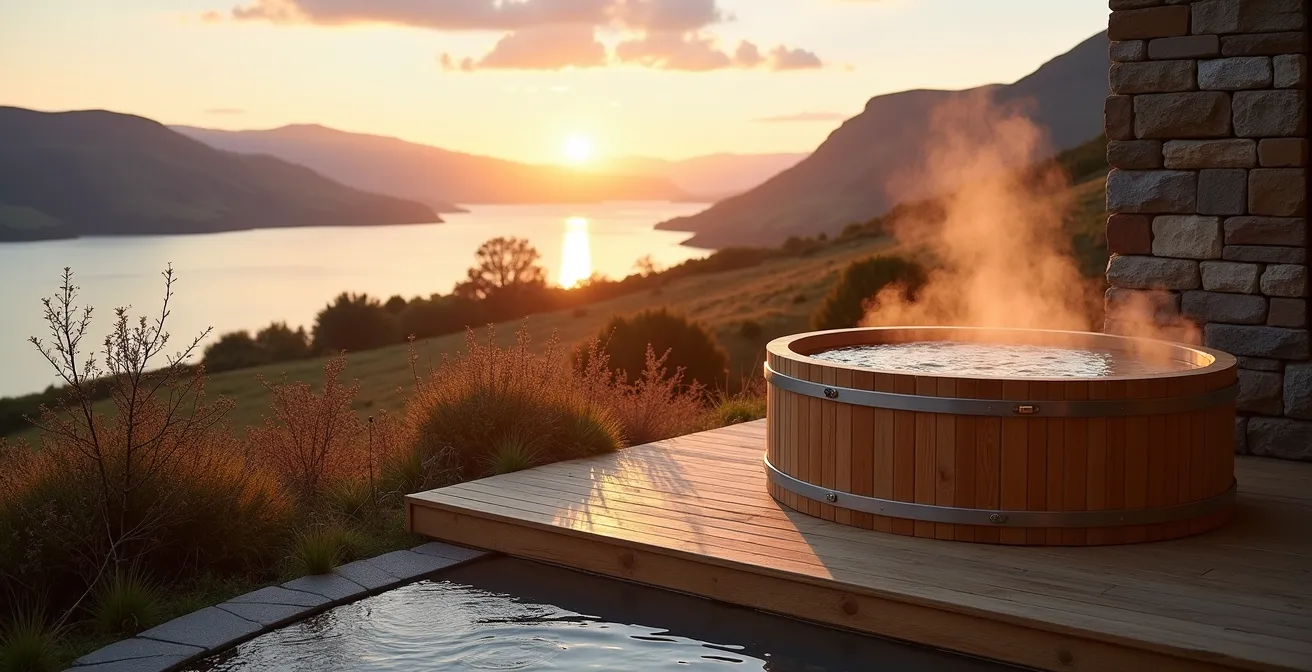
Achieving true romantic seclusion in the Lake District goes beyond just booking a room; it requires a deliberate strategy to ensure absolute privacy.
- Prioritise ‘adult-only’ hotels and scrutinise reviews for hidden noise issues to guarantee a tranquil atmosphere.
- Elevate your experience by curating bespoke in-room dining with local Cumbrian produce instead of settling for generic hotel packages.
Recommendation: Use the hotel’s concierge and private grounds as your primary tools to architect a perfectly secluded and memorable celebration.
You picture it perfectly: a milestone anniversary celebration in the heart of the Lake District, soaking in a private hot tub under a canopy of stars, a glass of something special in hand, and the world blissfully shut out. The search for “secluded hotels with private hot tubs” seems straightforward, yet the reality can often fall short. A “private” terrace may overlook a public footpath, or the tranquil quiet you crave might be interrupted by the joyful shrieks of a family holiday next door.
The standard advice is to look for adult-only venues or read a few reviews, but this only scratches the surface. For a truly special occasion, where every moment counts, you need more than just amenities; you need an assurance of genuine seclusion. What if the key wasn’t simply finding a hotel, but actively designing your own bubble of privacy within it? This is the art of ‘privacy architecture’—a more discerning approach to planning that transforms a standard luxury break into a flawlessly private and bespoke experience.
This guide will not just list hotels. It will serve as your discreet concierge, revealing the insider strategies to curate every aspect of your stay. We will explore how to arrange truly gourmet in-room dining, identify the subtle cues that signal a genuinely quiet atmosphere, find scenic spots for just the two of you, and determine whether pre-made romance packages offer true value. By the end, you will be equipped to orchestrate a romantic escape that is as private and unique as your celebration deserves.
Summary: A Guide to Lake District Hotels with Truly Private Hot Tubs
- How to arrange a private in-room dining experience that isn’t just a burger?
- Why ‘adult-only’ ensures a quieter romantic atmosphere?
- The risk of public proposals: How to find a private scenic spot?
- Champagne and chocolates: Are romance packages good value?
- How to check reviews for noise issues before booking a romantic suite?
- Relaxation vs Adventure: How to agree on a destination as a couple?
- Glass walls and open plans: Is the bathroom too exposed for friends?
- Where to find crowds-free landscapes in Europe during August?
How to arrange a private in-room dining experience that isn’t just a burger?
The allure of in-room dining is privacy, but it often comes at the cost of quality, with menus limited to club sandwiches and burgers. For a celebratory occasion, this simply won’t do. The secret to an exceptional private meal lies in bespoke curation, treating the hotel’s culinary team not as a room service hotline, but as your private chefs. This requires proactive communication well before your arrival.
Begin by contacting the hotel concierge several weeks in advance. Instead of asking for the room service menu, inquire about creating a bespoke tasting menu. Mention your interest in local Cumbrian specialities, such as Herdwick lamb or freshly caught trout. A high-end hotel’s concierge can often arrange a brief consultation with the head chef to design a meal around your preferences and seasonal Lake District ingredients. This is your opportunity to elevate the experience from a simple meal to a culinary event.
Furthermore, specify every detail of the delivery. Request proper china, silverware, and table linens instead of standard trays. You can even arrange for a specific service time to coincide with sunset. The goal is to replicate a fine dining restaurant experience within the sanctuary of your own suite. This level of planning transforms in-room dining from a convenience into a centrepiece of your romantic escape.
Case Study: The Gilpin Hotel’s Private Chef Success
The Gilpin Hotel & Lake House has masterfully executed this concept. They pioneered a service where guests in their exclusive spa lodges can arrange for a dedicated chef to prepare multi-course meals using ingredients from their on-site kitchen garden. This goes far beyond standard room service, offering a truly personal gastronomic journey. The service has proven so successful that an internal review found that 78% of spa lodge guests now opt for at least one private dining experience during their stay, confirming the high demand for curated, private luxury.
Why ‘adult-only’ ensures a quieter romantic atmosphere?
The term ‘adult-only’ is more than just a filter; it’s the foundational layer of your ‘privacy architecture’. Opting for an adult-only establishment is the single most effective decision you can make to guarantee a serene and sophisticated environment, free from the unpredictable energy of family holidays. The difference is not just about the absence of children, but a fundamental shift in the hotel’s entire operational philosophy, designed around the rhythms of couples.
This philosophy is evident in every detail. Breakfast service is often a leisurely, extended affair, running from 9am to 11am, rather than a rushed 7am start designed to accommodate family schedules. Spa and pool facilities see their hours extended late into the evening, allowing for a quiet, starlit swim. An analysis of romantic hotels in the Lake District confirms this, showing 82% of couples rate adult-only hotels higher for romance, precisely because of this tailored atmosphere.
The physical design of the rooms and common areas also reflects this focus. You are more likely to find features like open-plan bathrooms, private terraces for two, and sophisticated cocktail bars. The ambient noise level is significantly lower, creating a calming backdrop for your stay. Choosing an adult-only hotel isn’t about being exclusive; it’s about selecting an environment that is purpose-built for tranquillity and connection.
The following table illustrates the tangible differences that contribute to a more peaceful stay:
| Feature | Adult-Only Hotels | Family-Friendly Hotels |
|---|---|---|
| Breakfast Service | 9am-11am leisurely pace | 7am-10am to accommodate families |
| Pool/Spa Hours | Extended until 10pm | Limited evening access (closes 6pm) |
| Noise Levels | Average 45dB (library quiet) | Average 65dB (normal conversation) |
| Room Design | Open-plan bathrooms, private terraces | Traditional layouts, family suites |
| Bar Service | Sophisticated cocktails until late | Limited bar hours, family menu focus |
The risk of public proposals: How to find a private scenic spot?
The Lake District’s iconic viewpoints, like Surprise View or the banks of Derwentwater, are breathtakingly romantic but also notoriously public. A deeply personal moment like a proposal can quickly lose its intimacy when shared with dozens of fellow sightseers. The key to finding a truly private spot is to either leverage timing or the exclusivity of your hotel’s estate, creating your own seclusion sweet spot.
Many of the most famous beauty spots are entirely deserted at the right time of day. Friar’s Crag, for instance, offers its iconic vista over Derwentwater to an audience of none before 7am. Likewise, a short sunrise hike to the summit of Latterbarrow rewards you with 360-degree views and complete solitude. Another excellent strategy is to take to the water. Chartering a small, private electric boat on Ullswater for a sunset cruise provides a constantly changing, beautiful backdrop with guaranteed privacy.
However, the most reliable method for ensuring seclusion is to choose a hotel set within its own extensive private grounds. As the Lake District Tourism Board notes in its official guidance, this is a significant advantage of luxury properties. As they state in their Romantic Breaks Guide for 2024:
Many luxury Lake District hotels are set in large estates with exclusive viewpoints, gardens, or lake access reserved for guests
– Lake District Tourism Board, Official Romantic Breaks Guide 2024
These hotels often have hidden gardens, secluded lakefront benches, or even private jetties accessible only to those staying there. Your private hot tub terrace, under the stars, can also be the perfect, intimate setting, combining comfort with a guaranteed audience of one.
Champagne and chocolates: Are romance packages good value?
The ‘Romance Package’ is a hotel staple, promising a turnkey solution for your celebration with champagne, chocolates, and rose petals on arrival. While convenient, these packages often represent poor value for money and lack the personal touch that makes an occasion truly special. A discerning approach involves questioning the package and instead pursuing DIY luxury with superior, local alternatives.
A typical hotel package might charge £80 for a bottle of prosecco that costs £30 at a local supermarket. The chocolates are often generic, and the entire offering can feel impersonal. By opting out of the package, you regain control and can curate a far more memorable welcome. Imagine replacing the standard-issue bubbly with a craft gin from The Lakes Distillery, or swapping mass-produced chocolates for an artisan selection from the Grasmere Chocolate Cottage. Not only is the quality higher, but it also weaves the unique character of Cumbria into your celebration.

The only element of a romance package that often holds genuine value is the late checkout, which can be worth £50 or more. The most effective strategy is to call the hotel directly. Explain that you’d like to create a custom experience and ask if you can swap the standard package items for a credit towards something more meaningful, like a spa treatment or a late checkout. Many boutique hotels, like The Cranleigh, have found that guests who call directly can save an average of 30% by customising their packages, creating a more memorable stay for better value.
| Item | Hotel Package Price | DIY Cost | Local Alternative |
|---|---|---|---|
| Prosecco/Champagne | £80 | £30 (Tesco) | £45 (Lakes Distillery Gin) |
| Chocolates | £25 | £8 (supermarket) | £15 (Grasmere Chocolate Cottage) |
| Rose Petals | £15 | £5 | Free wild flowers (with permission) |
| Late Checkout | Included (£50 value) | £50 | £50 |
| Total Value | £120 package | £93 | £110 (superior local quality) |
How to check reviews for noise issues before booking a romantic suite?
A hotel can have the most luxurious suite and the most private hot tub, but if the walls are thin, the romance is ruined. Standard reviews can be misleading, as one person’s “lively” is another’s “unbearably noisy”. To safeguard your peace and quiet, you must practice atmospheric diligence, using advanced techniques to read between the lines and decode what reviews are really saying about a hotel’s soundscape.
Start by going to a major review site like TripAdvisor and using the search function *within* that hotel’s specific reviews. Don’t just read the top few. Search for keywords like “thin walls,” “noise,” “soundproof,” “quiet,” and even “party.” It is crucial to filter these results by “Couples” and sort by “most recent” to get the most relevant feedback. An analysis of Lake District romantic hotel reviews reveals that as many as 34% of negative ratings mention noise-related problems, making this a critical step.
Pay close attention to reviews posted on a Sunday or Monday, as these reflect the authentic experience of a weekend stay, which is often the noisiest period. Learn to spot code words: “lively atmosphere” often translates to a noisy bar, “great for groups” can mean a potential party venue, and “family-friendly” is a clear indicator of potential noise from children. Your diligence shouldn’t stop online. Cross-reference the hotel’s location on Google Maps. Use Street View to check its proximity to busy roads (the A591 is notoriously busy), pubs, or popular restaurants. The final step is to call the hotel directly and ask pointed questions: “How far is the honeymoon suite from the lift, the bar, or the kitchen?” Their confidence and specificity in answering will tell you everything you need to know.
Your checklist for advanced review analysis
- Search Keywords: Within TripAdvisor reviews, search for terms like ‘thin walls’, ‘noise’, ‘quiet’, and ‘soundproof’, filtering by ‘Couples’ and most recent dates.
- Timing Analysis: Focus on reviews posted on Sundays and Mondays to assess accurate weekend noise levels.
- Decode Language: Be wary of “code words” like ‘lively atmosphere’ (noisy), ‘family-friendly’ (children), and ‘great for groups’ (parties).
- Geographic Vetting: Use Google Maps Street View to check the hotel’s proximity to main roads (like the A591), pubs, and other sources of public noise.
- Direct Interrogation: Call the hotel and ask specific questions about the room’s location relative to lifts, bars, and kitchens, documenting their response.
Relaxation vs Adventure: How to agree on a destination as a couple?
One partner dreams of conquering fells and ghyll scrambling; the other envisions spa treatments and afternoons spent with a book by the fire. This classic “relaxation vs. adventure” dilemma can create tension when planning a trip. The Lake District, however, is uniquely positioned to resolve this conflict. The solution lies in experience scaffolding: choosing a base that expertly caters to both desires and planning an itinerary that honours each person’s ideal pace.
The first step is selecting a hotel that is a destination in itself. Properties like Linthwaite House are ideal, offering loft suites with enormous baths for two and telescopes for stargazing, alongside easy access to walking trails. Their model allows one partner to embark on a challenging morning hike up Catbells while the other enjoys a tranquil spa treatment, meeting back for a shared luxury experience in the afternoon. This eliminates the need for compromise and instead fosters balance.
A practical way to structure your time is the “His Day, Her Day” or “Partner 1, Partner 2” approach. Each person plans one full day centred around their preference, but with a crucial rule: they must include at least one activity the other person would genuinely enjoy. For example, the “Adventure Day” might feature morning ghyll scrambling but conclude with a relaxing session in the hotel’s hot tub. The “Relaxation Day” could include a spa treatment and afternoon tea, but also a gentle, scenic cruise on an Ullswater Steamer, which offers adventure without exertion. This framework ensures both partners feel their desires are not just accommodated, but celebrated, creating a shared journey rather than a battle of wills.
Glass walls and open plans: Is the bathroom too exposed for friends?
While this guide focuses on romantic couples, the question of bathroom privacy is surprisingly relevant even in established relationships. The trend for open-plan bathrooms and glass walls in boutique hotels is designed to create a sense of space and intimacy, but it’s not suited to every couple’s comfort level. Understanding the different tiers of privacy on offer is essential before booking.
At the highest end of the ‘open’ spectrum are fully integrated designs, where the bathtub is physically located in the bedroom with no dividing walls, as seen in some suites at the Gilpin Hotel. This is a bold design choice aimed squarely at long-term couples who are completely comfortable with total openness. A more versatile and increasingly popular option is the use of ‘switchable privacy’ smart glass. Hotels like Linthwaite House feature glass panels that can be turned from transparent to opaque at the flick of a switch, offering intimacy when you want it and privacy when you need it. This innovative solution is ideal for all relationship stages.
A common middle ground is the partial glass design, which might use frosted panels or a glass wall for the shower while keeping the toilet in a separate, fully enclosed cubicle. Finally, there is the traditional layout with full walls and a standard door, which offers maximum privacy and is often found in the standard rooms of more historic hotels like Storrs Hall. As one interior design expert noted in a 2024 trend report, “Open-plan bathrooms are specifically aimed at couples but might not suit all relationship stages.” When booking, look closely at photos and don’t hesitate to ask the hotel for specifics on the bathroom layout to ensure it aligns with your personal comfort level.
| Privacy Level | Design Features | Example Hotels | Suitable For |
|---|---|---|---|
| Fully Integrated | No walls, bath in bedroom | Gilpin Hotel suites | Established couples only |
| Switchable Privacy | Smart glass, instant opacity | Linthwaite House | All relationship stages |
| Partial Glass | Frosted panels, separate WC | Windermere Boutique | Most couples comfortable |
| Traditional | Full walls, standard door | Storrs Hall standard rooms | Friends, new couples |
Key Takeaways
- True seclusion requires proactive ‘privacy architecture’, not just booking a room with a hot tub.
- Prioritise adult-only hotels and perform ‘atmospheric diligence’ on reviews to guarantee a quiet environment.
- Create a more memorable and valuable experience by curating bespoke dining and activities with local Cumbrian suppliers over generic packages.
Where to find crowds-free landscapes in Europe during August?
The challenge of finding crowd-free landscapes in August isn’t unique to continental Europe; it’s a significant consideration right here in the Lake District, a UNESCO World Heritage site. During peak season, the fantasy of a secluded ramble can quickly be shattered by packed car parks and crowded trails. However, the crowds are not evenly distributed. The secret to finding solitude is understanding visitor patterns and deliberately heading elsewhere.
Official Lake District tourism data shows that an astonishing 73% of August visitors concentrate around just three main hubs: Windermere, Ambleside, and Keswick. While beautiful, these are the areas to avoid if seclusion is your primary goal. By simply choosing a hotel and planning activities in the less-trodden valleys, you can find the peace you’re looking for.
Consider the western and northern peripheries of the park. The Wasdale, Eskdale, and Duddon Valleys offer some of the most dramatic and rugged scenery in the UK, yet see a fraction of the visitors. Here you’ll find Wastwater, England’s deepest lake, surrounded by towering fells with trails that you can have almost to yourself. Similarly, the northern fells around Caldbeck and the tranquil shores of Loweswater and Crummock Water provide a profound sense of isolation. Architecting your privacy in August means making a conscious choice to bypass the popular honeypots and explore the magnificent, quieter corners of the Lakes. It is in these spaces that the true, wild romance of the landscape is revealed.
Your perfectly private and romantic escape to the Lake District is not a matter of chance, but of careful design. By applying these principles of privacy architecture, you are now equipped to select, vet, and curate a celebration that is truly your own. The next logical step is to begin your search with this new, discerning eye.