
In summary:
- Effective long-haul preparation is not a last-minute scramble but a structured, timed project plan starting 8 weeks out.
- Post-Brexit passport rules for UK citizens travelling to the EU are a major pitfall; the ‘issue date’ is now as critical as the expiry date.
- Securing your home and health requires significant lead time for tasks like arranging mail holds and completing vaccination courses.
- Smart packing and financial prep in the final weeks ensure a smooth transition from home life to your journey.
The familiar pre-trip feeling often begins as a low-level hum of anxiety. A long-haul journey, rich with promise, also presents a formidable mountain of tasks. Most of us tackle this with a sprawling, chaotic to-do list that grows more intimidating as the departure date looms. We check off “buy travel insurance” and “pack bags,” but this approach often leads to last-minute panic when we discover a passport isn’t valid, a required vaccination takes weeks, or our bank freezes our card on the first day.
The common mistake is focusing only on what needs to be done, not when. The real secret to a genuinely stress-free departure lies in shifting your mindset from a simple checklist to a structured project plan. It’s about sequential mitigation, where each task is completed in a specific order and timeframe to prevent foreseeable problems. This isn’t just about getting on the plane; it’s about creating a frictionless transition into your holiday, with all major risks managed weeks in advance.
This guide reframes your preparation as a calm, 8-week countdown. By assigning key tasks—from navigating bureaucratic hurdles to finalising packing—to specific weeks, you create the necessary headroom to handle any issue without stress. We will move through the critical milestones, ensuring that by the time you close your front door, your only focus is the adventure ahead.
Contents: Your 8-Week Countdown to a Stress-Free Departure
- Why ‘valid until’ date isn’t enough for entry into the EU post-Brexit?
- How to make your home look occupied without smart technology?
- Cloud or USB: Where to store backup copies of your passport?
- Capsule wardrobe: How to pack for 2 weeks in a carry-on?
- When to alert your bank about foreign spending to prevent freezing?
- The mistake of booking jabs 1 week before flying to Asia
- Train vs Plane: How much wine can you bring back from France?
- Train vs Plane for UK-Europe travel: Which is truly faster door-to-door?
Why ‘valid until’ date isn’t enough for entry into the EU post-Brexit?
Weeks 8-7: Bureaucratic Headroom. The single most critical task to tackle first is your passport. Since Brexit, the rules for British citizens entering the EU/Schengen Area have become a significant trap for the unwary. Relying solely on the ‘expiry date’ printed in your passport can lead to being denied boarding or entry. The issue is so prevalent that a recent UK Government report confirmed that over 2,000 British travellers were turned away at EU borders in 2023 due to these new rules.
The core of the problem is the “10-year rule.” Before September 2018, the UK Passport Office would often add up to nine unused months from an old passport onto a new one. This means a passport could have an expiry date that is, for example, 10 years and 6 months after its issue date. However, for entry to the EU, a British passport is now considered invalid if it is more than 10 years old on the day you enter, regardless of the printed expiry date. Furthermore, it must have at least three months of validity remaining on the day you plan to leave the EU.
To avoid this, you must check two dates: the issue date and the expiry date. If your passport was issued before September 2018, calculate the exact 10-year anniversary of its issue. This is its effective expiry date for EU travel. If this date falls before or during your trip, you must renew it, allowing at least 10 weeks for the process. This simple check, done two months out, provides ample time to secure a new passport and completely removes the number one cause of travel disruption for UK citizens.
How to make your home look occupied without smart technology?
Weeks 6-5: Analogue Failsafes. With your documents in order, the focus shifts to securing your home. While smart-home technology offers many solutions, relying on analogue, time-tested methods provides robust security without the risk of a Wi-Fi failure or app malfunction. The goal is to create the simple illusion of occupancy, and this is best achieved with the help of your community and trusted services. A pile of letters on the doormat is the most obvious sign of an empty house, making mail management a top priority.
The most effective solution in the UK is to use Royal Mail’s Keepsafe service. For a reasonable fee, they will hold all your mail for the duration of your trip and deliver it upon your return. This service requires at least five working days’ notice to set up, so arranging it a month in advance is a wise, stress-free move. At the same time, cancel any regular deliveries like newspapers or milk. These small details are what professional burglars look for.

Beyond mail, human-powered solutions are invaluable. The image above captures the essence of this: community trust. Ask a trusted neighbour or friend to perform simple, irregular actions that mimic daily life. This could include parking their car in your driveway occasionally, putting a bin out on collection day, or drawing the curtains at different times. These small, unpredictable acts are far more effective at deterring opportunists than a light on a predictable timer. Providing them with a key and your contact details establishes a reliable, low-tech security network.
Cloud or USB: Where to store backup copies of your passport?
Week 4: Digital Redundancy. As your departure approaches, it’s time to build a robust backup system for your critical documents. Losing your passport or wallet abroad can escalate from an inconvenience to a crisis if you have no way to prove your identity. The question isn’t whether to use cloud storage or a physical copy, but how to create a layered “defence in depth” strategy that combines both. A single point of failure—like a lost phone or a stolen bag—should never leave you completely stranded.
This system involves creating multiple, separated copies of essential information. Start by scanning or photographing your passport, driving licence, GHIC card, travel insurance policy, and flight confirmations. Also, create a simple text document with emergency contacts, credit card cancellation numbers, and details of any essential medications. This collection of files forms your primary backup, which you will then distribute across different layers of security.
The most organised way to approach this is with a structured plan that ensures you have access to your information in any scenario, from simple phone loss to the theft of your entire luggage. This provides true peace of mind for the methodical planner.
Your Defence-in-Depth Document Backup Plan
- Layer 1 (Cloud): Upload your document files to a secure, GDPR-compliant cloud service like OneDrive or Google Drive. Crucially, enable two-factor authentication to protect against unauthorised access.
- Layer 2 (Encrypted USB): Copy the same files onto an encrypted USB stick. Use free, built-in tools like BitLocker (Windows) or FileVault (macOS) to create an encrypted drive. This stick should be kept in your carry-on, separate from your laptop.
- Layer 3 (Physical Photocopies): Print two sets of physical photocopies. Keep one set in your carry-on luggage and the other in your checked suitcase. They must always be stored separately from your actual passport.
- Layer 4 (Trusted Contact): Email a password-protected ZIP file of your documents to a trusted family member or friend at home. If all else fails, they can send you the necessary information.
- Layer 5 (Contact Numbers): Before you leave, save the phone number for the nearest British Consulate in your destination country directly into your phone’s contacts. This is your ultimate fallback for passport emergencies.
Capsule wardrobe: How to pack for 2 weeks in a carry-on?
Week 3: Strategic Culling. Packing is often a source of stress, but a methodical approach can transform it into a satisfying exercise in efficiency. For a two-week trip, a well-planned capsule wardrobe allows you to fit everything into a carry-on, saving you from checked baggage fees, long waits at the carousel, and the risk of lost luggage. The principle is simple: select a limited number of garments that all coordinate, maximising the number of outfits you can create. Packing cubes are essential tools, allowing you to compress items and organise them by category, as shown in the organised flat-lay below.
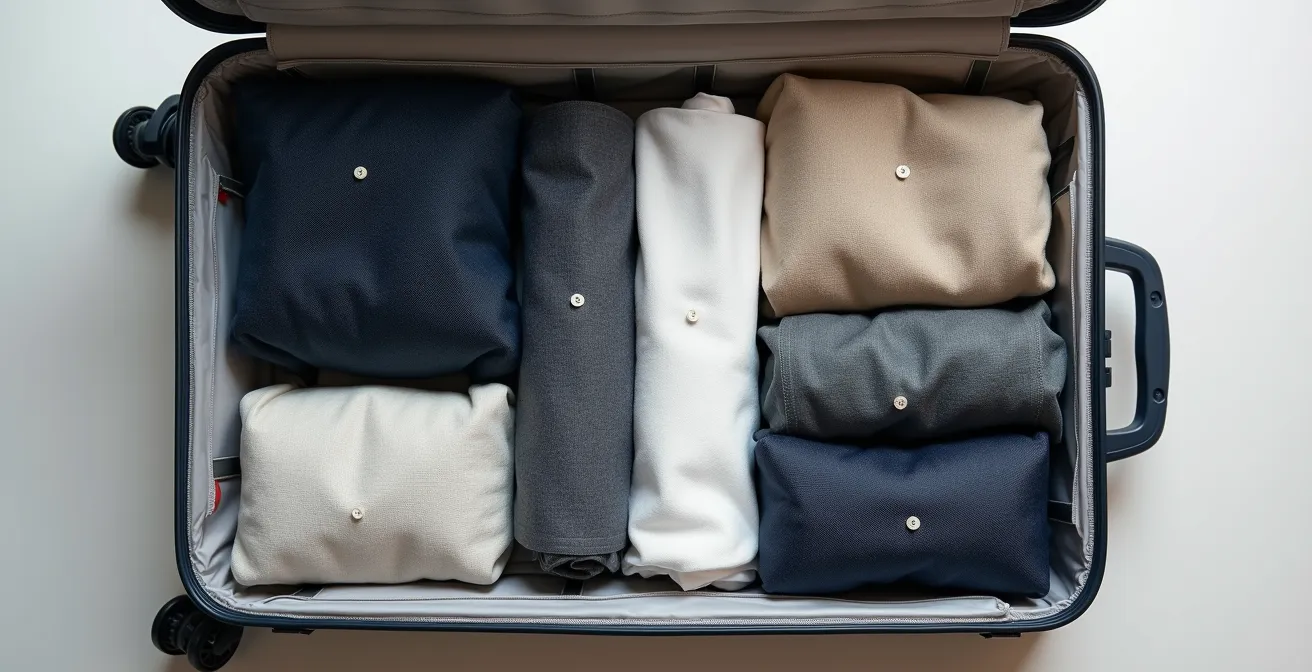
Start with a neutral colour palette (e.g., navy, grey, black) for your core items like trousers, skirts, or jackets. Then, add a few coordinating tops, shirts, or accessories in accent colours. Focus on versatile, wrinkle-resistant fabrics like merino wool or high-quality synthetics. For two weeks, a good rule of thumb is the 5-4-3-2-1 formula: five tops, four bottoms, three layers (e.g., a cardigan, a blazer, a light jacket), two pairs of shoes (one for walking, one smarter), and one or two key accessories like a scarf. Lay everything out on your bed before packing to ensure every piece works with at least two others.
However, the most meticulously planned wardrobe is useless if your carry-on bag doesn’t comply with airline restrictions. These vary significantly, especially among budget carriers. A methodical planner must check the specific rules for their airline well in advance. What is a free carry-on for one is an expensive add-on for another.
| Airline | Free Cabin Bag Size | Weight Limit | Priority/Extra Bag |
|---|---|---|---|
| EasyJet | 45x36x20cm | No limit | 56x45x25cm with Speedy Boarding |
| Ryanair | 40x20x25cm | No limit | 55x40x20cm (10kg) with Priority |
| British Airways | 56x45x25cm + handbag | 23kg total | Included in fare |
When to alert your bank about foreign spending to prevent freezing?
Week 2: Financial Readiness. In the final fortnight, your focus shifts to financial preparations. The old advice to “tell your bank you’re travelling” is becoming outdated, but the risk of having your card frozen for unusual activity remains real. The modern approach depends entirely on who you bank with. It’s crucial to understand your bank’s specific policy to avoid any payment issues while abroad.
Modern challenger banks like Monzo, Starling, and Revolut have built their systems for global use. They use location data and sophisticated fraud algorithms, meaning you typically do not need to set a travel notice. Their apps provide robust security features, allowing you to freeze and unfreeze your card instantly if it’s lost or stolen. For these banks, simply ensure your app is up to date and your contact details are correct.
For traditional high street banks (such as Lloyds, NatWest, or Barclays), the situation is less clear-cut. While their systems are improving, they are often more cautious. Setting a travel notice via their online banking portal or mobile app is a safe and recommended precaution. It takes only a few minutes and can prevent the major headache of a blocked card when you’re trying to pay for a hotel or dinner. This simple step acts as a valuable insurance policy against their fraud detection systems being overly aggressive. Regardless of your bank, a few universal rules apply to ensure a smooth financial experience:
- Make a small purchase at your UK departure airport (e.g., a coffee) after security. This ‘pings’ your card’s location in the UK just before you travel, confirming it’s active and in your possession.
- Carry a backup card from a different payment network. If your primary card is a Visa, have a Mastercard as a spare (or vice-versa), kept in a separate location.
- Save your bank’s international helpline number in your phone’s contacts before you leave. If you need to call, use hotel or airport Wi-Fi to make free ‘Wi-Fi Calls’ back to the UK, avoiding expensive roaming charges.
The mistake of booking jabs 1 week before flying to Asia
Weeks 8-6: Health & Immunisation. Alongside your passport, travel vaccinations are a long-lead-time item that cannot be rushed. Depending on your destination, particularly in parts of Asia, Africa, and South America, certain immunisations are either mandatory or strongly recommended. The critical mistake many travellers make is underestimating the time required for these vaccines to become effective or for a full course to be administered. Booking an appointment a week or two before your flight is often too late.
Many vaccination courses require multiple doses spaced weeks or even months apart. For example, the full course for Hepatitis B takes six months to complete for full immunity. Even single-dose vaccines, like Typhoid, require around two weeks to become fully effective. You must schedule a consultation with your GP or a private travel clinic at least six to eight weeks before departure to discuss your itinerary and plan your vaccination schedule. This provides the necessary “bureaucratic headroom” to ensure you are fully protected.
As a travel health advisory in UK guidance notes:
The danger isn’t just reduced efficacy. Arriving in a foreign country with mild fever or body aches from a recent jab can cause issues at immigration
– Travel health advisory, UK travel health guidance
This is a crucial point for the methodical planner. Arriving with side effects could trigger health screenings or unwanted attention from border officials. Planning well ahead ensures you are not only protected but also feeling your best upon arrival. The timeline for common travel vaccines highlights why early planning is non-negotiable.
| Vaccine | Number of Doses | Schedule | Minimum Time Needed |
|---|---|---|---|
| Rabies | 3 doses | Day 0, 7, 21/28 | 4 weeks |
| Japanese Encephalitis | 2 doses | 28 days apart | 4 weeks |
| Hepatitis B | 3 doses | 0, 1, 6 months | 6 months for full immunity |
| Typhoid (NHS free) | 1 dose | Single shot | 2 weeks before travel |
Train vs Plane: How much wine can you bring back from France?
Week 1: Final Details. As you finalise your plans, it’s wise to think about the return journey, specifically what you can and can’t bring back into the UK. Post-Brexit rule changes continue to catch travellers by surprise. For those travelling to the EU, personal allowances for alcohol are now strictly defined. While still generous, exceeding them can result in having your goods seized and paying tax.
The good news for wine enthusiasts is that the limits are substantial. Official post-Brexit rules allow you to bring back 18 litres of still wine (equivalent to 24 bottles) per person. This is in addition to either 4 litres of spirits OR 9 litres of sparkling or fortified wine. This allowance applies whether you travel by plane, ferry, or train, so your mode of transport doesn’t affect your customs limit—though it certainly affects how easy it is to carry 24 bottles of wine.
However, the more significant and often overlooked change is the strict new regulation on products of animal origin. Beyond alcohol, UK travellers now face a complete ban on bringing any meat or dairy products back from the EU for personal use. This means that classic holiday souvenirs like French cheese, Spanish charcuterie, or Italian salami are no longer permitted. This rule is enforced at the border and continues to catch many travellers unaware, leading to the confiscation of their prized foodie purchases. For all other goods, such as clothing or electronics, the personal allowance is £390 per person. Knowing these limits in advance prevents any unpleasant surprises on your way home.
Key takeaways
- The 10-year rule on passport issue dates is a critical, non-obvious check for all UK citizens travelling to the EU.
- Effective travel health planning requires a lead time of 6-8 weeks, as many vaccination courses take a month or more to complete.
- Door-to-door travel time, not just flight duration, is the true measure of speed; city-centre train travel is often faster for short-haul European trips.
Train vs Plane for UK-Europe travel: Which is truly faster door-to-door?
Strategic Overview. The final element of a well-planned trip is choosing the right mode of transport. For travel between the UK and nearby European capitals like Paris or Brussels, the choice between flying and taking the train is not as straightforward as it seems. While a flight is often perceived as faster, a methodical, door-to-door analysis frequently reveals a different reality. The crucial metric is not the journey time itself, but the total time from your front door to your city-centre destination.
Flying involves multiple time-consuming stages: travel to a distant airport (e.g., 45-60 minutes to get to Heathrow or Gatwick from central London), a recommended 2-3 hour buffer for check-in and security, the flight itself, and then another 30-60 minutes for deplaning, immigration, and travelling from the arrival airport (e.g., Charles de Gaulle) into the city centre. These hidden time costs add up significantly.
In contrast, high-speed rail like the Eurostar departs from and arrives in central city locations (St Pancras in London to Gare du Nord in Paris). Check-in is a far quicker 45-60 minutes, and there are no long taxi times on the tarmac or lengthy waits for luggage. The journey itself is longer than a flight, but the time saved at either end makes the train surprisingly competitive, and often faster overall. Furthermore, the time on the train is genuinely productive; with continuous Wi-Fi and ample space, you can work or relax for almost the entire journey, a stark contrast to the fragmented, often disconnected time associated with air travel.
The following comparison for a London-to-Paris trip illustrates why a door-to-door calculation is essential for making the most efficient choice.
| Factor | Eurostar | Flight |
|---|---|---|
| Check-in time | 45-60 minutes | 2-3 hours |
| Journey time | 2h 20min | 1h 15min flight |
| Airport/Station location | St Pancras (Zone 1) | Heathrow (45min from centre) |
| Arrival location | Gare du Nord (central Paris) | CDG (30-60min RER to centre) |
| Total door-to-door (approx.) | ~3.5-4 hours | ~5-6 hours |
| Productive time | 2+ hours connected | Limited (security, no electronics during taxi) |
By adopting this structured, timeline-based approach, you replace anxiety with control. You systematically address risks and complete tasks when they are most manageable, not when they become urgent. Start applying this 8-week countdown to your next long-haul journey to ensure your holiday begins not with a frantic rush, but with the quiet confidence of a well-prepared traveller.