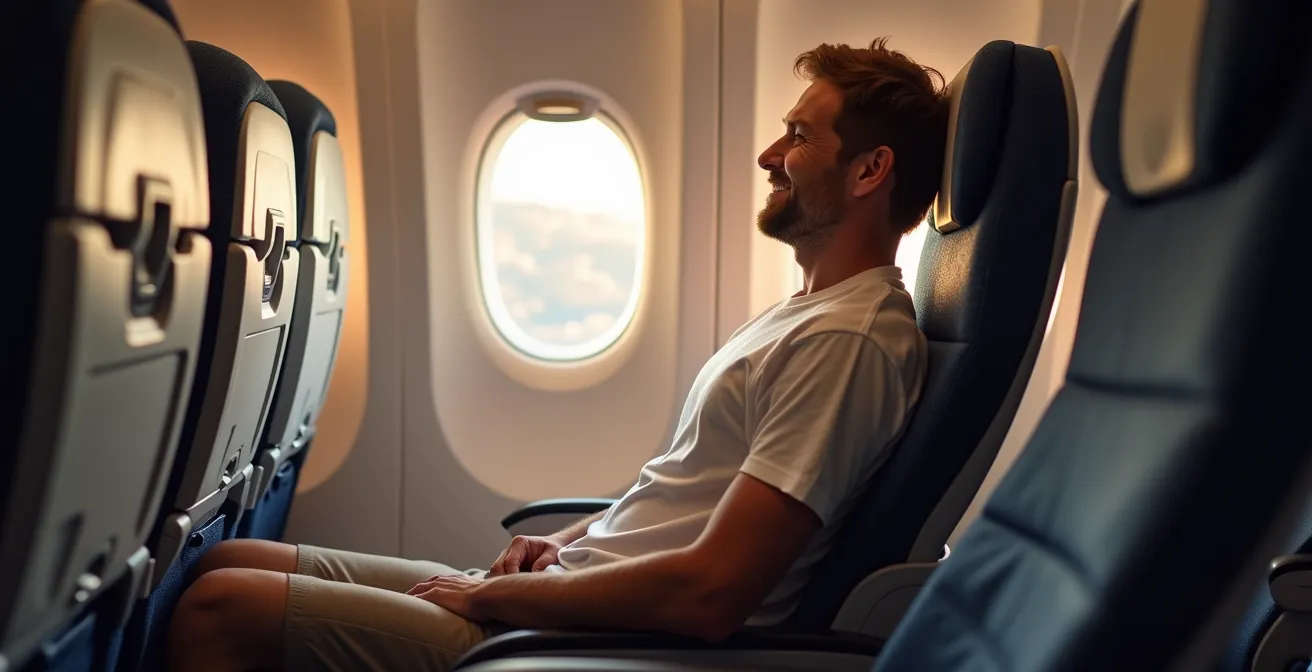
The dread of a 14-hour flight is real, especially for tall travellers who face inevitable back pain. The solution isn’t just to endure it, but to proactively manage your environment. This guide provides a physiotherapist’s strategy, focusing on dynamic sitting, targeted support, and physiological preparation to control spinal loading and turn your cramped economy seat into a space you can manage, ensuring you land ready to explore, not recover.
For any tall traveller, the thought of a 14-hour flight to Australia or Asia can trigger a familiar sense of dread. It’s not the destination, but the journey: the confinement, the impossibly small seat, and the near-certainty of arriving with a stiff, aching back. The standard advice is well-known: get up, stretch, and drink water. While not wrong, this advice often feels inadequate, a mere plaster on a problem that feels biomechanical and deeply ingrained in the economy class experience.
But what if the key wasn’t simply enduring the discomfort, but preventing it from ever taking hold? What if you could reframe the challenge from one of passive survival to active, ergonomic management? As a physiotherapist who frequently travels, I can tell you it’s possible. The secret lies in treating the aircraft cabin not as a hostile space, but as a micro-environment that you must control. It’s about understanding and mitigating spinal loading, practising dynamic sitting, and engaging in physiological pre-flighting long before you board.
This guide moves beyond the basics. We’ll explore the specific, evidence-based strategies that address the unique challenges faced by a taller frame in a small space. From the science of compression socks to the ergonomics of packing and the real physical cost of your travel choices, you’ll learn to turn your seat into a command centre for your own well-being. The goal is simple: to step off the plane feeling not just relieved, but genuinely refreshed and ready for your adventure.
This article provides a structured, physio-led approach to every stage of your long-haul journey. The following sections break down the key decisions and actions you can take to protect your back and enhance your comfort, from your feet to your final destination.
Summary: Your Ergonomic Guide to a Pain-Free Long-Haul Flight
- Flight Socks: Do They Really Work to Prevent Blood Clots?
- Window vs. Aisle: Which Is Better for Sleep vs. Stretching?
- Melatonin or Fasting: Which Method Resets Your Body Clock Faster?
- Shower Access: How to Use Lounges Without a Business Class Ticket
- Why Tomato Juice Tastes Better and Alcohol Hits Harder at 30,000ft
- Capsule Wardrobe: How to Pack for 2 Weeks in a Carry-On
- The ‘African Massage’: How to Cope with Rough Roads If You Have Back Pain
- Train vs. Plane for UK-Europe Travel: Which Is Truly Faster Door-to-Door?
Flight Socks: Do They Really Work to Prevent Blood Clots?
Yes, and their effectiveness is not just an old wives’ tale. For a physiotherapist, flight socks—or more accurately, graduated compression stockings—are a critical tool for managing the physiological stresses of long-haul travel. The primary concern during prolonged immobility is Deep Vein Thrombosis (DVT), a blood clot that forms in a deep vein, usually in the legs. The low cabin pressure and inactivity can cause blood to pool in your lower limbs, significantly increasing this risk.
Compression stockings work by applying a specific pressure gradient, with the tightest fit at the ankle and gradually decreasing pressure up the leg. This mechanical squeezing helps vessel walls and valves function efficiently, pushing blood back towards the heart and preventing it from stagnating. The science is robust; a landmark Cochrane review shows stockings can reduce DVT risk from a baseline of 10-30 per 1,000 travellers to just 1-3 per 1,000. For a 14-hour flight, that’s a significant reduction in a potentially life-threatening risk.
However, not everyone needs the highest medical-grade compression. Based on NHS guidance, you should strongly consider them if you fall into any of these categories:
- Passengers over 60 or with a family history of blood clots
- Those with recent surgery or major injury (within 3 months)
- Pregnant women or those on hormone replacement therapy
- Passengers with a BMI over 30 or significant varicose veins
- Anyone with a previous DVT or known blood clotting disorder
For best results, put them on first thing in the morning before your feet and ankles have a chance to swell. Using a pair of rubber gloves can provide the extra grip needed to pull them on smoothly. Ensure the material is evenly distributed without any wrinkles, which could otherwise create a tourniquet effect. This simple act of physiological pre-flighting sets the stage for a safer, more comfortable journey.
Window vs. Aisle: Which Is Better for Sleep vs. Stretching?
For a tall traveller concerned with back pain, the choice between a window and an aisle seat isn’t about the view; it’s a crucial ergonomic decision. There is a fundamental trade-off between lateral support for rest and freedom for movement. Neither is universally “better”—the right choice depends on your primary strategy for managing the 14-hour flight.
The window seat offers one distinct advantage: a stable, vertical surface to lean against. This allows you to create a more supported sleeping posture, using a pillow to bridge the gap between your head/shoulder and the fuselage wall. This can help prevent the head-nodding and C-shaped spinal slump that often lead to neck and back pain. For those who can sleep on planes and prioritize uninterrupted rest, the window is often the superior choice for managing spinal loading during sleep.
Conversely, the aisle seat is the champion of dynamic sitting. Its primary benefit is the freedom to get up and move every 30-60 minutes without disturbing others—a cornerstone of back pain prevention on long flights. It also allows you to periodically stretch a leg into the aisle, briefly changing the angle of your hips and lower back. This frequent micro-movement is essential for preventing muscle stiffness and disc compression. The downside is the lack of side support for sleeping and the constant disruption from fellow passengers and service carts.
This decision tree can help you choose the best seat for your specific needs.
| Feature | Window Seat | Aisle Seat |
|---|---|---|
| Lateral Support | Fuselage wall provides stable support for sleeping | No side support, risk of cart/passenger bumps |
| Movement Freedom | Must climb over others | Easy access to walk every 30-60 minutes |
| Leg Room | Fixed space | Can stretch leg into aisle periodically |
| Sleep Quality | Better for uninterrupted rest | Frequent disturbances |
| Back Pain Management | Better for maintaining sleeping posture | Better for regular, pain-preventing movement |
Ultimately, the best strategy for a tall person might be a hybrid approach: book an aisle seat for movement but create your own support using an inflatable neck pillow and a strategically placed lumbar roll. This gives you the freedom to move while making the most of your limited space during periods of rest.
Melatonin or Fasting: Which Method Resets Your Body Clock Faster?
Crossing multiple time zones on a 14-hour flight to Asia or Australia wreaks havoc on your circadian rhythm, the body’s internal 24-hour clock. The resulting jet lag can cause fatigue, insomnia, and digestive issues, compounding the physical discomfort of the flight itself. The two most discussed non-pharmaceutical methods for resetting this clock are melatonin supplementation and strategic fasting. From a physiological perspective, they work on different but complementary systems.
Melatonin is a hormone your body naturally produces in response to darkness, signalling that it’s time to sleep. Taking a low-dose supplement (0.5-3mg) can help nudge your body clock towards the new time zone. The key is timing: for an eastward flight (e.g., London to Singapore), you would take it in the evening of your destination time, a few hours before you plan to sleep. This helps initiate sleepiness at the “correct” new time. It’s a direct intervention to manipulate your sleep-wake cycle.
Fasting, on the other hand, is believed to work by rebooting a secondary “food clock” in the brain. Research suggests that by abstaining from food for about 12-16 hours leading up to the first breakfast time in your new destination, you can send a powerful signal to your body to reset its clock. When you finally eat, your body treats it as the start of a new day. This method is less about inducing sleep and more about resetting the entire metabolic and alertness schedule.

So which is faster? There’s no definitive winner, as individual responses vary. However, a combined approach is often most effective. Fast during the flight, stay well-hydrated with water, and then take a small dose of melatonin a few hours before your new bedtime upon arrival. Crucially, combine this with light exposure. Getting bright, natural sunlight in the morning at your destination is the single most powerful signal for resetting your master clock. This holistic strategy gives your body multiple, coordinated cues to adapt.
Shower Access: How to Use Lounges Without a Business Class Ticket
After 14 hours in a pressurised cabin, the simple act of taking a shower can feel transformative. It washes away the fatigue, eases muscle stiffness, and provides a powerful psychological reset before you face immigration or a connecting flight. While airport lounges with shower facilities were once the exclusive domain of premium-class travellers, there are now several accessible ways for an economy passenger to gain access, particularly in major UK hubs like Heathrow and Gatwick.
Think of it as a strategic investment in your physical well-being. That £30-£40 fee is not just for a shower; it’s for a space to stretch properly, rehydrate in a calm environment, and decompress away from the crowded terminal. This can be especially valuable if you have a few hours to kill before the next leg of your journey or before you can check into your hotel. It’s a key part of transitioning from “enduring the journey” to “starting the destination.”
For UK-based travellers, here are the most common options for securing that much-needed refresh:
- Priority Pass: An annual membership (starting around £69 in the UK, with pricier tiers offering free visits) grants access to a vast network of lounges worldwide, including many at Heathrow and Gatwick with shower facilities.
- Pay-per-use Day Passes: Many independent lounges, such as Plaza Premium and Aspire, sell day passes directly. You can book online in advance or pay at the door for £25-£45, which often includes shower use.
- Credit Cards with Lounge Access: Certain premium UK credit cards, like the American Express Platinum or some HSBC Premier accounts, include complimentary lounge access as a perk.
- Arrivals Lounges: While rarer, some airlines offer arrivals lounges. At Heathrow Terminal 5, for instance, British Airways Executive Club Gold members can use the arrivals lounge even when flying economy.
- Airport Hotel Day Rates: Some airport hotels, like the Sofitel at Heathrow T5 or the Hilton at Gatwick’s South Terminal, offer day-rate rooms for 4-8 hours, giving you a private space to shower and rest.
Planning this small luxury can make a huge difference in how your body feels upon arrival. It’s an active step in managing the cumulative physical toll of long-haul travel.
Why Tomato Juice Tastes Better and Alcohol Hits Harder at 30,000ft
The unique environment of an aircraft cabin—specifically the combination of low humidity and low pressure—has a profound effect on our physiology. This explains two common in-flight phenomena: the sudden appeal of tomato juice and the surprisingly potent effect of a single glass of wine. Understanding this is key to managing your body, particularly your hydration levels, which are critical for back health.
At 30,000 feet, cabin humidity can drop to below 20%, drier than many deserts. This, combined with low pressure, dulls our sense of smell and our perception of sweet and salty tastes. However, our ability to taste “umami”—the savoury, rich flavour abundant in tomatoes—remains largely unaffected. This is why tomato juice or a Bloody Mary can taste richer and more vibrant at altitude, cutting through the blandness. While interesting, the more critical takeaway is what this environment does to your hydration.
The extremely dry cabin air dehydrates tissue, causing them to ‘gum up’ and stick together, a process that can lead to trigger points and muscle pain. For your spine, this is particularly damaging. As the National Spine Health Foundation highlights, “Staying hydrated helps maintain disc health and keeps your back muscles limber, helping prevent spasms.” Your spinal discs are like small, water-filled cushions. Dehydration reduces their volume and shock-absorbing capacity, increasing spinal loading and making you more susceptible to pain.
Meanwhile, alcohol’s effects are amplified. The lower oxygen levels in the cabin can make you feel more intoxicated from a smaller amount. Furthermore, alcohol is a diuretic, actively accelerating dehydration. That one glass of wine has a double impact: it impairs your judgment about posture and movement while simultaneously robbing your spinal discs of the fluid they desperately need. The best in-flight beverage strategy is simple: for every hour you’re in the air, drink a glass of water and skip the alcohol and caffeine. Your back will thank you when you land.
Capsule Wardrobe: How to Pack for 2 Weeks in a Carry-On
For a traveller with back pain, the strategy of packing light is not about avoiding baggage fees; it’s a fundamental part of physiological pre-flighting. The most common moments for travel-related back injuries don’t happen in the air, but on the ground: lifting a heavy suitcase into a car boot, twisting to place it on a check-in scale, or heaving it off the baggage carousel. By committing to a carry-on only, you eliminate these high-risk movements entirely.
Packing a capsule wardrobe for two weeks in a small case requires a shift in mindset. It’s not about having an outfit for every occasion, but having a coordinated set of items that can be mixed and matched. The core principle is choosing a neutral base palette (e.g., black, navy, grey, beige) and adding a couple of complementary accent colours. Every top should work with every bottom. Focus on high-performance, lightweight fabrics like merino wool (which is odour-resistant and temperature-regulating) and technical synthetics that are wrinkle-resistant and dry quickly.

To maximise space, use packing cubes to compress clothing and keep your bag organised. Roll, don’t fold. Wear your bulkiest items—like a jacket and boots—on the plane. This disciplined approach forces you to be ruthless about what you truly need, reducing weight and bulk. This directly translates to less physical strain.
Ergonomic Packing and Luggage Strategy
Your choice of luggage is as important as what’s inside it. Travel health experts strongly recommend a four-wheeled spinner suitcase. This design allows you to push the case alongside you, keeping your spine neutral and avoiding the twisting and pulling motion associated with two-wheeled cases. This single change significantly reduces the torsional strain on your lower back. By distributing the weight evenly and using lightweight luggage, you prevent the very lifting and twisting motions that are common triggers for back injuries at the airport.
By treating packing as an extension of your back care strategy, you are taking control of your environment from the moment you leave your house, setting the foundation for a pain-free trip.
The ‘African Massage’: How to Cope with Rough Roads If You Have Back Pain
Your back pain management strategy can’t end when you disembark. A 14-hour flight is often just the prelude to another physically demanding part of the journey, especially if your destination involves travel on unpaved or poorly maintained roads—an experience wryly known as an “African massage.” The constant, high-frequency vibration and jarring impacts from a 4×4 vehicle can quickly undo all your careful in-flight work, aggravating spinal discs and triggering muscle spasms.
The key is to apply the same principles of ergonomic management and support from the plane to the vehicle. Your goal is to dampen vibration and maintain a supported, neutral spine. Don’t assume the vehicle will be set up for comfort. Be proactive. The same inflatable lumbar roll or folded-up jacket you used on the plane is your best friend in the safari truck. Place it in the curve of your lower back to maintain your natural spinal alignment and prevent slumping.
Engaging your core muscles can also act as an internal shock absorber. By gently tensing your abdominal and pelvic floor muscles, you create a “muscular corset” that helps to stabilise and protect your spine from sudden jolts. Before your trip, consulting a UK physiotherapist to learn specific core stability and pelvic floor exercises can be invaluable. This preparation turns your body into a more resilient system.
The transition from the controlled environment of the plane to the unpredictability of the road requires a clear plan. Following a structured approach can make all the difference.
Your Plane-to-4×4 Back Protection Plan
- Transfer Your Support: Immediately move your lumbar support pillow or custom roll from your flight bag into your seat in the safari vehicle before the journey begins.
- Vehicle Selection: If possible, inquire with your tour operator beforehand and request vehicles known for better suspension, such as a Land Cruiser 70 Series, over less-forgiving models.
- Pre-Trip Core Conditioning: In the weeks leading up to your trip, focus on core stability exercises (like planks and bird-dog) recommended by your physiotherapist to build spinal endurance.
- Active Core Engagement: During the drive, consciously practice gentle pelvic floor and deep abdominal contractions, especially when anticipating a rough patch of road. This braces your spine.
- Post-Drive Decompression: As soon as you arrive at your lodge, perform 5-10 minutes of gentle decompression stretches. Cat-cow, child’s pose, and gentle spinal twists can help reset your spine after hours of vibration.
By seeing the journey as a whole, from your front door to your final destination, you can create a continuous chain of protection for your back.
Key Takeaways
- Proactive Ergonomic Management: Don’t just endure the flight; actively control your micro-environment with targeted support and strategic choices.
- Dynamic Sitting is Essential: Frequent micro-movements and regular walks are more effective for back health than trying to hold a single “perfect” posture.
- Hydration is Non-Negotiable: Dehydration directly impacts spinal disc health. Prioritise water over alcohol and caffeine to keep your spine cushioned and resilient.
Train vs. Plane for UK-Europe Travel: Which Is Truly Faster Door-to-Door?
While a 14-hour flight to Australia is unavoidable, many shorter journeys present a choice. For a UK-based traveller heading to mainland Europe, the decision between flying and taking the train (like the Eurostar) is often framed purely in terms of time and cost. However, from a physiotherapist’s perspective, the most important metric is the total physical cost of the journey. When you factor this in, the train is often not just more comfortable, but significantly better for your back.
Air travel is a known trigger for back issues; some studies suggest as many as 8 out of 10 people experience back pain at some point, and the cramped, static nature of flying is a common aggravator. A short flight from London to Amsterdam might seem quick, but the “door-to-door” experience involves multiple physical stress points: travel to an out-of-town airport, long walks through terminals, extended periods of standing in queues, and finally, confinement in a cramped seat with limited movement.
The train, by contrast, offers a far superior ergonomic experience. City-centre stations reduce travel time, security is faster, and the time spent standing is minimal. Onboard, seats are wider, there is more legroom, and you have the freedom to get up and walk to a buffet car at any time. This ability to practice dynamic sitting and avoid static postures is invaluable.
Let’s compare the real-world physical journey from London to Amsterdam, a popular UK-to-Europe route, based on an analysis by The Physio Company.
This comparative analysis of physical stress highlights the hidden costs of air travel. While the flight itself is short, the cumulative time spent in physically compromising situations is significantly higher.
| Factor | Eurostar from St Pancras | EasyJet from Gatwick |
|---|---|---|
| Journey to Terminal | Direct tube/taxi to city centre station | 1-hour train to Gatwick + walking |
| Pre-departure Standing | 15-30 minutes security | 60-90 minutes queues |
| Seat Space | Wider seats, table, ability to walk | Cramped, limited movement |
| Movement Freedom | Walk to buffet car anytime | Restricted to narrow aisle |
| Total Door-to-Door | ~4.5 hours | ~5-6 hours |
| Physical Stress Points | Minimal | Multiple (luggage, queues, cramped seating) |
When you have a choice, considering the entire journey’s impact on your body is the ultimate form of proactive back care. For many European destinations, the train is not only less stressful but often faster and, most importantly, far kinder to your spine.
By adopting this physiotherapy-led mindset, you transform yourself from a passive passenger into the active director of your own well-being. The next time you plan a journey, long or short, your first step should be to evaluate the total physical cost and build an ergonomic strategy to mitigate it.