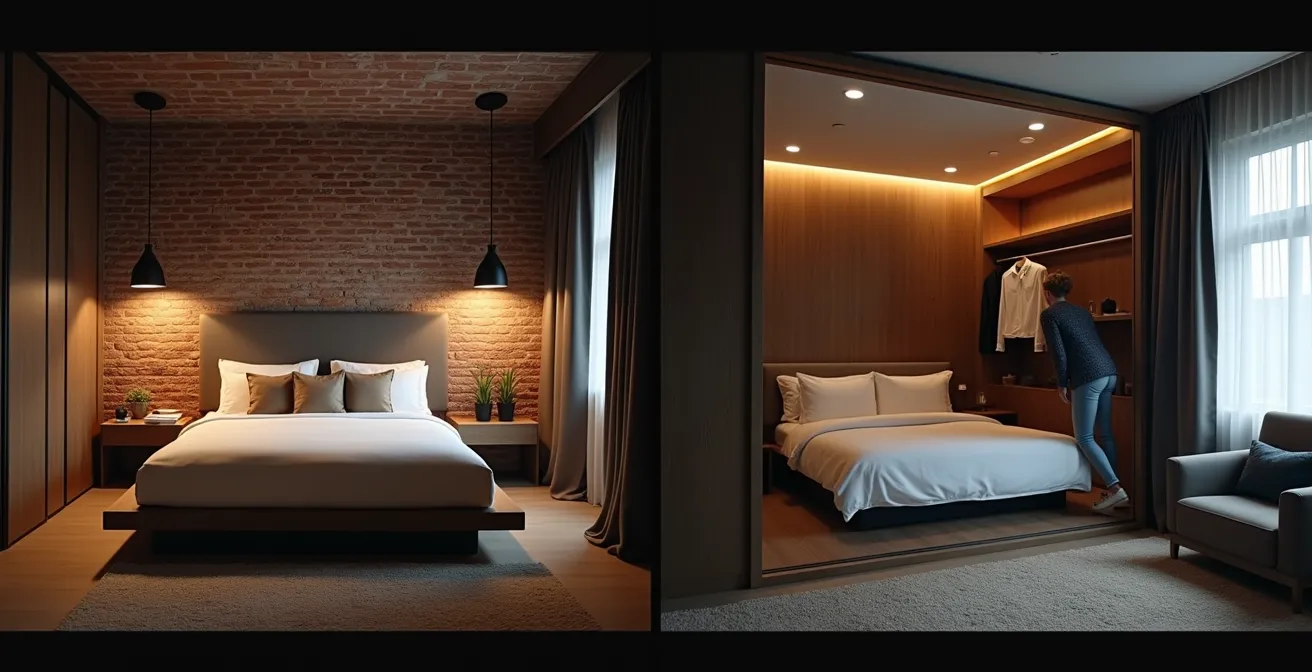
The seductive allure of a ’boutique’ hotel often masks critical flaws in comfort and practicality, particularly within the UK’s converted historic buildings.
- Photographic tricks and minimalist design frequently conceal rooms that lack adequate space, light, and storage.
- Many self-proclaimed ’boutique’ properties are sub-brands of major chains, sacrificing unique service for corporate efficiency.
Recommendation: Adopt an interior designer’s critical eye to decode visual cues, question design choices, and prioritise ‘livable volume’ over curated aesthetics before you book.
As an interior designer, I am professionally seduced by beautiful spaces. The allure of a UK boutique hotel, with its promise of unique character, curated art, and Farrow & Ball colour palettes, is a powerful one. We, the design-conscious travellers, are drawn to the narrative these images sell: a sophisticated, one-of-a-kind escape. Yet, too often, the reality falls painfully short. We arrive to find a room where ‘moody’ lighting means applying makeup in the dark, and ‘minimalist’ is a euphemism for having nowhere to hang a coat.
The common advice—to “read reviews” or “look at the photos”—is no longer sufficient. These hotels have mastered the art of digital presentation. The real problem lies in the inherent tension between preserving the aesthetic of a historic UK property and providing genuine, modern comfort. This is where architectural compromises are made, and where style begins to triumph over substance. We scroll through galleries of rooms in converted Georgian townhouses or Victorian mills, but we aren’t equipped to spot the red flags hidden in plain sight.
But what if the key wasn’t just to look, but to see? What if you could decode a hotel’s online presence with the same critical eye as a designer, identifying the trade-offs before they impact your stay? This is not about dismissing style, but about demanding that it serves function. It’s about ensuring that the £200-a-night experience is as comfortable as it is photogenic.
This guide provides a professional framework to do just that. We will dissect the visual tricks used to sell space, analyse the fatal flaws of impractical lighting and open-plan bathrooms, and reveal how to unmask a chain hotel in boutique clothing. Prepare to look beyond the lens and assess the true livable quality of your next stay.
To navigate this critical evaluation, this article breaks down the key areas where style often compromises substance. Explore the sections below to arm yourself with a designer’s toolkit for your next booking.
Summary: Decoding the Boutique Hotel Facade
- The wide-angle lens trick: How to estimate true square footage?
- Glass walls and open plans: Is the bathroom too exposed for friends?
- Why moody lighting makes it impossible to apply makeup?
- Where to put your clothes in a minimalist room with no wardrobe?
- Chain hotel in disguise: Is it really ’boutique’ or just a sub-brand?
- How to check reviews for noise issues before booking a romantic suite?
- Balcony or Beachfront: Is the £200/night upgrade really worth it?
- Concierge or Reception: What service level to expect in premium aparthotels?
The wide-angle lens trick: How to estimate true square footage?
The first deception in a boutique hotel’s arsenal is the wide-angle lens. This photographic tool can make a shoebox look like a suite, distorting proportions and creating an illusion of depth. As a designer, my first step is always to ignore the “feel” of the photos and hunt for tangible clues to the room’s livable volume. The UK boutique hotel market, with a projected £2.02 billion revenue in 2024, is booming, and much of this growth comes from converting existing, often small-scale, properties. Maximising perceived space is a key marketing tactic.
To counter this, you must become a spatial detective. Don’t trust the sweeping shots; instead, scrutinise the details. Look for familiar objects that can act as a scale reference. A UK king-size bed, for instance, is a fixed object: 1.5 metres wide. How many ‘bed-widths’ can you fit across the floor? This simple mental measurement cuts through the lens distortion. Similarly, look at the furniture. Does the desk chair look strangely small, or is there no room for a proper armchair, only a single stool?
These are all indicators of an architectural compromise where the developer has prioritised the number of rooms over their functional size. True luxury is not just about aesthetics; it’s about the freedom to move, unpack, and exist in a space without feeling constrained. A beautiful room that you have to shuffle sideways to navigate is a design failure.
Your Action Plan: Room Size Reality Check
- Bed Reference: Look for the UK king-size bed (150cm x 200cm) in photos. It occupies roughly 3 square metres and serves as a reliable scale anchor.
- Socket Spacing: Count visible power sockets. UK building regulations often dictate their spacing, giving you a subtle clue to wall length.
- Radiator Height: Check for standard UK panel radiators, which are typically 60cm high. Use them as a vertical reference against other furniture.
- Request Floor Plans: Email the hotel directly. Mentioning ‘corporate booking requirements’ often yields a floor plan that business hotels provide, revealing the true layout and dimensions.
- Benchmark Comparison: Compare against UK Housing Space Standards as a mental reference. A standard double bedroom is a minimum of 11.5 square metres; anything significantly less will feel cramped.
Glass walls and open plans: Is the bathroom too exposed for friends?
The open-plan bathroom, particularly one enclosed by glass walls, is a trend that screams ’boutique design’. It’s a bold architectural statement intended to create a sense of unbroken space and modern luxury. However, from a practical standpoint, it’s often a catastrophic failure of privacy. This design choice is particularly prevalent in UK cities like Edinburgh and Bath, where developers are converting historic listed buildings. A case study from Savills reveals that these conversions frequently feature glass partitions because moving or adding solid structural walls is forbidden by preservation laws. The city’s impressive 14.4% RevPAR growth is, in part, built upon these compromises.
While this might seem romantic for a couple, it becomes deeply awkward for friends travelling together or even for partners who value a moment of solitude. The “frosted” or “etched” glass that is often used provides only a suggestion of privacy. It blurs forms but rarely obscures them, especially when the bathroom is backlit. This trend prioritises a single, dramatic first impression over the day-to-day comfort of the guests. It’s a classic example of an aesthetic choice that is fundamentally unlivable for many.
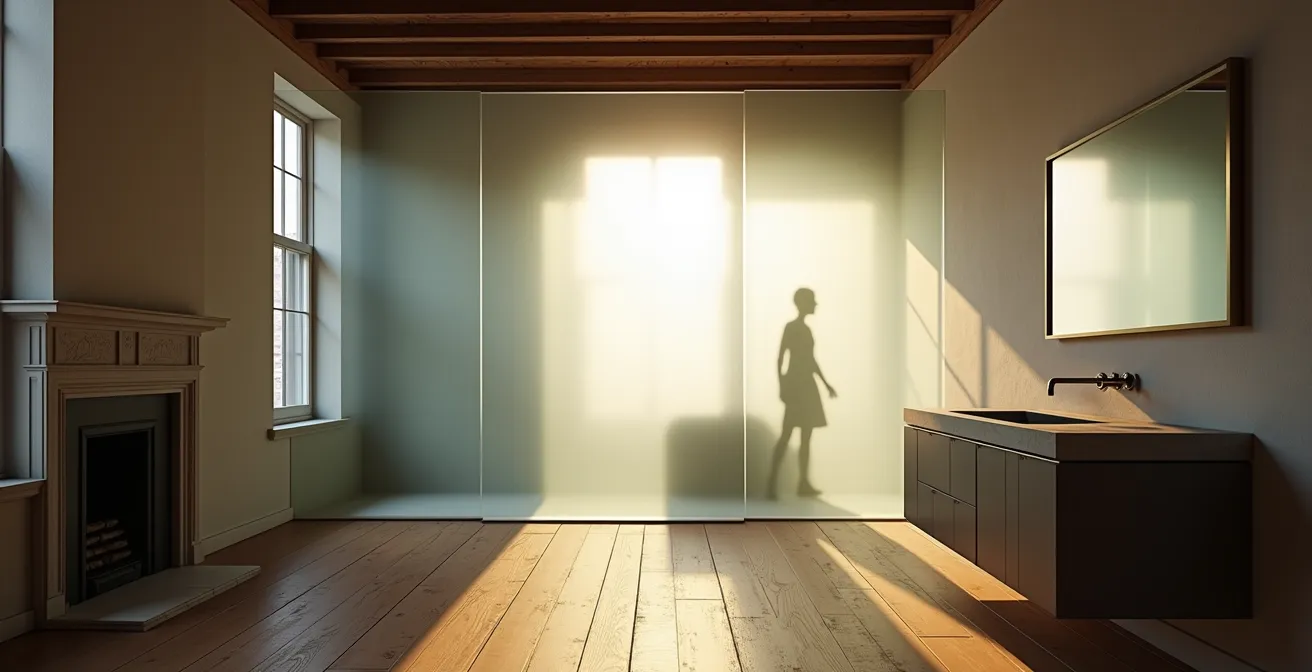
Before booking a room with this feature, you must ask a critical question: who are you travelling with, and what is your shared comfort level? The marketing photos will always be shot to minimise the transparency and maximise the ‘spa-like’ feel. Look for guest photos in reviews, which often show a more honest perspective. A beautiful bathroom you can’t comfortably use is merely a sculpture, not a functional part of your room.
Why moody lighting makes it impossible to apply makeup?
Lighting is the soul of a space, but in many boutique hotels, it has a split personality. There’s the ‘mood lighting’—dim, warm, and perfect for creating an atmospheric Instagram shot—and then there’s the lighting you actually need to live. The two are rarely the same. The obsession with low-level, atmospheric lighting often means that essential task lighting is completely neglected. This is most keenly felt at the bathroom mirror, where applying makeup or shaving becomes an exercise in guesswork. A single, stylish Edison bulb or a dramatic uplighter may look great, but it casts shadows and provides insufficient, poorly coloured light.
Good lighting design is about layers. A well-designed room should have ambient (general), task (functional), and accent (dramatic) lighting that can be controlled independently. Boutique hotels often invest heavily in the accent layer at the expense of the task layer. They forget that a hotel room is not a bar; it’s a temporary home where practical activities take place. This is a critical failure of user-centric design, favouring a fleeting aesthetic over the guest’s daily routine.
The following table, based on professional lighting standards, starkly illustrates the gap between what is often provided and what is actually required for practical tasks. The ‘Lux’ level is a measure of light intensity on a surface; the difference between a typical boutique setup and a functional one is not subtle.
| Lighting Type | Typical UK Boutique Hotel | Actual Guest Need | Lux Level |
|---|---|---|---|
| Bathroom Mirror | Single Edison bulb or uplighter | Bright task lighting both sides | 50-100 lux vs 300+ needed |
| Bedside | Exposed filament pendant | Adjustable reading light | 75 lux vs 200+ needed |
| General Room | Dimmable mood lighting | Bright option for packing/working | 100 lux vs 500+ for tasks |
| Natural Light | Heavy curtains for atmosphere | Sheer option for daylight | Variable based on UK weather |
When looking at hotel photos, actively hunt for light sources. Do you see dedicated, bright lights by the mirror? Are the bedside lights adjustable for reading, or are they fixed, low-wattage pendants? If every photo is bathed in a dim, golden glow, it’s a red flag that the room may be beautiful to look at but frustrating to live in.
Where to put your clothes in a minimalist room with no wardrobe?
The ‘minimalist aesthetic’ is another boutique hotel trend that can quickly descend into impracticality. In its purest form, minimalism is about stripping away the unnecessary to create a serene and uncluttered environment. In the hands of some hotel designers, however, it becomes an excuse to eliminate essential furniture. The most common victim is the wardrobe. You arrive in a beautifully sparse room, only to realise there is nowhere to hang your clothes besides a few trendy hooks on the wall.
This isn’t just an oversight; it’s often a calculated decision to maximise perceived space in a small room. Removing a bulky wardrobe instantly makes a room feel larger and more open, which looks better in photographs. This practice is becoming more common across the hotel sector. As one industry analysis notes:
Economy hotels averaging less than £100 per night increasingly eliminate wardrobes to maximise perceived space, despite 9,835 hotels competing for differentiation
– IBISWorld UK Hotel Industry Analysis, UK Hotels Industry Report 2026
While the quote mentions economy hotels, this space-saving logic has been enthusiastically adopted by boutique properties charging a premium. They replace the wardrobe with an ‘open hanging rail’ or a few stylish knobs. This might suffice for an overnight stay with a single shirt, but for a weekend trip or a business traveller with suits, it’s utterly inadequate. Your clothes end up draped over the single chair, and your ‘serene, minimalist’ room quickly becomes a chaotic mess. This is a prime example of style that actively works against comfort and usability.
Before you book, carefully examine the photos for evidence of proper storage. Don’t be fooled by a stylishly shot corner with a single linen shirt hanging on a hook. Look for an actual wardrobe or, at the very least, a substantial chest of drawers. If all you see are open rails, ask yourself if you’re willing to live out of your suitcase for the sake of a minimalist photo opportunity.
Chain hotel in disguise: Is it really ’boutique’ or just a sub-brand?
The term ’boutique’ implies independence, unique character, and personalised service. However, the success of this model has not gone unnoticed by major hotel corporations. They have responded by creating ‘soft brands’—collections of hotels that maintain a boutique aesthetic and individual name, but are owned and operated under the umbrella of a global chain. This creates a hybrid that often delivers the style of a boutique hotel but with the standardised, and sometimes impersonal, service of a chain.
Discerning this can be difficult, as these properties are designed to conceal their operational footprint. Yet, as a designer, you learn to spot the subtle tells. It’s in the generic key card, the standardised font on the in-room dining menu, or the presence of a global loyalty programme advertised at the front desk. These are the small cracks in the boutique facade that reveal a corporate backbone.
This is a significant trend in the UK market. As one analysis points out, major chains are leveraging this strategy to capture travellers seeking unique experiences. For example, Marriott’s Autograph Collection includes The Glasshouse in Edinburgh, and IHG’s Kimpton brand now operates several high-design properties in London. A Statista report on the UK hotel market confirms customers are seeking unique experiences, which is precisely the demand these soft brands are designed to meet. There’s nothing inherently wrong with this model, but it’s a question of transparency and expectation. If you’re paying a premium for what you believe is a one-of-a-kind, owner-operated experience, you should be aware if you’re actually staying in a cleverly disguised Marriott.
To unmask these properties, your due diligence must go beyond the hotel’s own website. Search for the hotel’s name along with terms like “owned by” or “part of”. Check the very bottom of the website’s homepage for a copyright notice that might mention a larger parent company. This isn’t about avoiding these hotels, but about aligning your expectations with the reality of the service and experience you are likely to receive.
How to check reviews for noise issues before booking a romantic suite?
Nothing shatters the illusion of a romantic boutique escape faster than the sound of late-night revellers or early-morning deliveries. While almost all hotels will have some reviews mentioning noise, the key is to perform a more targeted form of sensory due diligence, especially in the UK where building stock and cultural habits create predictable noise patterns. Many boutique hotels are in converted Victorian or Georgian buildings with original, single-glazed windows and poor sound insulation between floors.
A generic search for the word ‘noise’ in reviews is too broad. You must search for UK-specific keywords. For instance, searching for “last orders” or “11pm” will often surface reviews complaining about noise from nearby pubs as they empty onto the streets. Checking Google Maps for proximity to popular UK chain pubs like Wetherspoons, All Bar One, or Slug & Lettuce can be a major red flag, as these are hotspots for hen and stag parties. The risk of noise is amplified during periods of high occupancy, such as the festive season, which saw 73% occupancy in December across England, creating a higher density of guests and potential for disturbance.
Beyond street noise, you must also consider internal and service-related sounds. Look for reviews mentioning “bins,” “deliveries,” or “early morning.” The charmingly narrow streets of many UK towns and cities mean that service vehicles often have to operate very early to avoid traffic, with the noise echoing between buildings. Similarly, reviews mentioning “thin walls,” “creaky floors,” or “hearing footsteps” are critical indicators of poor soundproofing—a common compromise in historic conversions. A targeted review search strategy for a UK hotel should include:
- Searching for pub-related terms like “last orders” or “closing time”.
- Checking for proximity to major chain pubs known for large crowds.
- Filtering reviews by winter months (‘October-March’) when window insulation issues are most noticeable.
- Looking for mentions of service noise like “deliveries” or “bins”.
- Cross-referencing the address with the local council’s licensing register to identify any nearby late-night venues.
Balcony or Beachfront: Is the £200/night upgrade really worth it?
The ‘sea view’ or ‘balcony’ upgrade is one of the most potent temptations in hotel booking, often commanding a premium of £100, £200, or more per night. The promise is an idyllic scene: sipping coffee while gazing out at the serene coastline. However, in the context of the UK’s famously unpredictable weather, the value of this upgrade becomes highly questionable. You are often paying for the *potential* of a view, not the guaranteed enjoyment of it. Research from Edinburgh, for example, shows that hotels with castle views command huge premiums despite the city’s 200+ rainy days per year, proving that guests are willing to pay for the idea itself.
Furthermore, the quality of the ‘view’ can be misleading. In many UK seaside towns like Brighton, the prime beachfront hotels are separated from the sea by a busy main road. Your ‘beachfront’ balcony may come with a soundtrack of constant traffic. A comparative analysis of popular UK seaside locations reveals a stark difference in value for money. A £150 upgrade in one town might offer a dramatic, sweeping vista, while in another it provides a glimpse of a grey sea over a promenade full of arcades.
This table breaks down the realistic value proposition for a sea view upgrade in several popular UK destinations, factoring in typical pricing, view quality, and the number of days per year where the weather is likely to permit its enjoyment.
| Location | Base Room Price | Sea View Upgrade | Actual View Quality | Weather Usage Days/Year |
|---|---|---|---|---|
| St Andrews | £159 | +£80-120 | Firth of Forth, often grey | 60-80 days |
| Brighton | £125 | +£150-200 | A259 road between hotel and beach | 90-110 days |
| Cornwall | £110 | +£100-150 | Dramatic coastline, weather dependent | 70-90 days |
| Blackpool | £75 | +£50-75 | Promenade and tram lines visible | 50-70 days |
Before clicking that ‘upgrade’ button, apply a cost-benefit analysis. Check the long-range weather forecast, use Google Street View to inspect the immediate surroundings of the hotel for obstructions like roads or buildings, and ask yourself honestly: how much time will I realistically spend using this balcony or staring at this view? Often, the money saved could be better spent on a superb dinner at a restaurant with an even better view.
Key takeaways
- Trust physical references in photos (like bed size), not the distorted perspective of a wide-angle lens, to judge room size.
- Treat ‘mood lighting’ as a red flag for poor task lighting, and actively look for evidence of bright, functional lights in key areas.
- Recognise that ‘minimalism’ is often a euphemism for a lack of essential storage; always verify the presence of a wardrobe or drawers.
Concierge or Reception: What service level to expect in premium aparthotels?
The line between a hotel and a short-term rental is blurring, giving rise to the ‘premium aparthotel’. These properties offer the space and amenities of an apartment—like a kitchen—with some of the services of a hotel. For the independent, design-conscious traveller, this can seem like the perfect hybrid. However, it’s crucial to understand that the service model is fundamentally different. Expecting a traditional hotel experience will lead to disappointment.
The traditional concierge, who can secure last-minute reservations at exclusive restaurants, is being replaced by a ‘Community Host’ or ‘Neighbourhood Expert’. Their strength lies in providing curated local recommendations—the best coffee shop, the hidden gallery—rather than high-touch booking services. As research from Savills indicates, a 10.4% year-on-year drop in UK domestic tourism coincides with a preference for these self-service models, signalling a major shift in traveller expectations.
Service is often app-based and hands-off. Keyless entry, service requests, and communication are managed through a smartphone app. Housekeeping is typically weekly, not daily, with additional cleaning available for a fee. The 24/7 support you’d expect from a hotel often exists, but it may be a remote call centre, with on-site staff only available during specific hours. Instead of room service, you’ll find a curated list of top-tier Deliveroo partners. To manage your expectations when booking a premium UK aparthotel, consider the following new standards:
- Staff Role: Expect ‘Community Hosts’ knowledgeable about the local area, not traditional concierges for booking services.
- Digital First: Download the property’s app before arrival for keyless entry, communication, and service requests.
- Housekeeping: Assume weekly service is standard. Budget for extra cleaning if required more frequently (£20-£30 per clean is common).
- Food & Beverage: Room service is replaced by partnerships with local delivery services and guides to neighbourhood restaurants.
- Support: On-site staff presence is often limited (e.g., 7am-11pm), with 24/7 support handled by a remote team.
By applying this critical framework, you transform from a passive consumer of marketing images into an active, informed traveller. You can now appreciate style for what it is, while demanding the substance you deserve. The truly perfect boutique stay is out there—it’s the one where beautiful design works in service of your comfort, not against it.