
For a family of four in London, a one-bedroom apartment isn’t a luxury; it’s a strategic tool to prevent the spatial and scheduling conflicts that can ruin a holiday.
- A studio forces the entire family to operate in a single functional zone, leading to inevitable friction around sleep times and personal space.
- A one-bedroom creates two distinct zones—living and sleeping—which is essential for managing different schedules and maintaining parental sanity.
Recommendation: Prioritise finding a true one-bedroom layout. The gain in functionality and privacy far outweighs any perceived cost savings of a studio.
The “sleeps 4” label on a London studio apartment listing can feel like a victory for a parent planning a family trip. It seems to solve the central problem: fitting a family of four into a single, affordable city-centre accommodation. The conventional wisdom is to focus on location, check reviews, and then find the cheapest option that fits everyone. However, this approach overlooks the most critical factor for family harmony in a confined space.
The decision between a studio and a one-bedroom flat is not about square footage; it’s a strategic choice about managing functional zones and avoiding the temporal friction that inevitably arises when four people’s schedules collide. A studio, by definition, is a single zone where sleeping, eating, relaxing, and playing all happen in the same room. A one-bedroom, even a small one, fundamentally changes the dynamic by creating two zones. This separation is the key to a successful family city break.
This guide moves beyond generic advice to provide a practical, spatial analysis. We will dissect the daily realities of family life in both layouts, examining everything from the acoustic properties of Victorian conversions to the logistical drain of communal laundry. By the end, you’ll be able to audit rental listings not just as a tourist, but as a family accommodation specialist, ensuring your London trip is remembered for its adventures, not its accommodation compromises.
This article breaks down the crucial, often-overlooked details that determine whether a London apartment truly works for a family. The following summary outlines the key spatial and practical considerations we will explore.
Summary: A Family’s Guide to Choosing a London Apartment Layout
- Why period conversions in Kensington might keep your baby awake?
- The disappointment of ‘kitchenettes’ without an oven: How to check?
- The reality of sleeping on a pull-out couch for 7 nights
- In-unit washer vs communal laundry: Which saves more holiday time?
- How to baby-proof a rental apartment upon arrival?
- Venice or Amsterdam: Which canal city is actually wheelchair friendly?
- One-pot meals: How to cook healthy food with just a microwave and hob?
- How to make history interesting for teenagers during a cultural trip?
Why period conversions in Kensington might keep your baby awake?
The charm of a Victorian or Georgian period conversion in an area like Kensington is undeniable, but their architectural character often comes with poor acoustic separation. Original single-glazed sash windows are beautiful but offer almost no defence against the noise of London traffic, sirens, and pedestrians. For a family with a baby or light-sleeping children, a front-facing bedroom on a busy street can disrupt sleep schedules entirely. The issue isn’t just external noise; original floorboards transmit every footstep and conversation between levels, meaning your upstairs or downstairs neighbours become part of your holiday soundtrack.
While some properties have been updated, you can’t rely on photos alone. Modern building regulations for soundproofing were only introduced in 2003, so older conversions are particularly risky. When considering a period property, noise mitigation should be a top priority. The good news is that effective solutions exist, as analysis shows that specialist secondary glazing can achieve an 80% reduction in noise, but you must verify its presence. Similarly, properties near Tube lines like the District and Circle can experience low-frequency rumbles that are hard to escape. A seemingly quiet side street may still suffer from significant noise pollution.
Action Plan: How to Identify Noise Issues Before Booking
- Check for single-glazed sash windows, which offer minimal sound insulation against London street noise.
- Ask about the property’s conversion date; buildings converted before 2003 often lack modern soundproofing.
- Listen for tube rumble in video tours or ask the host if the property is near District and Circle lines.
- Assess floor noise transmission by asking if original Victorian floorboards are present.
- Verify room positioning and request a rear courtyard-facing room over a front-facing one on a busy street.
The disappointment of ‘kitchenettes’ without an oven: How to check?
For a family, a kitchen isn’t an amenity; it’s a strategic tool for managing budgets, picky eaters, and early morning breakfasts. The term ‘kitchenette’ on a London rental listing can be dangerously misleading. Many are designed for business travellers, featuring little more than a microwave, a mini-bar-sized fridge, and a two-ring ‘domino’ hob. This setup is inadequate for preparing a proper family meal, forcing you into the expense and stress of eating out for every meal. The absence of a fan-assisted oven is a major red flag, as it signals the kitchen is not designed for actual cooking.
You must become a kitchen detective during your search. Scrutinise listing photos for clues. A full set of four hob rings, an under-counter fridge (not a tiny cube), and the presence of a dishwasher (even a slimline model) are all signs of a functional kitchen. Don’t be afraid to ask the host directly for photos of the inside of the oven or for the model numbers of the appliances. A quick search on Google Lens with an appliance photo can often identify the model and its capabilities, confirming whether it’s a simple microwave or a combination oven with grilling and roasting functions.
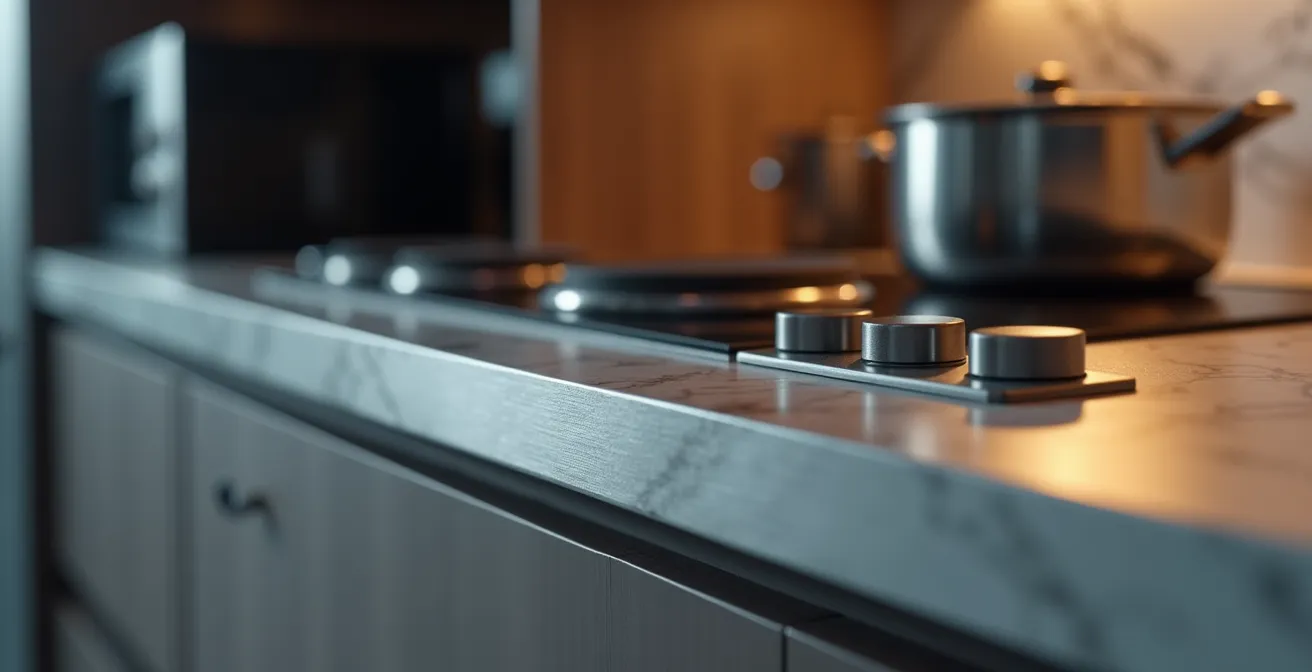
This level of detail is crucial. The difference between a real kitchen and a glorified hotel-room kitchenette is the difference between a relaxing holiday and a logistical nightmare. A proper kitchen gives you control and flexibility, saving both money and sanity.
The reality of sleeping on a pull-out couch for 7 nights
This is the central compromise of a studio apartment for a family of four. The pull-out sofa bed is presented as the solution, but it creates a cascade of problems that impact the entire holiday. Once deployed, the sofa bed consumes the entire living area, leaving virtually no walkable floor space. The room ceases to be a living room and becomes purely a bedroom. This means that once the children are asleep, the parents are trapped, unable to watch TV, talk at a normal volume, or turn on lights. Acoustic and visual privacy disappears entirely.
The morning routine is equally compromised. Everyone has to wake up at the same time, as one person getting up inevitably disturbs the others. The sofa bed must then be folded away to reclaim any living space, a daily chore that quickly becomes tedious. Furthermore, the mattress quality of a typical sofa bed is far inferior to a real bed, usually consisting of a thin 8-10cm foam pad that offers poor support for a full week’s sleep. A one-bedroom apartment completely solves these issues by creating two distinct functional zones. The living room remains a living room, parents can have a normal evening after the kids go to bed, and staggered wake-up times are possible.
The spatial trade-offs are not minor inconveniences; they fundamentally dictate the quality of your family’s downtime. The following table summarises the stark differences in daily living.
| Factor | Studio with Sofa Bed | One-Bed with Living Room |
|---|---|---|
| Floor Space When Deployed | 0-1m² walkable area | Full room remains usable |
| Privacy After 8 PM | None – shared space | Separate rooms allow normal evening |
| Morning Routine | Everyone wakes together | Staggered wake times possible |
| Storage During Day | Must fold daily or lose space | Can remain made up |
| Typical Mattress Quality | Thin foam (8-10cm) | Proper mattress (15-20cm) |
In-unit washer vs communal laundry: Which saves more holiday time?
For a family travelling light, laundry is a necessity, not a luxury. The choice between an in-unit washer and a building’s communal laundry or a local launderette is a choice between convenience and a significant logistical drain. A trip to a UK launderette is not a quick task. Factoring in travel time, waiting for a machine, the wash and dry cycles, and folding, you can easily lose 2.5 hours of precious holiday time. Moreover, the costs add up, as typical UK launderette visits cost between £8-£14 per full load, often requiring a dwindling supply of coins in an increasingly cashless society.
An in-unit washer/dryer transforms this chore into a non-event. You can run a load overnight and wake up to clean clothes, losing zero holiday time. It’s a game-changer for managing the constant flow of laundry a family generates. However, be wary of the “washer-only trap” common in UK rentals. Many apartments have a washing machine but no dryer. This leaves you with clothes airers taking up valuable living space for 24-48 hours while clothes slowly dry, a particular problem in London’s damp climate. An integrated washer-dryer combo unit is the gold standard for family travel convenience.
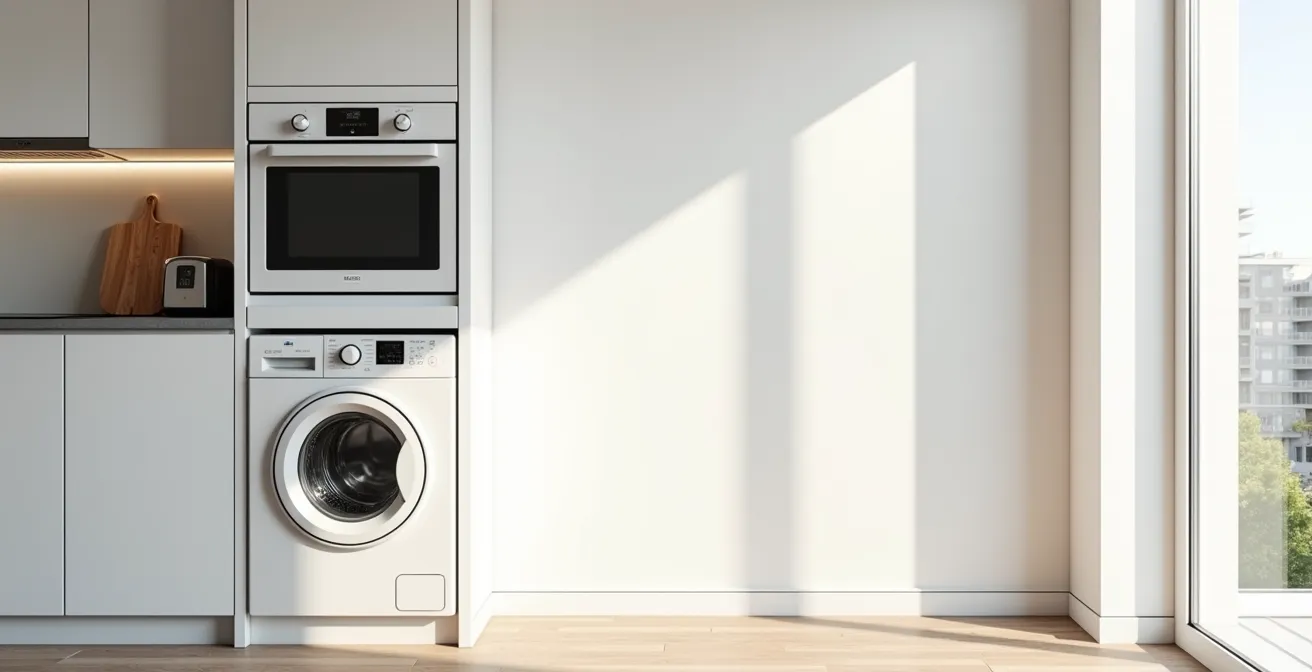
The time and energy saved by having this appliance in your apartment cannot be overstated. It allows you to pack lighter, deal with spills and accidents instantly, and keep your living space clear and functional. It’s a feature worth actively searching for and prioritising in your rental choice.
How to baby-proof a rental apartment upon arrival?
Arriving at a rental with a toddler or a crawling baby requires a quick and efficient safety audit. While dedicated family-friendly rentals may come with pre-installed gates, you can’t assume any property will be child-safe. You need a fast protocol to identify and mitigate the most common hazards found in London conversions. Unlike in many other countries, UK plug sockets have on/off switches. Your first action should be to walk the apartment and switch off all accessible sockets at the wall, providing instant protection.
Case Study: The Rise of Pre-Vetted Family Rentals
Recognising this parental anxiety, some London rental specialists are curating collections specifically for families. For instance, Home From Home, with its 30 years of experience, notes that families now actively prioritise ground-floor units or those with lift access to avoid narrow Victorian staircases. Their family-focused properties in areas like Greenwich and Holland Park are often pre-vetted to ensure features like window restrictors and stair gates are already in place, demonstrating a market shift towards providing built-in peace of mind.
Beyond sockets, focus on windows and stairs. Upper-floor flats must have restrictors on sash windows to prevent them from opening more than 10cm. Steep, narrow Victorian staircases, common in maisonettes, are a major fall risk and are rarely fitted with safety gates. Other hazards are less obvious but equally important. Heavy fire doors, standard in conversions, can cause serious finger-trapping injuries and should be propped open with a wedge. Many conversions also feature unexpected split-level floors between rooms, creating trip hazards. A quick scan and a roll of gaffer tape to secure loose wires or cover sharp furniture corners can make a huge difference.
Venice or Amsterdam: Which canal city is actually wheelchair friendly?
This title, while seeming out of place, serves as a powerful metaphor for accessibility within London’s rental market, particularly for families with a pram. You can think of London’s housing stock as falling into two categories: ‘Venice-style’ and ‘Amsterdam-style’. ‘Venice-style’ properties are the charming but challenging Victorian walk-ups in areas like Notting Hill. They are full of bridges (flights of stairs) and narrow paths (hallways), making daily life with a pram a significant physical effort. Carrying a child, a pram, and shopping up three flights of narrow stairs is a daily obstacle that quickly erodes holiday enjoyment.
In contrast, ‘Amsterdam-style’ properties are the modern, purpose-built apartment blocks often found in areas like London Bridge or Canary Wharf. These are designed for accessibility, featuring level access, lifts to all floors, and wider corridors. For a family, this means wheeling the pram directly from the street to your apartment door is effortless. As one parent noted, having a modern apartment on an upper floor with lift access made their trip manageable, a stark contrast to a previous trip battling a ‘Venice-style’ conversion. The pram, which must be stored in the main living area of a studio, becomes a constant obstacle, whereas a one-bedroom offers hallway or entrance space to keep it out of the way.
This “Pram Test” is a critical, practical filter for families. The choice of building style can have a bigger impact on your daily quality of life than the specific neighbourhood.
| Layout Type | Pram Storage Options | Living Impact |
|---|---|---|
| Studio Flat | Must keep in main living area | Blocks 30-40% of floor space when deployed |
| One-Bedroom | Hallway, bedroom, or entrance | Living space remains clear and functional |
| Ground Floor Access | Easy in/out movement | No lifting required for daily trips |
| Upper Floor Walk-up | Major daily obstacle | Requires folding or carrying up stairs |
One-pot meals: How to cook healthy food with just a microwave and hob?
Even with a limited ‘kitchenette’, you can still avoid the expense of eating out every night with some smart UK-specific meal planning. The key is to leverage the high-quality prepared foods available in British supermarkets like Marks & Spencer (M&S) or Sainsbury’s. A simple hob and microwave are all you need to assemble quick, healthy, and kid-friendly meals. Forget complex recipes; think in terms of simple assembly. For example, pre-cooked sausages or chicken can be heated on the hob in minutes, served with microwavable mash and ready-to-steam vegetable bags.
The ultimate British quick meal, beans on toast, requires only a hob and a toaster. Jacket potatoes, a national staple, can be cooked perfectly in a microwave in about 10 minutes and topped with tinned beans and grated cheese. Fresh pasta and ready-made sauces from M&S provide another 5-minute meal solution. The strategy is to minimise preparation time and maximise convenience. You can even place an online grocery order with Tesco or Sainsbury’s to be delivered on your arrival day, ensuring your fridge is stocked without wasting a moment of your holiday in a supermarket.
- Day 1: Pre-cooked sausages (hob 5 mins) with M&S microwave mash and steamed vegetable bags.
- Day 2: Jacket potatoes (microwave 10 mins) topped with Heinz beans and grated cheddar.
- Day 3: M&S fresh pasta (hob 3 mins) with ready-made sauce and a pre-washed salad.
- Emergency Backup: Keep Pot Noodles and tinned soups on hand for late-night or post-sightseeing emergencies.
Key Takeaways
- A one-bedroom apartment is superior to a studio for families, as it creates two essential functional zones for living and sleeping, preserving privacy and schedules.
- You must act as a ‘kitchen detective’ and verify the presence of a 4-ring hob, oven, and decent-sized fridge; do not trust the term ‘kitchenette’.
- Prioritise an in-unit washer-dryer and lift access (‘Amsterdam-style’ building) over a prestigious but impractical ‘Venice-style’ period conversion to minimise logistical drain.
How to make history interesting for teenagers during a cultural trip?
While the title suggests a focus on museums, the real answer for making a cultural trip successful with teenagers lies in the accommodation. After a day of sightseeing, teens need space and a degree of autonomy. A studio apartment, where they are forced to share a single room with the entire family, provides neither. It creates a pressure-cooker environment that can lead to friction. The key to a harmonious trip is providing them with their own zone for downtime, device use, and privacy.
Case Study: The Importance of ‘Two Distinct Zones’ for Teens
Analysis of family travel patterns consistently shows that for families with teenagers, one-bedroom apartments with a separate living room are essential. The ability to create ‘two distinct zones’ allows teens to decompress with their devices in the living room while parents relax in the bedroom. This separation is crucial for maintaining harmony. Choosing a flat in a safe, central area like South Kensington or Covent Garden also allows parents to grant trusted teens a short, controlled radius of independence—a trip to a nearby café, for instance—which is impossible when everyone is cooped up in one room.
This is where a one-bedroom apartment with a living room becomes invaluable. It’s not just a separate room; it’s a separate social and psychological space. As one analysis notes:
A one-bed in a safe, central area like Covent Garden or South Kensington allows parents to grant trusted teens a short radius of freedom
– London accommodation analysis, Family apartment rental considerations
This small measure of independence and privacy is often more memorable for a teenager than another historical exhibit. The right apartment layout, therefore, is not just a logistical choice but a tool for managing family dynamics and ensuring everyone, including your teens, enjoys the trip.
Now, armed with this spatial strategy, you can audit London rental listings not just by looking at photos, but by visualising your family’s daily routine within them. Prioritise the functional layout over superficial charm, and you will secure a base that enhances, rather than hinders, your London family adventure.