The secret to an incredible first Kenyan safari isn’t just seeing the Big Five; it’s mastering the overlooked logistical details before you leave the UK.
- Making informed choices about where you stay (conservancies) directly impacts your experience and local communities.
- Understanding the nuances of tipping, health precautions, and insurance is non-negotiable for a smooth, safe adventure.
Recommendation: Shift your focus from a simple packing list to a strategic plan that covers ethics, comfort, and safety—this is the key to transforming a standard holiday into a trip of a lifetime.
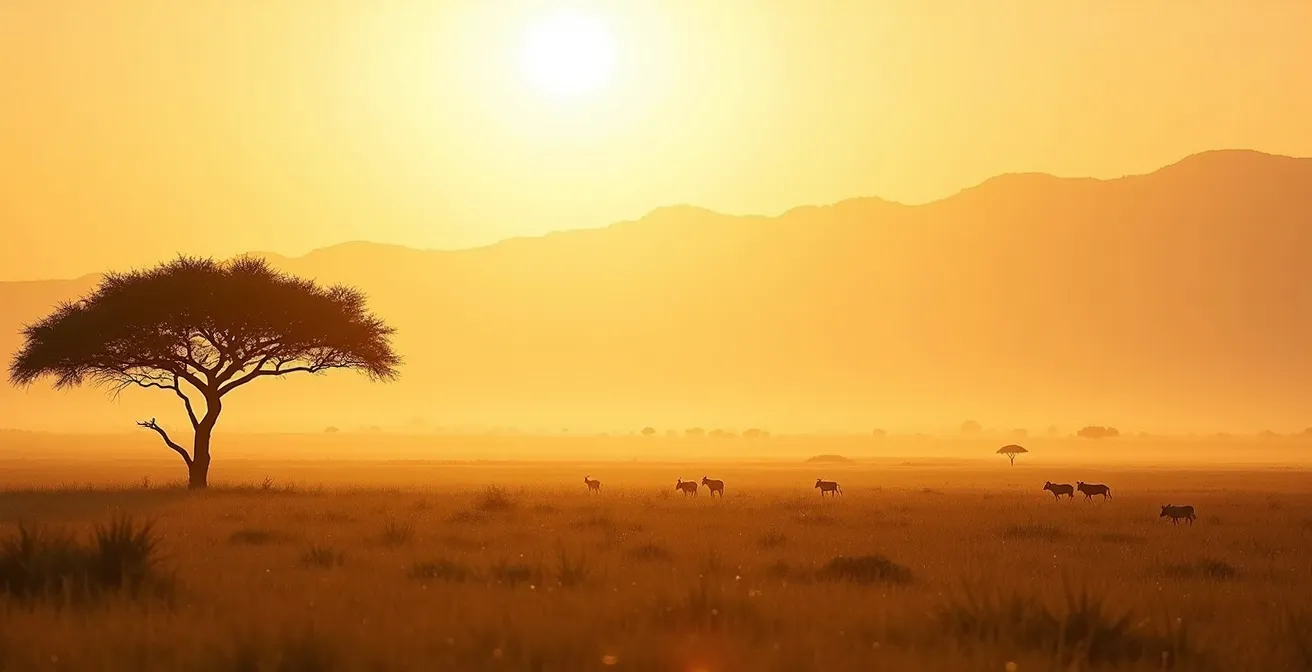
The dream of a Kenyan safari often begins with a single image: a lone acacia tree against a fiery sunset, the silhouette of a giraffe, or the thunderous sound of the Great Migration. For first-timers, especially those of you planning from the UK, the excitement is immense. You’ve got your binoculars ready and you’re mentally ticking off the Big Five. But then, the logistical reality sets in. The internet bombards you with generic advice about packing hats and sunscreen, leaving you overwhelmed with the questions that truly matter. What do you *really* need to know?
As a ranger, I’ve seen countless safaris, and the difference between a good trip and a truly life-changing one comes down to what I call ‘safari intelligence’. It’s not about the brand of your camera or the colour of your shirt (though we’ll get to that). It’s about the small, strategic decisions you make before you even board the plane at Heathrow or Gatwick. It’s about understanding the ‘why’ behind the costs, the ‘how’ of staying comfortable and healthy, and the ‘what if’ of your travel insurance.
Forget the surface-level checklists for a moment. This guide is built from years on the ground, answering the real, practical questions that transform a tourist into a savvy, respectful, and prepared traveller. We’re going to move beyond the brochure and delve into the unseen logistics—the choices about money, ethics, and personal well-being that will define your adventure. This is your insider briefing for a seamless and profound Kenyan safari experience.
This article dives into the eight critical questions that first-time safari-goers from the UK often overlook. From the financial and ethical implications of your accommodation to practical advice on health and safety, each section is designed to give you the confidence to plan your perfect journey.
Summary: Your Essential UK-Focused Kenya Safari Planning Guide
- Why pay more for a conservancy in the Masai Mara?
- Khaki or Green: Does clothing colour actually matter for animals?
- How much to tip your driver-guide per day in Kenya?
- The ‘African Massage’: How to cope with rough roads if you have back pain?
- July or October: When is the river crossing most likely to happen?
- Satellite phone or PLB: What do you really need for off-grid trips?
- Malarone vs Doxycycline: Which anti-malarial has fewer side effects?
- Is your extreme sport covered by standard travel insurance?
Why Pay More for a Conservancy in the Masai Mara?
One of the first big decisions you’ll face when planning is whether to stay in the main Masai Mara National Reserve or in an adjacent private conservancy. The price tag for conservancies is noticeably higher, and it’s fair to ask: is it worth it? The answer is a resounding yes, and it boils down to two key factors: a superior wildlife experience and a direct ethical impact. The higher cost is an investment in exclusivity and sustainability.
In a private conservancy, the number of vehicles and lodges is strictly limited. This means you escape the crowds. While a leopard sighting in the main reserve might attract dozens of vans, conservancies often limit it to a maximum of five vehicles. This creates a more intimate and respectful encounter with wildlife. Furthermore, conservancies permit activities forbidden in the national reserve, such as night game drives and guided walking safaris, offering you a completely different perspective on the African bush. You also have the freedom to drive off-road for a better angle on a sighting, a practice that is restricted in the main reserve to prevent environmental damage.
Your investment also creates a powerful, positive feedback loop for conservation and community. Many conservancies lease the land directly from local Maasai families, providing them with a stable, predictable income. This model makes wildlife a valuable asset to the community, incentivising them to protect the animals and their habitat. According to in-depth reports on conservation tourism, this direct benefit is a cornerstone of modern, sustainable safari models. The table below breaks down the key differences.
| Feature | Main Masai Mara Reserve | Private Conservancy |
|---|---|---|
| Vehicle density | Up to 100+ vehicles at river crossings | Maximum 5 vehicles per sighting |
| Night drives | Not permitted | Included |
| Walking safaris | Not allowed | Available with guide |
| Off-road driving | Restricted | Permitted for better viewing |
| Community benefit | Limited direct impact | Direct lease payments to Maasai landowners |
Ultimately, paying for a conservancy transforms your trip from a simple viewing experience into an active participation in a successful conservation model. Experts on sustainable travel confirm that in many setups, community conservancies can earn between 4% to 10% of lodge gross revenues, a vital income stream that directly links your holiday to the preservation of this incredible ecosystem.
Khaki or Green: Does Clothing Colour Actually Matter for Animals?
This is one of the most frequently asked questions, and a topic surrounded by myths. The simple answer is yes, colour matters, but not for the reason most people think. You are not trying to hide from a lion like a soldier in camouflage. Most predators, especially the big cats, rely more on scent, sound, and movement to detect prey, not colour, as their vision is different from ours. So why the strict dress code of khaki, beige, and olive green?
The real reasons are far more practical. First, it’s about not alarming the prey. Bright colours like red or yellow are unnatural in the bush and can cause skittish animals like antelope or zebra to bolt, ruining a sighting for everyone. Neutral, earthy tones simply blend into the landscape, making you a less intrusive presence. Second, and more importantly for your comfort, is avoiding certain insects. Dark colours, particularly black and dark blue, are known to attract tsetse flies, which have a painful bite. White, on the other hand, stands out starkly and will show every speck of dust within minutes on a game drive.

For UK travellers, you don’t need to buy a whole new wardrobe from a specialist store, but investing in a few key pieces is wise. The goal is comfort, practicality, and blending in. Think layers: a t-shirt, a long-sleeved shirt, and a fleece or jacket for chilly mornings and evenings. Here are some UK-specific shopping suggestions:
- Budget-Friendly: Decathlon is a great starting point for basic khaki or beige T-shirts, trousers, and fleeces, with items often priced between £15-£30.
- Mid-Range & Technical: Craghoppers, widely available online and in outdoor shops, offers the NosiLife range. This clothing has insect-repellent fabric woven in and typically costs £40-£80 per item.
- Specialist Performance: Brands like Rohan offer high-tech safari wear with features like UV protection and lightweight, quick-drying materials, with prices generally from £60 to £120.
How Much to Tip Your Driver-Guide per Day in Kenya?
Tipping is a fundamental part of the safari economy in Kenya and a topic that can cause anxiety for first-time visitors from the UK. It’s not just a bonus for good service; it forms a significant and expected portion of the income for guides, trackers, and camp staff. Understanding the etiquette shows respect and appreciation for the hard work that goes into making your safari memorable. It’s a crucial piece of ‘safari intelligence’ to get right.
The general rule is to tip your main safari guide/driver separately and then leave a collective tip for the general camp staff (chefs, housekeepers, security) in a communal tip box, usually found at reception. The widely accepted currency for tipping is USD, and it is crucial to bring crisp, clean, modern notes, as torn, old, or marked bills can be difficult for locals to exchange. While Kenyan Shillings (KES) are fine for small purchases, USD is the standard for the safari industry.
So, how much is appropriate? While it’s always at your discretion, there are established guidelines that are helpful for budgeting. A common recommendation is $10-15 USD per person, per day for your guide. If you are travelling as a couple, that would be $20-30 per day for the guide. It’s customary to give this tip directly to your guide in an envelope at the very end of your time with them. The following table, based on recommendations from established Africa travel specialists, provides a solid framework.
| Staff Member | Recommended Tip (per day) | Currency |
|---|---|---|
| Safari Guide/Driver | $10-15 per person | USD (pristine notes) |
| Lodge/Camp Staff | $5-10 per couple | USD or KES |
| Game Tracker | $10 per person | USD |
| Porter | $5 per bag | USD or KES |
| Transfer Driver | $5 per couple | USD or KES |
Planning for tips is as important as budgeting for park fees. It’s a direct way to thank the individuals who work tirelessly behind the scenes and on the front lines to ensure you have an incredible and safe experience. If you are travelling in a group, it’s common to pool your money together for the main guide’s tip.
The ‘African Massage’: How to Cope with Rough Roads if You Have Back Pain?
Game drives in Kenya are an adventure, but let’s be frank: the tracks inside the parks are not the M25. The bumpy, unpaved roads are affectionately known as the ‘African Massage’. While this is part of the authentic experience, for anyone with a history of back pain or a sensitive disposition, it can be a source of genuine concern. However, with a bit of proactive preparation—what I call building ‘traveler resilience’—you can absolutely enjoy the ride without paying for it later.
Your first step should be communication. When you book your safari from the UK, inform your tour operator about your back concerns. They can often make small but significant adjustments. Ask about the age and suspension of their vehicles—a well-maintained Land Cruiser with good suspension makes a world of difference. You should also request a seat in the middle row of the vehicle. The seats over the rear axle are invariably the bumpiest, while the front passenger seat can sometimes feel a bit cramped. The middle row offers the best balance of stability and viewing.
Beyond that, a few key items in your luggage can be lifesavers. You don’t need a lot, but the right support can transform your comfort levels on long game drives. A small inflatable lumbar pillow takes up almost no space but provides excellent support when wedged behind your lower back. Similarly, a simple back brace can provide stability during the bumpiest sections. Don’t let a physical concern put you off the trip of a lifetime; just plan for it.
Your Action Plan: Preparing for the ‘African Massage’
- Communicate Proactively: When booking, inform your operator about your back issues and specifically request middle-row seating. Ask about their vehicle’s suspension.
- Pack Smart Supports: Purchase a Therm-a-Rest inflatable lumbar pillow (from Cotswold Outdoor) and a Mueller adjustable back brace (from Boots or Amazon UK) before you leave. A memory foam seat cushion is also an excellent addition.
- Include Anti-inflammatories: Pack non-prescription painkillers like Ibuprofen or paracetamol as a precaution, but consult your GP before you travel about what’s best for you.
- Stay Active & Stretch: During breaks in your game drive, get out, walk around, and do some gentle back stretches to keep your muscles from seizing up.
- Manage Your Ride: On particularly rough patches, engage your core muscles and use the grab handles to lift yourself slightly off the seat, letting your legs absorb the shock.
July or October: When is the River Crossing Most Likely to Happen?
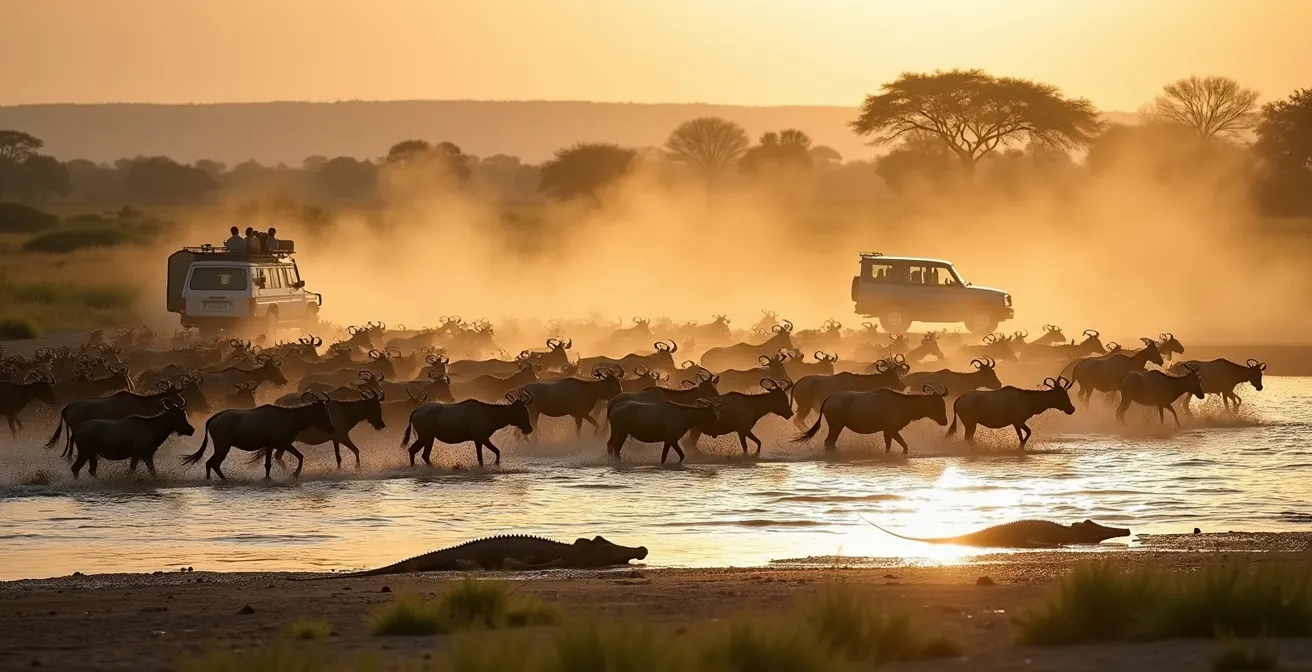
The Great Wildebeest Migration is one of Earth’s most spectacular wildlife events, and its dramatic climax is the Mara River crossing. Many first-timers from the UK plan their entire trip around seeing this, but there’s a common misconception about the timing. The migration isn’t a single event but a year-round cycle. The vast herds are generally in the Masai Mara from late July through October. However, if your heart is set on witnessing a river crossing, you need to understand the nuance of “peak experience timing.”
A river crossing is not a scheduled event. It’s a chaotic, desperate, and instinct-driven spectacle that can happen at any time, or not at all. The herds can mass at the river’s edge for days, teasing and turning back, before one brave individual finally takes the plunge, triggering a cascade of thousands behind it. Your chances of seeing this are a combination of luck and strategic timing. While crossings can occur anytime the herds are in the Mara, your probability increases significantly later in the season.
As the grazing thins out in the Mara, the pressure to return south to the Serengeti’s fresh grasses in Tanzania builds. This desperation often fuels the most dramatic crossings. While July and August are peak season due to UK school holidays, with high visitor numbers, the most intense crossing activity is often observed later. Indeed, wildlife travel experts note that if you want to catch the height of the drama, visiting during September and early October often sees the most dramatic river crossings. This period can also be slightly less crowded than the August peak.
Patience is your greatest asset. A good guide will know the likely crossing points and will be happy to wait with you, engine off, for hours if necessary. It’s a game of patience, but the reward—the raw, untamed power of nature unfolding before your eyes—is an experience that will stay with you forever.
Satellite Phone or PLB: What Do You Really Need for Off-Grid Trips?
In an age of constant connectivity, the thought of being completely ‘off-grid’ can be both liberating and daunting. While most established safari camps and lodges in Kenya have Wi-Fi (albeit slow at times), once you are out in the vehicle, mobile phone signal is patchy at best and non-existent in remote areas. This leads to the question: do you need a satellite phone or a Personal Locator Beacon (PLB) for safety?
For the vast majority of first-time visitors from the UK on a standard, guided safari, the answer is no. Your vehicle will be equipped with a long-range radio, and your guide is in constant contact with the lodge and other vehicles. They are your lifeline and have robust emergency protocols in place. Bringing your own device is often an unnecessary expense and complication. The need for personal satellite communication arises only in very specific circumstances, such as undertaking an unsupported walking safari in a remote region or embarking on a fully independent self-drive expedition.
If you do fall into that niche category, the choice between a PLB and a satellite phone depends on your needs. A PLB is a one-way emergency device. When activated, it sends an SOS signal with your GPS coordinates to a global rescue coordination centre. It’s for life-threatening situations only. A satellite phone, on the other hand, allows for two-way communication, letting you make calls or send texts from anywhere. It’s for when you need to communicate, not just call for rescue. For UK travellers, renting this equipment is the most cost-effective option, and it’s essential to understand the differences.
This comparative analysis, with costs relevant for UK travellers, highlights the distinct functions of each device as detailed by specialists in remote travel safety.
| Feature | Personal Locator Beacon (PLB) | Satellite Phone |
|---|---|---|
| UK Rental Cost (2 weeks) | £80-120 | £150-250 |
| Purchase Price | £250-400 | £800-1500 |
| Function | Emergency SOS only | Two-way voice/text communication |
| UK Registration | Required (Maritime & Coastguard Agency) | Not required |
| Best for | Remote unsupported treks | Guided safaris with communication needs |
Remember, for 99% of guided safaris, your operator has this covered. Trust in their expertise and equipment. Over-preparing with unnecessary tech can add weight to your luggage and a needless layer of complexity to your trip.
Malarone vs Doxycycline: Which Anti-Malarial Has Fewer Side Effects?
Let me be clear from the outset: I am a safari ranger, not a medical professional. The information here is for guidance based on common traveller experiences, but it is absolutely essential that you consult your GP or a travel clinic in the UK well in advance of your trip. They can provide advice based on your personal medical history and the most up-to-date NHS guidelines. That said, malaria is a serious risk in many parts of Kenya, and prevention is a critical part of your ‘traveler resilience’ plan.
Prevention is a two-pronged attack: avoiding bites and taking prophylactic medication. For avoiding bites, especially during the dusk and dawn hours when mosquitoes are most active, you should use an effective insect repellent. Look for products containing at least 50% DEET for maximum protection. You can also treat your clothing with a Permethrin spray before you leave the UK. This adds another layer of defence.
- Top DEET Repellents: Jungle Formula Maximum Strength (available at Boots) or Lifesystems Expedition 50+ (from stores like Cotswold Outdoor).
- Natural Alternative: Incognito Natural Spray, which is PMD-based, is a popular choice available at Holland & Barrett.
- Clothing Treatment: Permethrin clothing spray can be bought from retailers like Millets or online and should be applied to your clothes and allowed to dry before packing.
When it comes to medication, the two most common choices prescribed in the UK are Malarone and Doxycycline. They differ significantly in cost, side effects, and how long you need to take them after your trip. This comparison of anti-malarials outlines the key considerations for travellers.
| Medication | UK Cost (per tablet) | Key Side Effects | Duration After Trip |
|---|---|---|---|
| Malarone | £3-4 (private only) | Minimal, vivid dreams | 7 days |
| Doxycycline | £0.30-0.50 (NHS possible) | Sun sensitivity (critical in Kenya) | 28 days |
Malarone is often preferred as it generally has fewer side effects, though it is more expensive and only available on private prescription. The key side effect for Doxycycline is photosensitivity, which can be a major issue in the strong equatorial sun of Kenya, increasing the risk of severe sunburn. Your doctor will help you weigh these factors to make the best choice for you.
Key Takeaways
- Investing in a conservancy stay elevates your safari from a simple holiday to an exclusive experience that actively supports conservation.
- Practical preparation for health (malaria) and comfort (bumpy roads) is not optional; it is the foundation of a successful and enjoyable trip.
- Your standard UK travel insurance may not cover safari activities; verifying your policy and checking FCDO advice is a final, critical step.
Is Your Extreme Sport Covered by Standard Travel Insurance?
This is the final, and arguably most important, piece of your planning puzzle. You’ve booked the flights, chosen the lodge, and planned your anti-malarials. But have you read the small print on your travel insurance? Many travellers from the UK assume their standard annual policy will cover them, but a Kenyan safari often falls into a grey area. Activities you consider a normal part of the holiday, like a hot-air balloon ride over the Mara, or even a simple walking safari, can be listed as ‘hazardous activities’ or ‘extreme sports’ and may be excluded from a basic policy.
The first step is to sit down with your current policy document. Use the search function to look for keywords like ‘safari’, ‘hot-air ballooning’, ‘walking safari’, ‘game drives’, and check the general exclusions section. You may be surprised at what you find. If the cover is ambiguous or absent, you must contact your insurer for clarification in writing or upgrade your policy. Going on safari without adequate medical cover, including medical evacuation, is an unacceptable risk. The cost of an air ambulance from a remote part of Kenya to a hospital in Nairobi can be astronomical.
Furthermore, your entire policy could be invalid if you travel against government advice. As a UK citizen, this means you must always check the Foreign, Commonwealth & Development Office (FCDO) website for their current advice on travel to Kenya before you purchase insurance and before you depart.
Your UK travel insurance is likely void if the FCDO (Foreign, Commonwealth & Development Office) advises against travel to your destination.
– Travel Insurance Expert, UK Safari Insurance Guide
If your current provider can’t offer the cover you need, there are specialist UK insurers who understand the specific risks of a safari. They provide comprehensive policies designed for this kind of adventure. Here are a few to research:
- Battleface: A specialist in adventure and remote travel, their policies typically cover all standard safari activities.
- Campbell Irvine: Long-established and well-regarded for their comprehensive safari insurance, which includes medical evacuation as standard.
- True Traveller: A good option for those who want to add specific adventure packs to a standard policy, including cover for balloon safaris.
Frequently Asked Questions About Kenya Safari Logistics
Do I need to register a PLB before leaving the UK?
Yes, you MUST register your PLB with the UK’s Maritime and Coastguard Agency (MCA) before travel. This links the device’s SOS signal to your personal details, which is crucial for rescuers in an emergency.
Which UK companies rent satellite equipment?
Major UK rental companies include Cellhire and GTC (Global Telesat Communications). It’s wise to compare prices as rental rates can vary significantly, often from £10-£20 per day plus call charges.
Is a satellite phone necessary for guided safaris?
For most guided safaris, it’s not necessary. Your tour operator and guide will have robust emergency communication systems, such as long-range radios. A satellite phone is more useful for independent travellers or those on expeditions who need to stay in regular contact with home or work from remote areas.