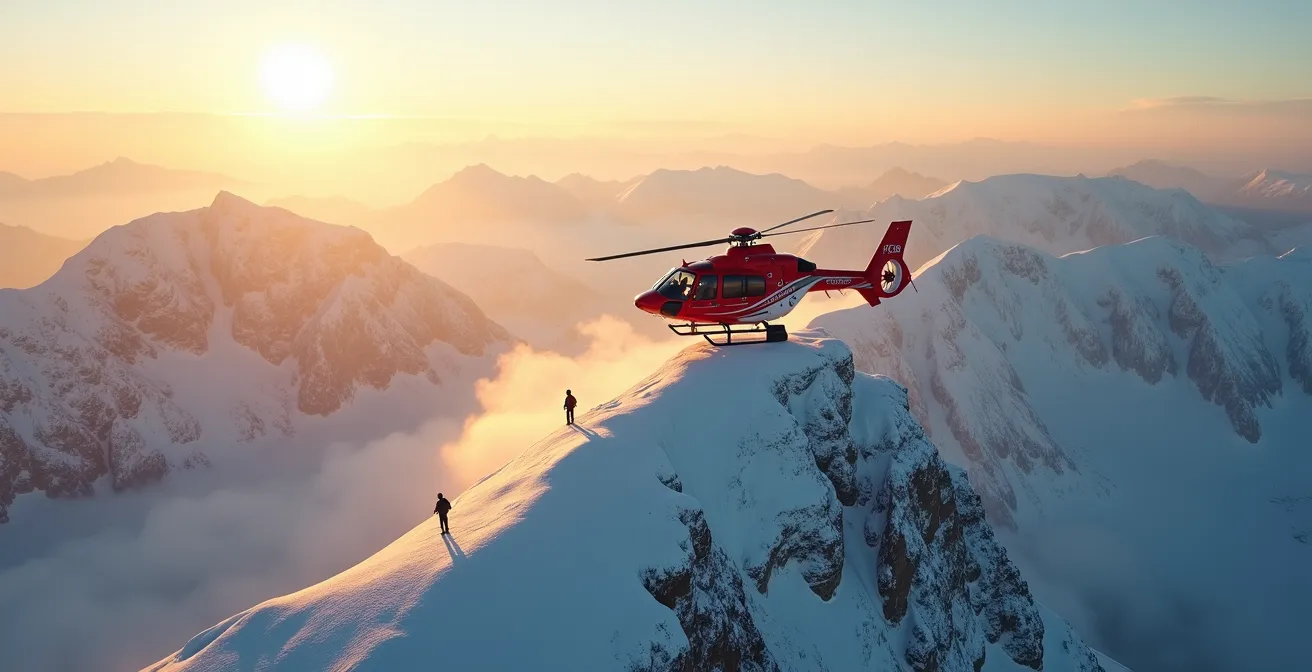
Believing your travel insurance ‘covers’ your extreme sport is a dangerous assumption; the real risk is not the activity itself, but having your coverage voided by a minor mistake.
- Coverage can be instantly nullified by simple errors, such as ignoring a guide’s advice or using the wrong type of emergency communication device.
- The ‘free’ mountain rescue you’re accustomed to in the UK can cost over £10,000 in the Alps—a bill you will pay personally if your claim is deemed invalid.
Recommendation: Stop asking ‘is my sport covered?’ and start asking ‘do I understand the exact rules I must follow to keep my coverage valid?’
The thrill of pushing your limits in a remote location is a powerful draw. You’ve invested in the gear, trained for the challenge, and booked the trip. The last thing on your mind is the dense legal jargon of a travel insurance policy. Many adventure seekers operate under the fatal assumption that once they’ve ticked the “adventure sports” box, they are fully protected. This is a critical error in judgment. Standard travel insurance is almost always insufficient, and even specialist policies are not a blanket guarantee of safety or financial protection.
The common advice is to “get specialist cover” and “read the fine print,” but this guidance is dangerously superficial. It fails to address the core issue: a specialist policy is a contract that places strict obligations on you, the policyholder. Your coverage is contingent on your behaviour. The real danger isn’t just getting injured; it’s getting injured and discovering that your own actions—or inactions—have rendered your multi-million-pound policy completely worthless, leaving you personally liable for a catastrophic bill.
This assessment is not about discouraging adventure. It is about shifting your perspective from that of a casual tourist to a calculated risk manager. We will dissect the mechanisms by which insurance claims are denied and coverage is voided. By examining specific scenarios, from altitude sickness and diving certifications to helicopter rescues and equipment choice, you will learn to identify the hidden liabilities. This guide will provide the framework to ensure your policy actually performs when you need it most, transforming it from a piece of paper into a reliable safety net.
This article provides a critical risk assessment of common scenarios where adventurers find their insurance coverage is not what they assumed. Explore the specific points of failure to ensure you are genuinely protected on your next trip.
Summary: A Risk Assessor’s Guide to Extreme Sports Insurance
- Diamox vs Descent: How to react when a headache starts at 3000m?
- PADI vs SSI: Does the diving certification agency matter for safety?
- Helicopter rescue: Who pays the £10,000 bill if you break a leg?
- How to vet a bungee jump operator in a developing country?
- Satellite phone or PLB: What do you really need for off-grid trips?
- How to prepare for a solo hike in the Scottish Highlands without getting lost?
- The danger of picking mushrooms without a guide
- Why does the GHIC card not replace travel insurance?
Diamox vs Descent: How to react when a headache starts at 3000m?
The onset of a headache at high altitude is not just a discomfort; it is a critical warning sign and your first test of insurance compliance. Acute Mountain Sickness (AMS) can progress rapidly, and your reaction is scrutinised by insurers. The prevailing medical advice is unequivocal: the most effective treatment for AMS is immediate descent. Pushing onward, even after taking medication like Diamox (acetazolamide), can be interpreted as acting against medical advice. This is a crucial point; UK travel insurers will often include clauses that void your coverage if you fail to act on a clear medical imperative.
According to NHS guidance, symptoms like a headache, nausea, and fatigue are hallmarks of AMS. If a guide, a doctor, or even common sense dictates you should descend, refusing to do so can have severe financial consequences. An insurer could argue that by continuing your ascent, you wilfully increased the risk, thereby breaking the terms of your contract. This would mean a subsequent, more expensive emergency evacuation might not be covered. The choice is not simply between a pill and turning back; it is a decision that directly impacts your financial liability.
The only correct course of action, from both a medical and insurance standpoint, is to stop, inform your guide, and descend immediately until symptoms improve. Medication is a preventative tool, not a cure to be used to push physical limits against medical advice.
Action Plan: UK Traveller’s Medical Consultation for Altitude Sickness
- Book a consultation with a UK travel clinic 4-8 weeks before your departure to discuss altitude plans.
- Obtain a private prescription for Diamox (125mg twice daily), as the NHS does not cover preventative travel medication.
- Trial Diamox at home for 2 days before travelling to check for any adverse side effects and report them.
- Begin the medication 24-48 hours before you plan to ascend above 2,500 metres.
- Continue taking the medication for at least 2 days at your highest altitude or until you are fully acclimatised.
PADI vs SSI: Does the diving certification agency matter for safety?
For scuba divers, the brand on your certification card—be it PADI, SSI, or BSAC—is less important to an insurer than the numbers printed on it. While research from Defaqto shows that 97% of UK single-trip travel insurance policies cover scuba diving, this statistic hides a critical reality. Coverage is not a simple yes/no; it is tiered and strictly limited by the depth and type of diving specified in your policy and for which you are certified.
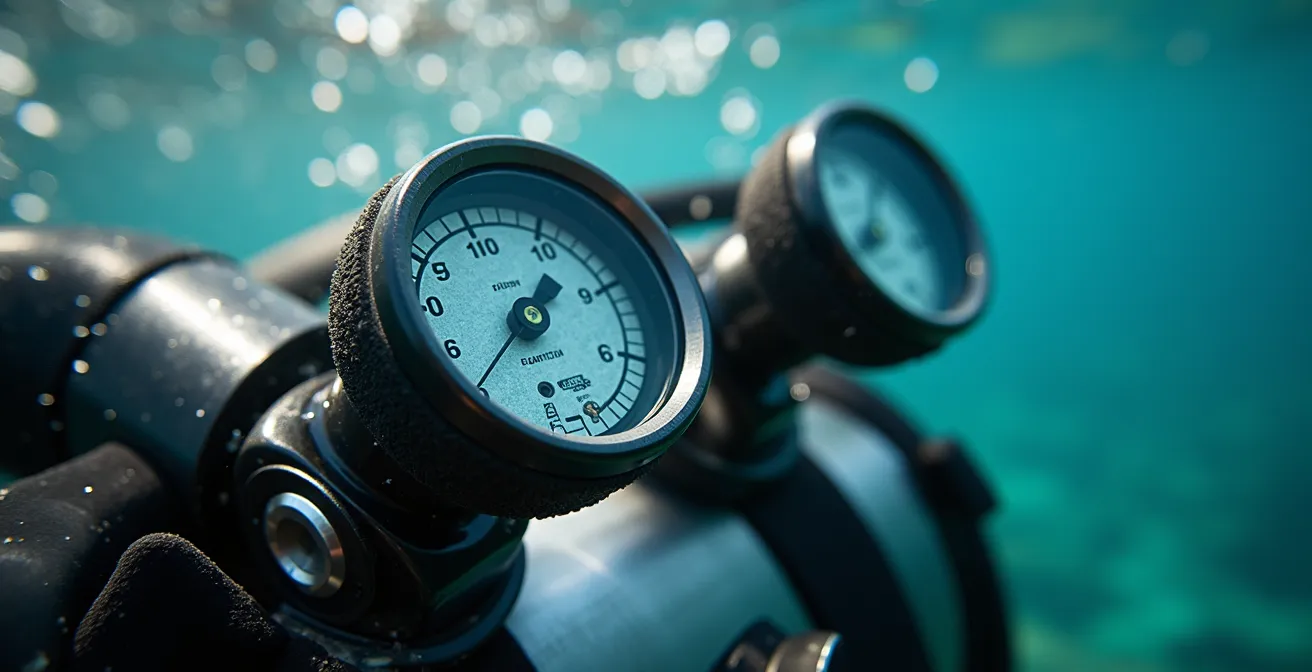
A standard Open Water certification typically qualifies you to dive to 18 metres. If your policy covers you for this depth but you have an accident at 25 metres, your claim will almost certainly be rejected. The insurer’s position is clear: you were operating outside the bounds of your training and your policy’s specific terms. It is your responsibility to ensure your policy’s depth limit matches or exceeds the depth of your planned dives. Furthermore, activities like solo diving, cave diving, or diving with enriched air (Nitrox) often require specific add-ons or separate policies entirely.
The following table illustrates how different certification bodies are generally perceived by UK insurers, but remember, the ultimate arbiter is the specific depth and activity wording in your individual policy document.
| Certification Body | UK Insurer Recognition | Depth Limit Coverage | UK-Specific Requirements |
|---|---|---|---|
| PADI | Widely accepted | 18m (Open Water) | Standard coverage |
| SSI | Widely accepted | 18m (Open Water) | Standard coverage |
| BSAC (British Sub-Aqua Club) | Preferred for UK waters | 20m (Ocean Diver) | Often required for UK cold water diving |
Helicopter rescue: Who pays the £10,000 bill if you break a leg?
For any UK-based hillwalker or climber, the sight of a rescue helicopter is a welcome one, backed by the knowledge that Mountain Rescue services in England, Wales, and Scotland are free at the point of use. This creates a dangerously complacent mindset when travelling abroad. The moment you step into the French Alps, the Dolomites, or the Rockies, that safety net vanishes. A helicopter rescue is no longer a public service; it is a private commercial transaction with a staggering price tag.
A seemingly simple incident, like a broken leg from a fall while skiing or hiking, can trigger a chain of costs that quickly escalate. You are not just paying for a flight; you are billed for every component of the rescue operation. A typical invoice for a mountain rescue in the French Alps could include itemised charges for helicopter flight time (€3,500), a specialist winch operator (€1,200), an on-board doctor (€800), and the ground support team (€1,500). The total bill can easily surpass £7,000 before you even reach the hospital.
This is where your travel insurance is supposed to step in. However, if your claim is invalid for any reason—perhaps you were skiing off-piste against resort rules, or you ignored weather warnings—you are personally and solely responsible for this entire bill. The financial consequences of a voided policy are not abstract; they are itemised, invoiced, and legally enforceable. A stark contrast exists for adventurers, as a £10,000+ Alpine rescue is a common scenario, unlike the free service in the UK.
How to vet a bungee jump operator in a developing country?
The temptation of a cheap thrill can be overwhelming, but vetting an adventure sports operator, especially in a country with lax regulatory oversight, is a non-negotiable part of your risk management. Your insurance policy is not a substitute for due diligence. In fact, your insurer expects you to act with reasonable caution. Choosing an obviously unsafe operator could be deemed “reckless behaviour,” a term that insurers use to deny claims.
As travel insurance expert Alvaro Iturmendi from Confused.com warns, your actions are under scrutiny. He states:
If you injure yourself due to behaviour your insurer considers reckless, you probably won’t be covered.
– Alvaro Iturmendi, Confused.com Travel Insurance Expert
This means the responsibility is on you to perform a basic safety assessment. Before handing over your money, you must actively look for signs of professionalism and safety compliance. A reputable operator will have clear safety protocols, well-maintained equipment, and staff who can answer questions confidently. Your pre-activity checklist should be as much about assessing the operator’s competence as it is about your own readiness.
Here are critical steps to take before committing to an activity with a local operator:
- Check if the operator is used by major UK adventure travel companies like Explore!, Exodus, or G Adventures, as they perform their own safety audits.
- Document your attendance at the safety briefing with photos or videos, which can serve as evidence in an insurance claim.
- Verify that equipment inspection certificates are publicly displayed and are current.
- Ask if their operational standards are similar to UK Health & Safety Executive (HSE) guidelines.
- Cross-reference the activity and location with the latest FCDO travel advice for specific country-related warnings.
- Photograph all waivers and safety documentation you sign before participating.
Satellite phone or PLB: What do you really need for off-grid trips?
Entering an area with no mobile signal fundamentally changes your risk profile. Your ability to communicate in an emergency becomes your most critical piece of equipment. The choice between a Personal Locator Beacon (PLB) and a satellite phone is not just about technology; it’s about understanding how the rescue and insurance chain is activated. Both devices can save your life, but they function very differently from an insurer’s perspective.
A PLB is a one-way distress signal. When activated, it sends an emergency alert via satellite to a government-run coordination centre, like the UK’s Mission Control Centre (UKMCC), which then initiates a search and rescue operation. It is a simple, robust, last-resort tool. A satellite phone, however, allows for two-way communication. This is a crucial distinction for insurers. It allows you to speak directly to your insurer’s 24/7 emergency assistance line to explain your situation, get medical advice, and, most importantly, allow them to pre-authorise costs. This can be the difference between a smoothly coordinated rescue and a logistical and financial nightmare.
Even within the UK, extensive mobile blackspots in areas like the Scottish Highlands make these devices essential, not just for international expeditions. Choosing the right device depends on your trip and your insurance policy’s requirements.
| Feature | PLB (Personal Locator Beacon) | Satellite Phone |
|---|---|---|
| Emergency Signal | Goes to UK Mission Control Centre (UKMCC) | Direct call to insurer’s 24/7 line |
| UK Rental Cost | £40-60/week | £75-150/week |
| Insurance Preference | Basic emergency only | Preferred – allows pre-authorisation |
| Scottish Highlands Use | Essential for remote areas | Recommended for coordination |
How to prepare for a solo hike in the Scottish Highlands without getting lost?
Venturing into the wilderness alone carries a heightened level of risk that insurers scrutinise closely. While solo hiking is a rewarding experience, it removes the safety net of a group. Insurers often have specific clauses relating to solo activities, and failure to demonstrate adequate preparation can be grounds for denying a claim. As one policy from Compare the Market notes, coverage may be invalid if “for certain activities, you weren’t part of an organised group or accompanied by a guide or instructor.”
To counteract this, a solo hiker must be able to prove that they took extraordinary measures to mitigate risk. This is not just about carrying a map and compass; it’s about creating a documented trail of meticulous planning that can be presented to an insurer if something goes wrong. In the UK, authorities like Police Scotland have formalised this process. Submitting a route plan is not just good practice; it’s a way of officially logging your intentions and creating a framework for a timely rescue if you become overdue.
Your preparation must be methodical and verifiable. Before a solo hike in an area like the Scottish Highlands, you must complete the following steps:
- Access detailed forecasts from the Mountain Weather Information Service (MWIS).
- Check the Scottish Avalanche Information Service (SAIS) if undertaking a winter hike.
- Complete the Police Scotland online route card with exact timings, waypoints, and equipment details.
- Share the detailed route plan with a reliable emergency contact, including your expected time of return.
- Instruct your contact to call 999, ask for Police, then Mountain Rescue if you are significantly overdue.
- Leave a physical copy of your route plan visible in your vehicle at the trailhead to assist potential search teams.
The danger of picking mushrooms without a guide
While it may not seem as “extreme” as skydiving, foraging for wild food like mushrooms falls into a category of risk that insurers view with caution. The danger is not from falling, but from poisoning. The misidentification of a single mushroom can lead to severe illness, organ failure, or death, resulting in substantial medical and repatriation costs. From an insurer’s perspective, this is an unquantifiable risk unless you can prove you have taken steps to mitigate it through proper training.
Specialist insurers may cover a vast range of activities, with some policies listing over 156+ activities covered by specialist extreme sports policies, but this coverage is always conditional. For an activity like foraging, an insurer will want to see evidence of “due diligence.” Simply wandering into a forest with a basket is a gamble they are unwilling to underwrite. You must demonstrate that you have converted an uninformed risk into a managed activity.
To ensure any potential medical claim related to foraging is not rejected, you must follow a strict safety protocol. This involves seeking formal training and being able to document it:
- Book a course with a certified instructor from a reputable body like The Association of Foragers.
- Verify that the course provider has their own public liability insurance.
- Check that the foraging location legally permits picking (avoiding Sites of Special Scientific Interest – SSSIs).
- Document your participation in the safety briefing and the course itself.
- Keep your course certificate as proof of your competence and due diligence for your insurer.
- Know the contact details for the National Poisons Information Service in case symptoms occur post-consumption.
Key Takeaways
- Your insurance policy is a strict contract; violating its terms, even unintentionally, can lead to a void claim and massive personal debt.
- The cost of emergency services abroad is not subsidised. A helicopter rescue you get for free in Scotland can cost you over £10,000 in Europe.
- Due diligence is your responsibility. You must vet operators, check equipment, follow medical advice, and document your preparations to prove you have not been reckless.
Why does the GHIC card not replace travel insurance?
There is a persistent and perilous misunderstanding among UK travellers that the Global Health Insurance Card (GHIC) is a form of travel insurance. It is not. The GHIC provides access to state-provided healthcare in EU countries at the same cost as a local resident. While valuable, it is dangerously inadequate for anyone engaging in adventure sports, for several critical reasons.
The GHIC’s limitations are starkly exposed in an emergency. It does not cover mountain rescue, private medical clinic fees, or, most critically, medical repatriation back to the UK. The cost of an air ambulance to bring an injured person home can run into tens of thousands of pounds, a cost the GHIC will never cover. Specialist travel insurance policies, by contrast, are designed to cover these exact eventualities, with leading UK extreme sports insurers now providing up to £10 million for emergency medical and repatriation coverage.
Consider the scenario of a skiing accident in Austria. The table below illustrates the gaping holes in GHIC coverage that only a comprehensive travel insurance policy can fill.
| Coverage Item | GHIC Coverage | Travel Insurance Coverage |
|---|---|---|
| State hospital bed | ✓ Covered | ✓ Covered |
| Mountain rescue | ✗ Not covered | ✓ Up to £10,000 |
| Private clinic fees | ✗ Not covered | ✓ Covered |
| Repatriation flight to UK | ✗ Not covered | ✓ Up to £2 million |
| UK physiotherapy follow-up | ✗ Not covered | ✓ Often included |
| Lost ski pass replacement | ✗ Not covered | ✓ Up to £500 |
The consistent theme is clear: insurance is not a magical shield. It is a system of rules that you must understand and adhere to. The ultimate responsibility for your safety, and for ensuring your financial protection remains valid, rests with you. This requires a fundamental shift in mindset from passive tourist to active risk manager. Before your next adventure, scrutinise your policy not for what it covers, but for what it demands of you. Your life, and your life’s savings, may depend on it.