
For a safety-conscious traveller arriving in a high-risk South American city at night, the £50 premium for a private transfer is not a cost of convenience, but a calculated investment in risk mitigation.
- Rideshare services introduce multiple “failure points,” including driver cancellations after long waits, luggage incompatibility, and significant safety vulnerabilities in unregulated environments.
- A pre-booked transfer eliminates uncertainty regarding price, driver identity, vehicle suitability, and wait times, drastically reducing your cognitive load upon arrival.
Recommendation: The certainty, security, and accountability offered by a licensed private transfer service far outweigh the monetary savings of a rideshare for high-stakes arrivals.
Landing in a bustling South American airport late at night presents a unique set of challenges. After a long-haul flight, your immediate priority is a safe and seamless journey to your accommodation. The price difference is stark: a ride-hailing app like Uber might quote a fare that looks incredibly tempting, often £50 or more cheaper than a pre-booked private transfer. The decision appears to be a simple trade-off between cost and convenience. However, from a security risk perspective, this is a dangerously simplistic view.
The common advice to “just grab an Uber” or “negotiate with a local taxi” fails to account for the hidden variables and potential failure points that can turn a simple airport pickup into a high-stress, or even high-risk, situation. The real question is not about saving money, but about managing uncertainty. This analysis moves beyond the surface-level cost comparison. Instead, we will dissect the journey from a risk consultant’s viewpoint, evaluating the specific vulnerabilities that arise when opting for a seemingly cheaper service in an unfamiliar environment. We will assess whether that £50 is merely for comfort, or if it buys you something far more valuable: certainty and security.
This guide breaks down the critical factors that should inform your decision. By examining common scams, logistical challenges, and the stark differences in service policies, you will be equipped to make a decision based on a comprehensive risk assessment, not just a price tag.
Contents: A risk-based comparison
- The ‘broken meter’ trick: How to spot a rogue driver at arrivals?
- Ski bags and golf clubs: Will they fit in a standard Uber XL?
- Meet & Greet service: Why is it essential for non-English speakers?
- Waiting time policies: Does your driver leave if the flight is 2 hours late?
- The law vs reality: Can you get a guaranteed rear-facing seat in a taxi?
- Which taxi scams cost tourists £50+ in major capital cities?
- How to insure a £2,000 camera when standard limits are £250?
- Navigating the Tokyo Metro: How to avoid getting lost in Shinjuku station?
The ‘broken meter’ trick: How to spot a rogue driver at arrivals?
One of the most common risks at any major international airport is the prevalence of rogue drivers and taxi scams. The ‘broken meter’ is a classic tactic, but the modern equivalent in the rideshare world involves app manipulation, inflated cash demands, and navigating chaotic, poorly-lit pickup zones. In some cities, the situation is more acute; for instance, at Buenos Aires airports, Uber users have reported facing harassment from local taxi unions, often being forced to sit in the front seat to avoid detection, which immediately flags them as operating in a ‘sketchy’ grey area. This is not the low-stress start to a trip you envision.
The primary difference lies in the vetting process and accountability. A private transfer driver is a licensed professional employee of a registered company. Their identity is known, their vehicle is tracked, and the price is fixed in pounds sterling before you even leave the UK. This removes all ambiguity. In contrast, a rideshare driver is a gig-economy worker with varying levels of professional commitment. The table below, based on service comparisons in the region, highlights the fundamental differences in reliability.
| Service Type | Wait Time | Price Certainty | Driver Verification |
|---|---|---|---|
| Uber | 30-90 minutes | Surge pricing common | App verification only |
| Private Transfer | 0 minutes (pre-arranged) | Fixed price in GBP | Licensed & insured |
| Airport Taxi | Variable queue | Negotiable/meter | Official badge required |
Furthermore, recent traveller reports indicate that wait times for Ubers at major South American airports can range from 30 to 90 minutes, a significant “failure point” when you are tired and exposed in an unfamiliar public space. A rogue driver can be spotted by their insistence on operating outside the app, demanding cash upfront, or claiming the pre-agreed fare is incorrect. A private transfer eliminates this risk entirely by removing the transaction from the equation at the point of service.
Ski bags and golf clubs: Will they fit in a standard Uber XL?
For travellers with oversized luggage such as ski bags, golf clubs, or multiple large suitcases, the choice of vehicle is not a matter of comfort but of necessity. While ride-hailing apps offer larger vehicle options like an ‘Uber XL’, there is a critical element of uncertainty: you have no guarantee of the exact model or its actual capacity until it arrives. An ‘XL’ could be a spacious minivan or a compact SUV with limited practical trunk space, especially for awkwardly shaped sports equipment. This gamble can result in a significant problem on the kerbside: a driver who cannot fit your luggage and is forced to cancel, leaving you to restart the booking process under pressure.
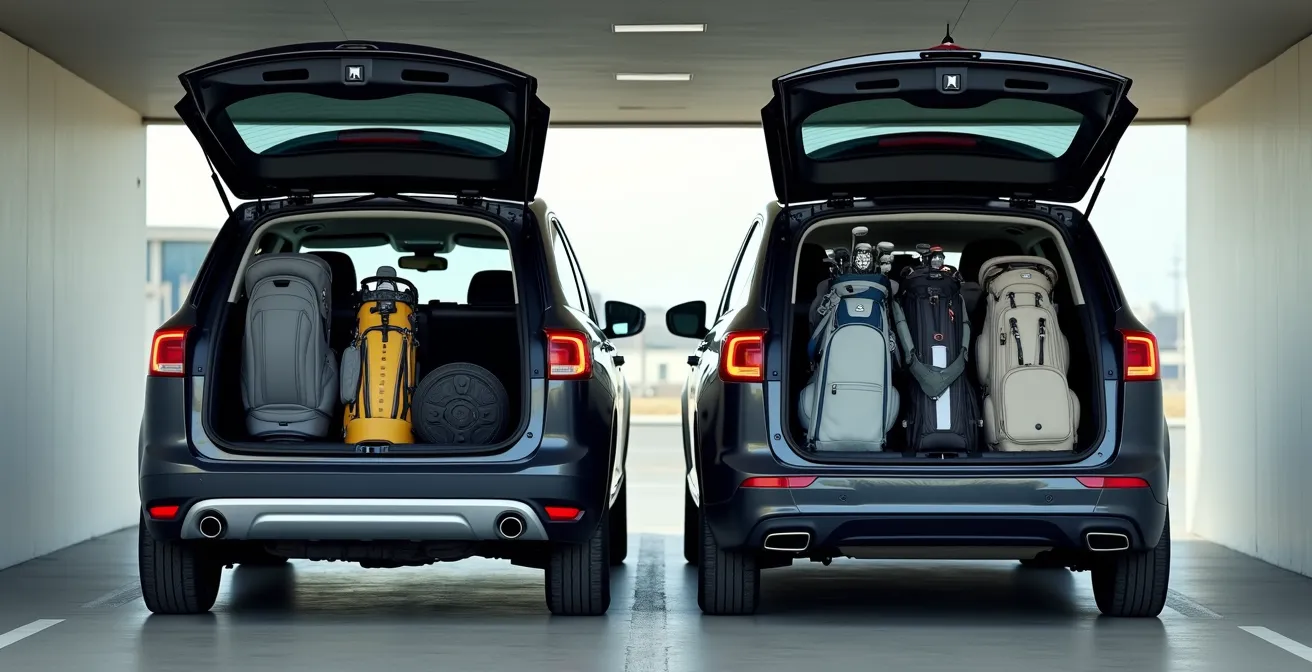
As the illustration demonstrates, the risk is not just about convenience but about logistical failure. A private transfer service mitigates this risk entirely. During the booking process, you specify your exact luggage requirements. The company then dispatches an appropriate vehicle—typically a spacious minivan or van—guaranteeing that all your equipment will fit. This eliminates the uncertainty and the potential for a last-minute, stressful search for an alternative, which will almost certainly be more expensive and less secure than your original options. The small premium paid for a private service is, in this context, an insurance policy against logistical chaos.
Meet & Greet service: Why is it essential for non-English speakers?
The value of a ‘Meet & Greet’ service is often underestimated, particularly by seasoned travellers. However, upon landing in a new country, several factors can immediately complicate your arrival. As one operator notes, the “No Data” landing is a common and critical failure point.
UK tourist’s mobile data may not work immediately upon landing
– Puerto Vallarta Airport Transfers, Airport Transfer vs Uber Guide 2025
Without a local SIM or functioning data roaming, you cannot use a ride-hailing app, contact your driver, or navigate to a designated pickup zone. You are effectively digitally stranded. For a non-Spanish or non-Portuguese speaker, navigating a chaotic arrivals hall to find a SIM card vendor or a reliable WiFi spot is a significant source of stress and vulnerability. A Meet & Greet service, standard with any reputable private transfer, bypasses this entire sequence of potential problems. The driver is waiting for you in the arrivals hall, holding a sign with your name. This single feature is a powerful tool for reducing cognitive load and eliminating risk. Case studies from challenging airports like Bogotá’s El Dorado show that professional services which monitor flights and provide direct contact points are invaluable for avoiding confusion.
The advantages extend beyond simple navigation:
- Immediate Assistance: The driver helps with your luggage from the moment you clear customs.
- No Digital Reliance: Communication is face-to-face, requiring no local data or app functionality.
- Local Expertise: The driver can provide trusted advice on safe ATM locations or where to purchase a SIM card once you are securely in the vehicle.
- Peace of Mind: Many services offer free cancellation or rescheduling, providing flexibility if your travel plans change unexpectedly.
Waiting time policies: Does your driver leave if the flight is 2 hours late?
Flight delays are a common reality of international travel. So are long queues at immigration, especially at major hubs. For example, Brazil’s busiest airport, São Paulo-Guarulhos, handles over 45 million passengers annually, and clearing immigration can easily take over an hour during peak times. This is where the starkly different operational models of rideshares and private transfers become a critical risk factor. A rideshare driver’s business model is based on volume and quick turnarounds. They are not incentivised to wait. A private transfer company, however, prices this eventuality into their service.
The fundamental difference in policy is a major failure point for the cheaper option. An Uber driver, after a standard 5-minute wait, will often cancel the ride and charge a fee, leaving you stranded after you’ve finally cleared customs. A private transfer company, on the other hand, builds a buffer into their service. They actively monitor your flight status and automatically adjust the pickup time. The driver will be there when you arrive, whether you are on time, an hour early, or two hours late. This contrast in service-level agreement is not a luxury; it is a core component of risk management for an international arrival.
| Service | Standard Wait Time | Flight Tracking | Late Arrival Policy |
|---|---|---|---|
| Uber | 5 minutes | No | Cancellation fees apply |
| Private Transfer | 60+ minutes | Yes – automatic adjustment | Free rescheduling |
| Airport Taxi | N/A – on demand | No | Must find new taxi |
Paying the £50 premium is, in effect, paying for the guarantee that your transport will wait. It transfers the risk of travel delays from you to the service provider, ensuring a secure pickup regardless of circumstances beyond your control.
The law vs reality: Can you get a guaranteed rear-facing seat in a taxi?
For those travelling with young children, vehicle safety is non-negotiable. UK travellers are accustomed to strict regulations where, by law, children under 3 must use an appropriate car seat. The assumption that this standard can be easily met abroad is a dangerous one. In South America, the availability of child car seats in standard taxis or rideshare vehicles is extremely low to non-existent. While some Uber services in other parts of the world offer a ‘Car Seat’ option, this is not a feature you can rely on in most South American cities.

The reality is that you are responsible for your child’s safety. As one analysis of rideshare policies points out, Uber drivers can and will legally refuse to transport families who do not have a proper child restraint. This is not out of malice; it is a matter of driver liability and safety. The consequence for the travelling family is catastrophic: being left on the kerb at night with luggage and a small child, with no safe transport options available. A private transfer company, by contrast, treats child safety as a core part of its service. When you book, you can request and guarantee an age-appropriate child or infant seat. The vehicle that arrives will have it pre-installed and ready. This is a level of certainty and safety that rideshare apps simply cannot provide in this region.
Which taxi scams cost tourists £50+ in major capital cities?
The £50 you might save by opting for a local taxi or rideshare can be lost in an instant through a variety of common scams. Beyond the ‘broken meter’, tourists are frequently targeted with inflated flat rates, unnecessary detours, or claims that the agreed-upon app fare doesn’t include airport fees or tolls. Unofficial ‘coordinators’ often prey on confused travellers in the arrivals hall, directing them to un-metered cars at exorbitant prices. At Santiago’s airport, for example, an official taxi to downtown should cost between $25-40 USD, but scammers can easily inflate this figure. These tactics are designed to exploit your disorientation and eagerness to get to your hotel, with overcharging often reaching 2-3 times the standard fare.
The most effective shield against these scams is to make yourself a worthless target. A security expert from DM Airport Transfers provides a powerful insight into this strategy:
By pre-paying in GBP, you become a ‘zero value’ target
– DM Airport Transfers, Holiday Travel Tips: Avoiding Airport Taxi Scams
When your transfer is fully paid for in advance, there is no financial transaction to be manipulated at the destination. The driver has no incentive to negotiate, overcharge, or demand extra fees. You simply get in the car and are taken to your destination. This single act of pre-payment removes the primary motivation behind the vast majority of airport transport scams. That £50 premium is not just buying a ride; it is buying you immunity from being a profitable target for scammers upon arrival.
How to insure a £2,000 camera when standard limits are £250?
Protecting valuable equipment like a high-end camera, laptop, or professional gear is a major concern for many travellers. The risk of loss or theft is heightened during transfers, and the recourse available to you varies dramatically between transport options. A critical factor often overlooked is that typical UK travel insurance policies have a £250 standard single item limit. This leaves a significant coverage gap if you are travelling with items worth thousands of pounds.
While insurance is one aspect, the accountability of the transport provider is another. If you leave an item in an Uber, your only recourse is to attempt to contact a gig-economy driver through an app, with notoriously mixed success rates. The ‘chain of custody’ is weak. A licensed private transfer company, however, operates with a fleet of professional, employed drivers and a central dispatch. Contacting the company to retrieve a lost item is a straightforward process with a much higher likelihood of success. This increased accountability can also be a crucial factor when making a claim on your travel insurance, as having a formal report from a licensed transport provider adds significant weight and credibility to your case, compared to a dispute with an anonymous rideshare driver. The £50 premium contributes to this system of accountability and traceability, providing a safety net that is absent in more informal transport arrangements.
Key Takeaways
- The £50 price difference is a risk premium that buys certainty in price, vehicle, and driver identity.
- Private transfers eliminate critical “failure points” of rideshares, such as driver cancellations, luggage incompatibility, and the need for local data on arrival.
- Pre-paying in your home currency makes you a ‘zero value’ target for common airport taxi scams, shifting the risk away from you.
Navigating the Tokyo Metro: How to avoid getting lost in Shinjuku station?
While this article focuses on South America, the principle of managing ‘cognitive load’—a concept perfectly embodied by the challenge of navigating Tokyo’s infamous Shinjuku station—is directly applicable to your arrival at a mega-airport like São Paulo-Guarulhos or Bogotá’s El Dorado. After a long flight, your decision-making capacity is diminished. The mental energy required to find reliable WiFi, download a local map, navigate to a designated and often chaotic rideshare pickup zone, verify the correct car and driver, and then hope they don’t cancel, is immense. This is the hidden cost of the cheaper option: it demands significant mental resources from you at a time when you are most fatigued and vulnerable.
A private transfer is engineered to minimise this cognitive load. The journey from the customs hall to your hotel becomes a simple, linear process with no complex decisions required on your part. This stark difference in the traveller’s journey can be audited step-by-step.
Your arrival journey: A cognitive load audit
- Private Transfer Path: Clear customs → Meet driver with nameboard → Walk directly to pre-vetted vehicle.
- Uber/Rideshare Path: Clear customs → Find reliable WiFi/purchase local SIM → Open app and request ride → Navigate to crowded, unfamiliar pickup zone → Wait, hoping for no cancellation → Identify and verify correct vehicle among dozens of others.
By choosing the pre-booked option, you are essentially outsourcing the logistical and mental stress of the arrival process. You are not paying more for the same journey; you are paying for an entirely different, vastly simplified, and more secure experience. This allows you to conserve your mental energy for the start of your trip, rather than depleting it on a stressful and uncertain transfer.
Therefore, when evaluating your transport options, the final decision isn’t just about the fare. It is a strategic choice about how you manage risk, uncertainty, and your own well-being. For any safety-conscious UK traveller arriving in an unfamiliar environment at night, the investment in a pre-booked, vetted, professional transfer service is the most prudent and secure choice you can make.
Frequently asked questions about transport and valuables in South America
What happens if I leave valuable items in an Uber?
You must use the app to contact the driver by navigating to your trip history and selecting ‘Find Lost Item’. However, success rates in recovering items from gig economy drivers vary significantly and can be very low.
Are private transfer companies more accountable for lost items?
Yes, as a general rule. Licensed transfer companies have established business structures, direct communication lines, and employed drivers, making the process of reporting and recovering a lost item more straightforward and generally more successful.
Does UK travel insurance cover theft from vehicles?
Coverage varies widely between policies. However, making a successful claim is often easier and more credible when you can provide a formal report from a licensed, registered transport provider rather than an informal rideshare service. Always check your policy’s specific clauses regarding theft from vehicles and single-item value limits.