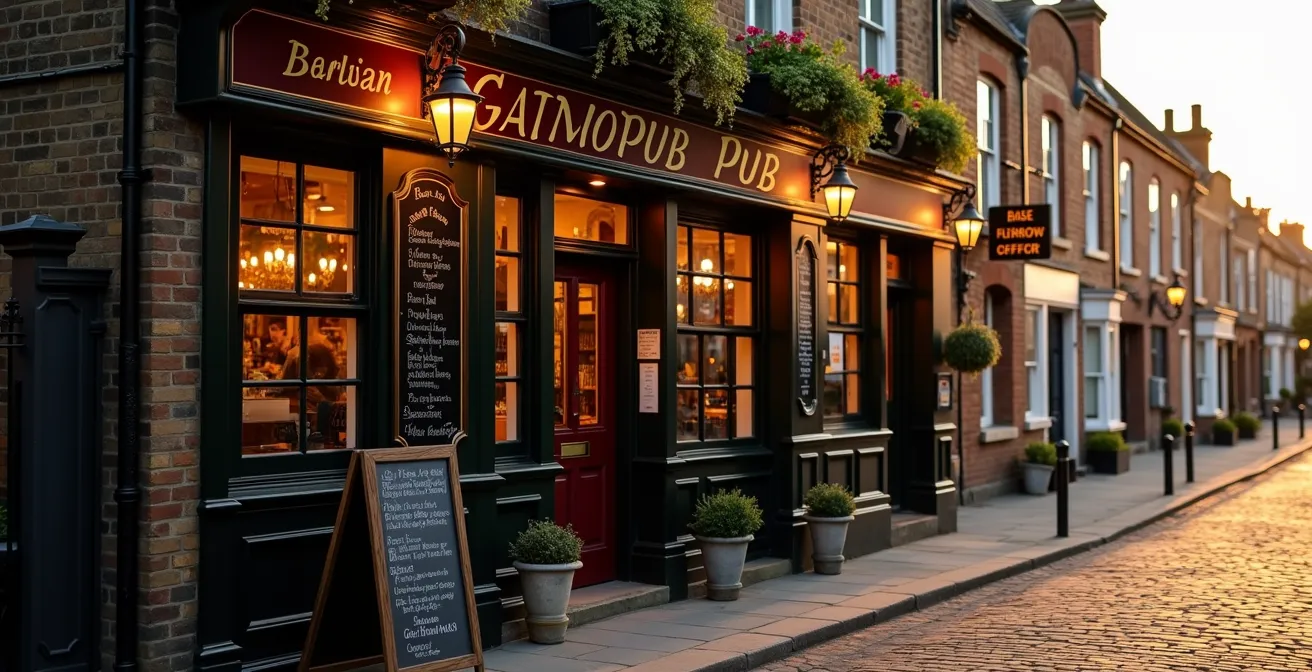
Contrary to popular belief, spotting a tourist trap isn’t about looking for laminated menus. It’s about learning to read the subtle social and economic signals that separate a cynical ‘transactional space’ from a genuine ‘community hub.’ This guide teaches you to decode these signs, from the rhythm of a local bus to the handwriting on a pub chalkboard, so you can travel with the discerning eye of a local, not the wide-eyed wallet of a tourist.
Let’s be honest. Most travel advice is a comforting lie, a collection of tired clichés recycled by people who think discovering a “hidden gem” means finding a Starbucks down a slightly smaller alley. You’ve heard it all before: avoid restaurants with pictures on the menu, don’t eat near the main attractions, look for crowds of locals. It’s not wrong, necessarily. It’s just utterly superficial. It’s like judging a book by its cover, assuming you even know what the local covers look like.
The real art of travel, the skill that separates a weary tourist from a temporary resident, is not following a checklist. It’s about developing a new sense: the ability to read the socio-economic signals a place emits. Is this a business designed for a high-turnover, one-time transaction with an uninformed audience? Or is it a community hub, a place that has to earn the loyalty of its neighbours day after day? The former is a trap; the latter is the entire point of leaving home. A survey even found that for nearly 70% of travelers, tourist trap visits diminished their trip enjoyment, a tragedy of wasted time and money.
So, forget the obvious. We’re going deeper. This isn’t a guide on what to see, but *how* to see. We will deconstruct the subtle language of authenticity, from public transport and accommodation choices to the very texture of a menu, to sharpen your instincts and ensure your money and time are spent on genuine connection, not cynical performance.
This article provides a framework for developing that instinct. Below is a breakdown of the core signals we will learn to decode, turning you from a passive consumer into an active cultural critic.
Contents: A Cynic’s Guide to Dodging the Obvious
- Why taking the local bus is better than a hop-on hop-off tour
- What to expect from a homestay experience in rural Italy?
- How to negotiate at a souk without offending the vendor?
- Where to find live music gigs that locals actually attend?
- Cooking class or food tour: Which offers better cultural insight?
- Photos on the menu: Is it a warning sign or just helpful for foreigners?
- Bath vs Bristol: Is the UNESCO city worth the crowding?
- Why staying with a host enhances your trip compared to an empty Airbnb?
Why taking the local bus is better than a hop-on hop-off tour
The hop-on hop-off bus is perhaps the most perfect metaphor for tourism as a passive spectator sport. You sit insulated in a bubble, listening to a pre-recorded narrative while the real city flows past, unseen and unheard. The primary socio-economic signal here is the price. Transport for London’s official pricing shows that a single bus journey is £1.75, while a tourist bus will fleece you for £25-£30 or more. This isn’t a premium; it’s a tax on ignorance. You are paying an exorbitant fee to be segregated from the local population.
Choosing the local bus is an active decision to reject this segregation. You save a fortune, yes, but the real profit is cultural. You see the city at its own pace, witnessing the daily commutes, the school runs, the tired shoppers. It’s an uncurated, authentic slice of life. A traveller on a Rick Steves forum perfectly captured this, noting they saw “tons” of London from the top deck of a regular bus for a “tiny fraction of the cost.” The best sightseeing routes aren’t the ones on the tourist map; they are the arteries of the city itself.
For instance, in London, you can curate your own, superior tour:
- Route 11: This is the classic ‘free’ tour, passing St Paul’s, the Strand, Trafalgar Square, Westminster, and Victoria.
- Route 9: A heritage route connecting the grand museums of South Kensington with the Royal Parks and Palaces.
- Route 35: A journey through the city’s markets, from the hip stalls of Shoreditch to the sprawling energy of Clapham.
Riding the local bus introduces a degree of what I call authenticity friction—it might not be as direct, it requires a little more thought—but this friction is the very thing that generates real experiences.
What to expect from a homestay experience in rural Italy?
The fantasy of a rural Italian homestay is potent: rolling hills, home-cooked pasta from a smiling nonna, and the gentle clinking of wine glasses at sunset. The reality, for the unprepared, can be a shock. This isn’t a hotel. The plumbing might be temperamental, the WiFi a distant rumour, and the aforementioned nonna might be more interested in her television soaps than in entertaining you. This is not a failure; it is a sign of authenticity. You haven’t paid for a performance; you’ve been granted temporary access to someone’s actual life.
The key expectation to manage is one of boundaries and rhythm. You are a guest in a home, not a customer in a service establishment. Breakfast might be at a fixed time, not because they are rigid, but because that’s when the family eats before starting their day’s work. The best meal of your life might be offered not on the ‘menu’, but because you showed genuine interest in the vegetable garden. The most valuable recommendation—for a village festival, a hidden waterfall, the best local cheese maker—will come not from a brochure, but from a conversation over a shared cup of coffee.
This is the trade-off. You sacrifice the sterile, on-demand convenience of a corporate hotel for something far more valuable: context and connection. The experience requires more from you. You must be observant, respectful, and curious. You must be willing to adapt to their schedule, not the other way around. If you are, the reward is an insight into a culture that no museum or guided tour could ever provide. If you aren’t, you will simply feel inconvenienced and leave a one-star review complaining that the real Italy wasn’t exactly like the movie.
How to negotiate at a souk without offending the vendor?
The idea of haggling sends a shiver down the spine of the average Brit, conditioned as we are to the fixed-price certainty of the high street. This anxiety is a major barrier, often leading to one of two errors in a foreign market: either paying the first price asked (the ‘tourist tax’) or engaging in an aggressive, uninformed negotiation that causes offence. The secret isn’t to become a master haggler overnight, but to understand the cultural context. Negotiation in many cultures isn’t a battle; it’s a form of social interaction, a dance.
To ground this, let’s look at our own backyard. We haggle more than we think, but only in specific, socially-sanctioned arenas. You wouldn’t haggle for a pint in a pub, but you might at a car boot sale. This understanding—that the context is everything—is what you must take abroad. The vendor in a Marrakech souk is not a cashier at Tesco; the opening price is an invitation to a conversation, not a final demand. Your goal is a price that is fair to both of you, a point of mutual satisfaction. It starts with a smile, a respectful question (“Is there a little room on the price?”), and a willingness to walk away politely if the gap is too large.
This comparative table, contextualised for the UK, should clarify where the lines are drawn, both at home and by extension, abroad.
| Acceptable to Haggle | Never Haggle | Negotiation Style |
|---|---|---|
| Car Boot Sales | High Street Shops | ‘What’s your best price on this?’ |
| Antique Fairs (Newark, Ardingly) | Supermarkets | ‘Would you take X for it?’ |
| Portobello Road Market Stalls | Pubs & Restaurants | ‘If I buy multiple items…’ |
| Independent Vintage Shops | Farmers Markets (from producers) | Always polite, never aggressive |
The key is to remain friendly, detached, and respectful. It’s a game, not a war. Treat it as such, and you’ll not only get a better price but also a more memorable human interaction.
Where to find live music gigs that locals actually attend?
If a tourist trap restaurant is a cynical performance of culture, a tourist trap music venue is its ear-splitting equivalent. Think Irish pubs in Prague with American cover bands, or “authentic” flamenco shows in Seville with dinner included. The signal is obvious: the marketing is aimed at you, the tourist. The prices are high, the seats are all reserved, and the music is a fossilised, greatest-hits version of the local sound.
Finding the real thing requires ignoring the tourist-facing advertisements entirely. The real music scene of a city is a living, breathing organism; it’s a community hub, not a packaged product. It lives on dog-eared flyers stuck to the walls of student union bars, in the listings of local street-press magazines you find in independent record shops, and on the websites of university radio stations. The key is to look for where the conversation about music is already happening among locals, not where it’s being broadcast to tourists.
Look for the signs of a genuine venue: a scruffy chalkboard announcing a “band night” with an absurdly low entry fee, a crowd that spills out onto the pavement with their own drinks, a sound system that values raw energy over polished perfection. These places don’t need to advertise to tourists because their survival depends on the £5 entry fee from a hundred locals, not the £50 ticket from ten visitors. The music will be newer, riskier, and infinitely more representative of what is actually happening in that city’s culture right now. It might not be what you expected, but it will be real.
Cooking class or food tour: Which offers better cultural insight?
The modern foodie traveller is faced with a choice: the food tour, a curated sprint through a dozen “must-try” bites, or the cooking class, a deep dive into a single dish or technique. Both are sold on the promise of cultural insight, but they deliver fundamentally different things. It’s a choice between breadth and depth, between tasting and understanding. As a critic, my allegiance is clear, but let’s be objective.
The food tour is a sampler platter. You get a little taste of many things. In the context of London, a Borough Market tour is a classic example. You’ll try artisanal cheese, sample charcuterie, and probably have an oyster, all while getting a quick-fire history of the market. It’s efficient, it’s tasty, and it gives you a great overview. However, the insight is often surface-level. The interaction with each vendor is fleeting, a transaction disguised as an experience. You learn *what* people eat, but rarely *why*.
The cooking class, by contrast, is a commitment. It focuses your attention. Instead of tasting twenty things, you will spend three hours mastering one.
Case Study: Borough Market Tour vs. Sunday Roast Masterclass
A comparison of two London food experiences highlights the difference. A Borough Market tour offers breadth, with quick tastings from multiple vendors for around £15-£30. It provides a cultural overview. In contrast, a specialised cooking class, like “Mastering the Perfect Sunday Roast,” costs more (£60-£120) but offers hands-on skills and, crucially, deeper conversations with the chef-instructor about British family traditions, ingredient sourcing, and the cultural significance of the meal. The tour gives you data; the class gives you the story.
The food tour is better if you’re short on time and want to map out a city’s food scene. But if you want genuine cultural insight, the cooking class is unequivocally superior. The act of creation, the shared time with a local expert, the conversations that unfold while kneading dough or stirring a pot—this is where the real understanding lies.
Photos on the menu: Is it a warning sign or just helpful for foreigners?
Ah, the laminated picture menu. The international symbol for “we don’t trust our food to speak for itself, and we don’t expect you to come back.” In 90% of cases, yes, it’s a blaring siren of a warning sign. It is the ultimate socio-economic signal that you are in a transactional space designed for non-locals. The logic is simple: a restaurant that relies on a regular local clientele doesn’t need pictures. Their customers know what “spaghetti carbonara” is. The pictures exist to solve a problem: a transient, multi-lingual clientele who don’t know the food and won’t be back to complain if it’s dreadful.
The picture menu is the culinary equivalent of a phrasebook. It’s a clumsy but effective tool for basic communication when no common language exists. But just as you wouldn’t expect profound poetry from a phrasebook, you shouldn’t expect culinary excellence from a picture menu. It signals a kitchen that prioritises accessibility over quality, often relying on frozen, pre-prepared ingredients that can be microwaved to match the glossy, often stock, photograph. It’s a business model built on a constant stream of new, undiscerning customers.
Now, for the cynical nuance. Is it *always* a bad sign? Almost. The only exception might be in countries with non-Roman alphabets, where a picture can be a genuinely helpful tool for a foreigner in a very local, non-touristy spot. But let’s be realistic, in most European contexts, it’s a red flag. The authentic alternative isn’t a menu in impenetrable local dialect; it’s often a simple, typed A4 sheet, or better yet, the handwritten chalkboard. The chalkboard signals freshness, seasonality, and confidence. It says, “This is what’s good today.” The picture menu says, “This is what we have in the freezer.”

The texture of the chalk on the slate, the imperfections of the handwriting—these are signals of a human touch, of a place connected to the present moment. It’s the antithesis of the static, impersonal photograph.
Bath vs Bristol: Is the UNESCO city worth the crowding?
The choice between Bath and Bristol is a perfect case study in the conflict between postcard-perfect tourism and lived-in authenticity. Bath is a UNESCO World Heritage site, a stunningly preserved Georgian city that feels like walking onto a film set. Bristol is its scrappy, creative, and slightly chaotic neighbour. For the tourist, Bath is the obvious choice. For the traveller seeking a genuine urban experience, the answer is more complex.
Bath’s perfection is its problem. It is so beautiful, so well-preserved, that it can feel like a museum of a city rather than a living one. The crowds are immense, and the city centre often feels like a transactional space almost entirely dedicated to servicing them. Finding a pub or cafe that isn’t catering primarily to the tourist trade can be a challenge. Bristol, on the other hand, is unapologetically alive. As the birthplace of Banksy and a hub for music and street art, its energy is contemporary and evolving. It’s a city with a pulse, with neighbourhoods like Stokes Croft and Clifton that feel authentic because they are primarily for the people who live there.
This doesn’t mean you should skip Bath. It means you should be strategic. Use Bristol as your base, and treat Bath as a targeted surgical strike.
Your Action Plan: The Hub and Spoke Strategy
- Base yourself in Bristol for an authentic ‘lived-in’ neighbourhood experience.
- Take the 15-minute train to Bath for targeted day trips, not an overnight stay.
- Visit Bath’s iconic Royal Crescent at sunrise, before the tour buses arrive.
- Book evening sessions at the Thermae Spa after the day-trippers have departed.
- Explore Bristol’s Harbourside or a pub in Clifton for a genuine local evening social scene.
By treating the UNESCO city as an excursion rather than the main event, you get the best of both worlds: the world-class architectural beauty of Bath and the authentic, vibrant culture of Bristol.
| Aspect | Bath | Bristol |
|---|---|---|
| Train Connection | Direct from London (90 min) | 15 min from Bath, direct from London (90 min) |
| Best Time to Visit | Sunrise at Royal Crescent, Evening at Thermae Spa | Anytime – living city rhythm |
| Authentic Areas | Walcot Street artisan quarter, Canal towpaths | Stokes Croft, Clifton, Harbourside |
| Cultural Scene | Preserved Georgian beauty, UNESCO heritage | Banksy birthplace, vibrant music/arts scene |
| Photography | World-class architecture, Instagram-perfect | Street art, creative grit, urban authenticity |
Key Takeaways
- Authenticity is not a checklist of sights, but a mindset focused on reading the ‘socio-economic signals’ of a place.
- Genuine experiences often involve ‘authenticity friction’—small inconveniences that are signs you’ve left the curated tourist path.
- Prioritise depth over breadth: a deep dive into one thing (a cooking class, a neighbourhood) is often more insightful than a superficial tour of many.
Why staying with a host enhances your trip compared to an empty Airbnb?
The rise of the self-check-in Airbnb, the one with the key in a lockbox and a laminated sheet of rules on the table, is the final victory of transaction over interaction. You get the space, but you miss the soul. You are sleeping in a city, but you are not connected to it. It offers the illusion of “living like a local” while providing none of the mechanisms for actually doing so. The true value of staying in a home, the kind of experience offered by a traditional B&B or a homestay, isn’t the bed; it’s the host.
A host is the ultimate antidote to the tourist trap. They are a real-time, hyperlocal search engine. They are the gatekeepers to what I call ‘curated serendipity’. As the British B&B Association puts it in their guide:
A host provides ‘curated serendipity.’ They offer real-time, hyperlocal advice that is impossible to Google, such as ‘Don’t go to that pub tonight, they have a private function, go to this one instead.’
– British B&B Association, Guide to Authentic British Hospitality
This is the crucial difference. Google can tell you the five best-rated pubs in a town. A host can tell you which of those five has the good fireplace, which one has the pub quiz on tonight, and which one to avoid because the landlord is in a foul mood. This is information that is impossible to scale or digitise. The “British Welcome” ritual of offering tea upon arrival, as one Yorkshire host noted, isn’t just about hospitality; it’s the moment that opens up the conversation that leads to a guest discovering a one-off village fête that weekend—an experience an Airbnb guest, staring at a lockbox, would never have.
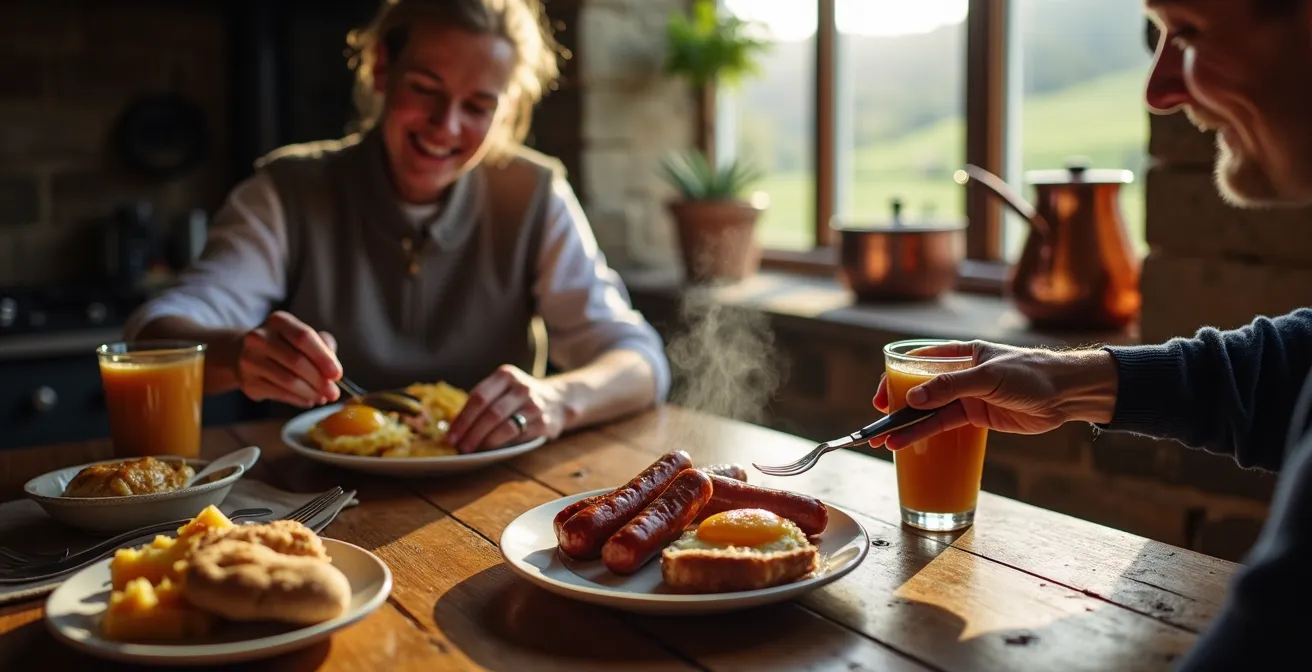
Choosing a stay with a present, engaged host is the single most effective strategy for piercing the tourist bubble. It’s a conscious decision to prioritise human connection over the sterile convenience of an automated check-in. It is the fundamental building block of authentic travel.
So, the next time you’re planning a trip, don’t just ask yourself where you want to go. Ask yourself who you want to meet. The answer will guide you far better than any online review.