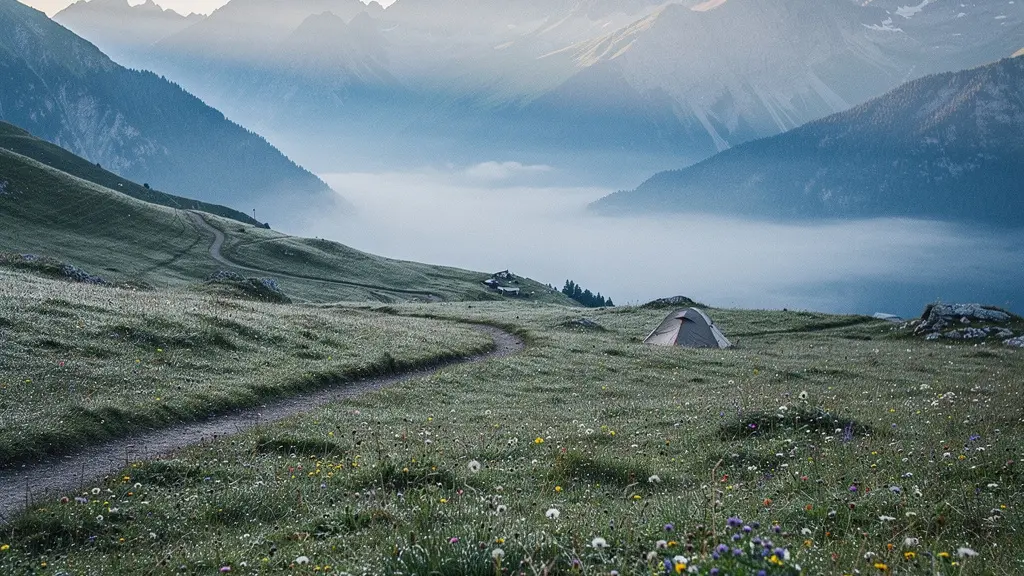
Finding empty landscapes in August isn’t about discovering secret countries; it’s about mastering the art of the ‘micro-shift’ within popular destinations.
- Swap overpriced hotspots for budget-strategic gems like the Albanian Riviera, which offers a Maldives-like experience for a fraction of the cost.
- Use hyper-specific timing—like the ‘post-shower gleam’ or the ‘Northern Latitude Advantage’—to capture light and scenes that day-trippers will always miss.
Recommendation: Focus on local laws (like wild camping in Scotland) and responsible practices to unlock unique, crowd-free perspectives that others overlook.
As a landscape photographer, my August feed used to be a painful scroll. The same over-saturated shots from the same five crowded viewpoints in Europe. The frustration is real: you crave wild, untamed nature, but peak season delivers a reality of selfie sticks and overflowing car parks. You’ve heard the standard advice a thousand times—go to Eastern Europe, wake up at dawn, avoid the cities. This is well-intentioned but ultimately shallow advice for anyone serious about capturing the soul of a landscape.
The truth is, the world doesn’t have many secrets left. The real art of finding solitude isn’t about discovering a place no one has heard of. It’s about out-thinking the crowds in the places everyone knows. It requires a strategic mindset, one that trades conventional wisdom for a deeper understanding of light, weather, local laws, and even budget. It’s about executing subtle but powerful ‘micro-shifts’ in time, space, and approach that open up a completely different version of a destination.
This isn’t a guide to unknown places. This is a scout’s playbook for seeing popular regions with new eyes. We won’t just tell you where to go, but how to unlock its hidden, empty moments. From leveraging the unique light of the British Isles to understanding why a smaller budget can be your greatest strategic advantage, we’ll deconstruct the methods that separate a professional scout from a frustrated tourist. Forget finding a new pin on the map; it’s time to learn how to read the existing map in a way no one else does.
This guide breaks down the core strategies that professional scouts use to find solitude and capture unique shots during Europe’s busiest month. Each section reveals a different ‘micro-shift’ you can apply to your own planning.
Table of Contents: A Scout’s Guide to Solitude in August
- Why choose Albania over the Maldives for turquoise waters on a budget?
- How to prepare for a solo hike in the Scottish Highlands without getting lost?
- The 5am rule: Is waking up early really worth it for photos?
- The error of ‘off-roading’ that destroys protected peatlands
- When to visit the Lake District to avoid the notorious rain?
- Boat rental without a license: Is it safe in the Greek islands?
- Where can you legally wild camp in England vs Scotland?
- Budgeting for a once-in-a-lifetime bucket list trip to the Maldives
Why choose Albania over the Maldives for turquoise waters on a budget?
The first strategic shift is to reframe ‘budget’ as a tool, not a limitation. The desire for exotic, turquoise waters often leads to bucket-list destinations like the Maldives, which are not only financially ruinous in August but also engineered for a specific, crowded type of tourism. A true scout knows that authentic beauty often lies where the masses, guided by high-end marketing, aren’t looking. Albania’s Ionian coast is a prime example. Here, the water is just as clear and the beaches as stunning, but the experience is fundamentally different—and strategically better for a photographer seeking peace.
The financial argument is a clear-cut case for strategy over status. Recent data suggests a daily budget of around €80 for two people is comfortable in Albania, a figure that would barely cover lunch in a Maldivian resort. This isn’t about being cheap; it’s about reallocating resources towards a longer, more immersive trip.
This table illustrates the stark reality of choosing a budget-strategic location over a high-demand one for a trip from the UK in August. The savings don’t just mean a less expensive holiday; they represent freedom from the tourist machine.
| Category | Albania (August) | Maldives (August) |
|---|---|---|
| Flight from UK | £150-300 return | £600-1200 return |
| Hotel per night | €35-40 | $200-500 |
| Daily budget (2 people) | €80-100 | $400-600 |
| Week total estimate | £800-1200 | £3500-5000 |
To make this strategy work, especially in August, you must be prepared. Avoid the peak-season trap of Ksamil by staying in nearby Sarande, use public buses for intercity travel, and always carry Albanian Lek. Guesthouses booked in advance are your best bet, offering value and a local connection that resorts can’t match.
To fully grasp the financial advantage, review the core principles of this strategic budgeting.
How to prepare for a solo hike in the Scottish Highlands without getting lost?
The next shift is mental: embracing preparation as a prerequisite for freedom. The Scottish Highlands offer some of Europe’s most profound solitude, but their beauty is matched by their unforgiving nature. The error amateurs make is confusing ‘wild’ with ‘unprepared’. True freedom to explore comes not from just walking into the hills, but from having the systems in place to do so safely. A solo hike, in particular, demands rigorous planning.
Your navigation system must be redundant. Relying solely on a phone is a critical mistake. A professional’s setup involves a primary digital tool, like the OS Maps app with downloaded offline maps, and a physical, waterproof OS Explorer map with a compass as a non-negotiable backup. Even on well-trodden paths like the West Highland Way, where help is often nearby, these skills are what keep you safe when the weather turns or you take a less common detour. The trail’s popularity is a safety net, not an excuse to neglect your own preparedness.
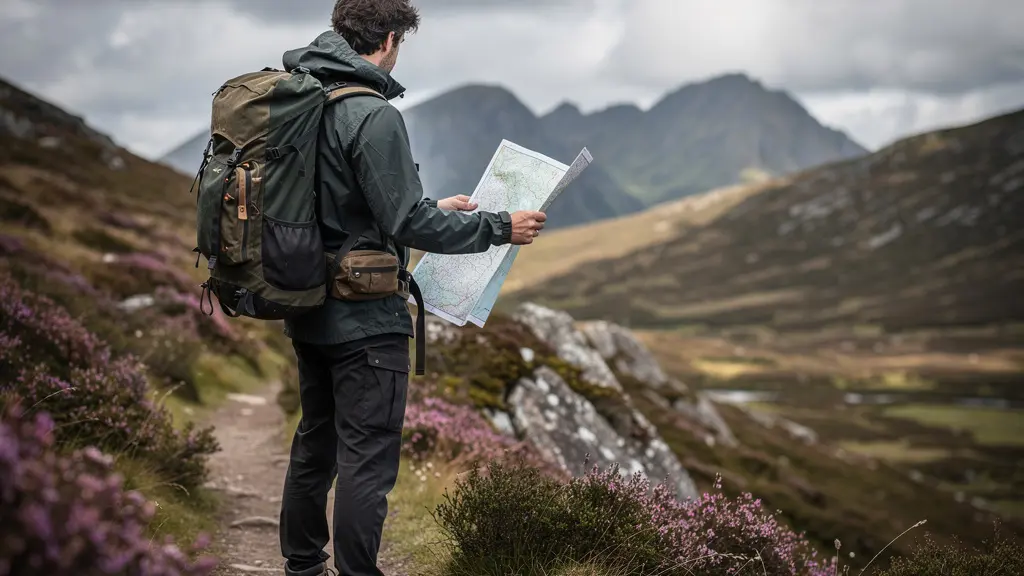
Before you even step on the trail, check the Mountain Weather Information Service (MWIS)—it’s the industry standard for a reason. Registering your route and expected return time with someone is not optional. This isn’t about fear; it’s about professionalism. It’s the boring work that unlocks the exhilarating moments of solitude when you’re the only person for miles, watching the clouds roll over the Munros.
Your Pre-Hike Navigation Protocol: The Highlands Checklist
- Download the OS Maps app and purchase the relevant 1:50,000 or 1:25,000 maps for your intended area.
- Carry physical, waterproof OS Explorer maps and a real compass as a fail-safe. Know how to take a bearing.
- Install the OS Locate app; it provides an emergency grid reference to share with Mountain Rescue, even without a phone signal.
- Check the detailed MWIS forecast for your specific mountain area before setting off.
- Leave your detailed route plan and your estimated time of return with a reliable contact.
To ensure your safety, it’s worth re-reading these essential preparation steps before any solo venture.
The 5am rule: Is waking up early really worth it for photos?
The “wake up early” advice is a classic platitude. It’s not wrong, but it lacks the critical context that turns it into a powerful strategy. The real secret isn’t just *that* you wake up, but *why* the light at that time is special in certain locations. In the UK, particularly in Scotland and Northern England during summer, this is about leveraging a phenomenon I call the ‘Northern Latitude Advantage’.
Because of the high latitude, the sun rises and sets at a much shallower angle than in southern Europe. The result is a dramatically extended “golden hour” and “blue hour”—the periods of soft, diffused light that are most prized in landscape photography. While a sunrise in the Mediterranean might offer a 20-minute window of perfect light, a Scottish dawn can give you over an hour of magic. This is not just a marginal gain; it is a fundamental shift in opportunity.
As landscape photography forums often discuss, this specific advantage is what allows for more considered, creative compositions. One expert noted this specific effect:
The Northern Latitude Advantage provides extended ‘golden hour’ and ‘blue hour’ in the UK’s northern latitudes during summer, offering a longer window for quality light than in southern Europe.
– Professional landscape photographers, UK Photography Forums
So, is the 5 am rule worth it? Absolutely, but not just to beat the crowds. It’s worth it because in places like the Highlands or the Lake District, you are granted a gift of time and light that photographers further south can only dream of. You have more time to walk to a secondary location, change lenses, or simply wait for the perfect moment when the light kisses the peak. It’s a strategic advantage, hiding in plain sight.
Understanding this principle is key to capturing exceptional images, so take a moment to review the concept of the Northern Latitude Advantage.
The error of ‘off-roading’ that destroys protected peatlands
A deep respect for the environment is what separates a true nature lover from a mere content creator. One of the most damaging mistakes one can make in the British uplands is going ‘off-road’ or straying from paths, especially across moorland. This isn’t about personal freedom; it’s about protecting an ecosystem of global importance. The soft, boggy ground you might be tempted to cross is likely a protected peatland.
These habitats are the UK’s largest terrestrial carbon store, and damaging them has severe consequences. Trampling delicate vegetation and compacting the soil disrupts the hydrology, releasing vast amounts of carbon into the atmosphere. Research shows that the UK’s peatlands store 3.2 billion tonnes of carbon. Every footprint that widens a muddy path contributes to this degradation. The professional’s code is simple: stay on the designated path, even if it’s wet.
This principle is part of the ‘Leave No Trace’ ethos, which is not a set of friendly suggestions but a strict code of conduct for operating in wild spaces. It governs everything from waste disposal to fire safety and is non-negotiable for anyone claiming to love these landscapes.
- Stay on paths: Even when muddy, walk through the middle of the path to avoid widening it and eroding the surrounding habitat.
- Waste management: Pack out absolutely everything, including biodegradable items like fruit peels, which decompose extremely slowly in the cold, acidic soil of the uplands.
- Fire safety: Never, ever light a fire on peat moorland. The fire risk is year-round as fire can smoulder underground for weeks before re-emerging.
- Wildlife protection: Keep dogs on leads from March to July to protect ground-nesting birds like curlews and lapwings.
The empty landscape you seek is a privilege, not a right. Protecting its integrity is the price of admission. The best photographers know their presence should be invisible.
Adhering to these principles is paramount, so it is vital to internalise the rules of responsible access.
When to visit the Lake District to avoid the notorious rain?
This question contains a flawed premise. The strategic photographer doesn’t avoid the rain in the Lake District; they learn to use it. Attempting to find a consistently dry week in August is a fool’s errand. The real secret is understanding the *pattern* of the rain and the unique photographic opportunities it creates. This is a temporal micro-shift: stop fighting the weather and start working with it.
While August in the Lakes averages 12-15 rainy days, this rarely means constant, day-long downpours. The typical pattern is one of intense, fast-moving showers. The magic happens in the moments immediately after a shower passes. This phenomenon is known among local photographers as the ‘post-shower gleam’. As the clouds break, the low-angled sun illuminates a landscape saturated with water. The wet slate of the Langdale Pikes turns to silver, and the greens of the fells become intensely vibrant. This is a light you simply cannot get on a clear, sunny day.
Weather patterns in August often show morning showers clearing by midday. This makes afternoon hikes more reliable and positions you perfectly for the dramatic late-afternoon light. Locations like Blea Tarn are transformed by this effect, offering mirror-like reflections under dynamic, clearing skies. For wet conditions, low-level forest walks such as those in Grizedale Forest or along the Derwentwater shoreline remain sheltered and beautiful, with the rain enhancing the scent of pine and earth. For any hike in these conditions, gear is critical. A waterproof jacket with a minimum 10,000mm hydrostatic head rating is non-negotiable; 20,000mm is preferred.
The crowds often retreat when the rain starts. This is your cue to get into position. By embracing the weather, you not only get a more dramatic and authentic photograph, but you also often get the landscape all to yourself.
Mastering the weather is a skill, so reviewing the strategy for handling is a wise investment of time.
Boat rental without a license: Is it safe in the Greek islands?
To truly escape the crowds, sometimes you have to leave the land behind. Renting a small motorboat in the Greek islands is one of the most effective ways to find your own private cove, even in the chaos of August. Many are surprised to learn that Greek maritime law permits renting a boat with up to a 30hp engine without a license. This unlocks a level of freedom and solitude that is impossible to find on land.
However, this freedom comes with significant responsibility. ‘No license’ does not mean ‘no rules’ or ‘no danger’. Safety is paramount. The Aegean Sea can be unpredictable, and the notorious Meltemi wind can pick up suddenly in the afternoons, turning a calm bay into a hazardous situation. Your travel insurance must be checked to ensure it explicitly covers the operation of motorized watercraft; most standard policies do not.
Before you even turn the key, you must receive a thorough briefing from the rental company on the boat’s operation, safety equipment, and the local sea conditions. A professional approach involves more than just listening; it means creating your own safety checklist.
- Insurance Check: Confirm your travel insurance covers you for operating a motorized boat. No coverage, no rental.
- Weather Awareness: Learn to recognise the signs of the Meltemi wind (sudden whitecaps) and plan to be back before it typically rises in the afternoon.
- Navigation: Download offline marine charts for your area. Don’t rely on your phone’s mobile data.
- Anchoring: Practice deploying and retrieving the anchor in a calm, empty area before trying to navigate a crowded bay.
- Fuel Management: Calculate the fuel needed for your planned route and add a 30% reserve. Never trust the fuel gauge alone.
- Traffic Rules: Stay at least 500 metres clear of the main ferry lanes. They are the motorways of the sea and have absolute priority.
Used responsibly, a small boat is a key to a hidden Greece, allowing you to access beaches and coves that are only reachable from the water, guaranteeing the peace and quiet you’re searching for.
The freedom of the sea is alluring, but requires diligence. It is crucial to memorise the safety protocols for unlicensed boat rental.
Where can you legally wild camp in England vs Scotland?
For the ultimate immersion in a landscape, nothing beats wild camping. Waking up in a silent valley with the dawn light hitting your tent is the photographer’s dream. However, the ability to do this is governed by law, and this legal knowledge is another critical micro-shift. The rules in England and Scotland are fundamentally different, and knowing this distinction is key to planning a successful trip.
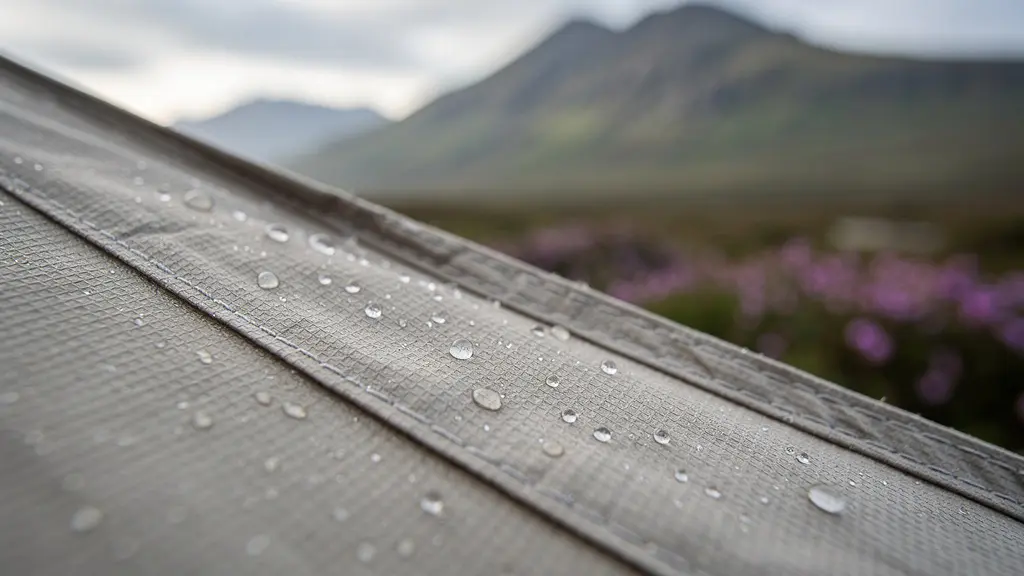
In Scotland, the Land Reform Act of 2003 grants the public a right to roam, which includes the right to wild camp on most unenclosed land. This is an incredible privilege. It means you can responsibly pitch a tent in some of the most spectacular landscapes in Europe without seeking permission. The key word is ‘responsibly’—it means following the Scottish Outdoor Access Code, which involves leaving no trace, staying away from buildings and roads, and usually staying for only a couple of nights.
England is a completely different story. Wild camping is technically illegal on all land without the landowner’s express permission. There is one, and only one, significant exception. Following a lengthy legal battle, a Supreme Court ruling confirmed that Dartmoor remains the only legal wild camping area in England, and even then, it’s restricted to specific common land areas shown on an official park map.
This legal distinction is not a minor detail; it is the most important factor in planning a wild camping trip in the UK. This table breaks down the core differences:
| Aspect | Scotland | England |
|---|---|---|
| Legal Status | Legal under Land Reform Act 2003 | Illegal without permission (except Dartmoor) |
| Where Allowed | Most unenclosed land | Dartmoor commons only (specific areas) |
| Permission Needed | No | Yes (except Dartmoor) |
| Duration | 2-3 nights same spot | 1-2 nights (Dartmoor) |
| Group Size | Small groups, no specific limit | Small groups only |
Understanding your rights and responsibilities is the first step to a successful wild camp. Be sure to review the legal differences between England and Scotland.
Key takeaways
- Strategic budgeting is a tool for freedom; a lower-cost destination like Albania often provides a more authentic and less crowded experience than a high-cost hotspot.
- Master ‘temporal micro-shifts’ by using hyper-specific timing. The extended light of the ‘Northern Latitude Advantage’ and the dramatic ‘post-shower gleam’ offer opportunities that day-trippers miss.
- Leverage local laws and customs. The right to wild camp in Scotland is a powerful tool for accessing unique, empty landscapes that are legally off-limits elsewhere.
Budgeting for a once-in-a-lifetime bucket list trip to the Maldives
The phrase ‘once-in-a-lifetime’ is often a marketing-driven justification for exorbitant spending. Let’s deconstruct the budgeting for a classic bucket-list trip like the Maldives to see what you are actually paying for. While the images are undeniably beautiful, the cost in August is staggering, and it buys you into a system designed for high-density, low-authenticity tourism. The seaplane transfers, the overwater villas, the imported food—it all adds up to a budget that could fund a month-long, multi-country expedition elsewhere in Europe.
The numbers speak for themselves. The total cost for one week in the Maldives can easily be double or triple that of a full month exploring Europe’s hidden gems, as the comparison shows.
| Expense Category | 1 Week Maldives | 1 Month Europe (Off-beaten) |
|---|---|---|
| Flights from UK | £800-1200 | £150-300 |
| Accommodation | £2000-3500 | £900-1200 |
| Food & Drink | £700-1000 | £600-800 |
| Activities | £500-800 | £300-500 |
| Transport | £300 (seaplane) | £250-400 |
| Total | £4300-6500 | £2200-3200 |
What if you could have the Maldives experience—the crystal-clear water, the sense of quiet island life—without the price tag and the crowds? This is the final and most important strategic shift: the alternative. It requires research, but the rewards are immense.
Case Study: The Halki Island Alternative
The tiny Greek island of Halki in the Dodecanese offers the ‘Maldives experience’ at a tiny fraction of the cost. It boasts pristine turquoise waters, secluded pebble beaches you can have to yourself even in August, and a single, quiet port village with traditional tavernas. There are no large resorts. A week in a beautiful villa can cost €700, and a meal in a local restaurant is around €15. The total weekly cost for two people is approximately €1500, compared to over €5000 in the Maldives, for what is arguably a more authentic and peaceful experience.
This is the essence of the scout’s mindset. It’s about looking at the desired *feeling*—solitude, beauty, clear water—and finding the smartest, most effective way to achieve it, rather than simply following the marketing trail to the most obvious and expensive location.
To truly master this approach, it’s worth revisiting the foundational idea of choosing strategy over status.
Stop chasing the bucket list and start building your own. Apply this strategic thinking to your travel planning and you will discover that the world’s most beautiful empty spaces are not found, but created through intelligent choices.