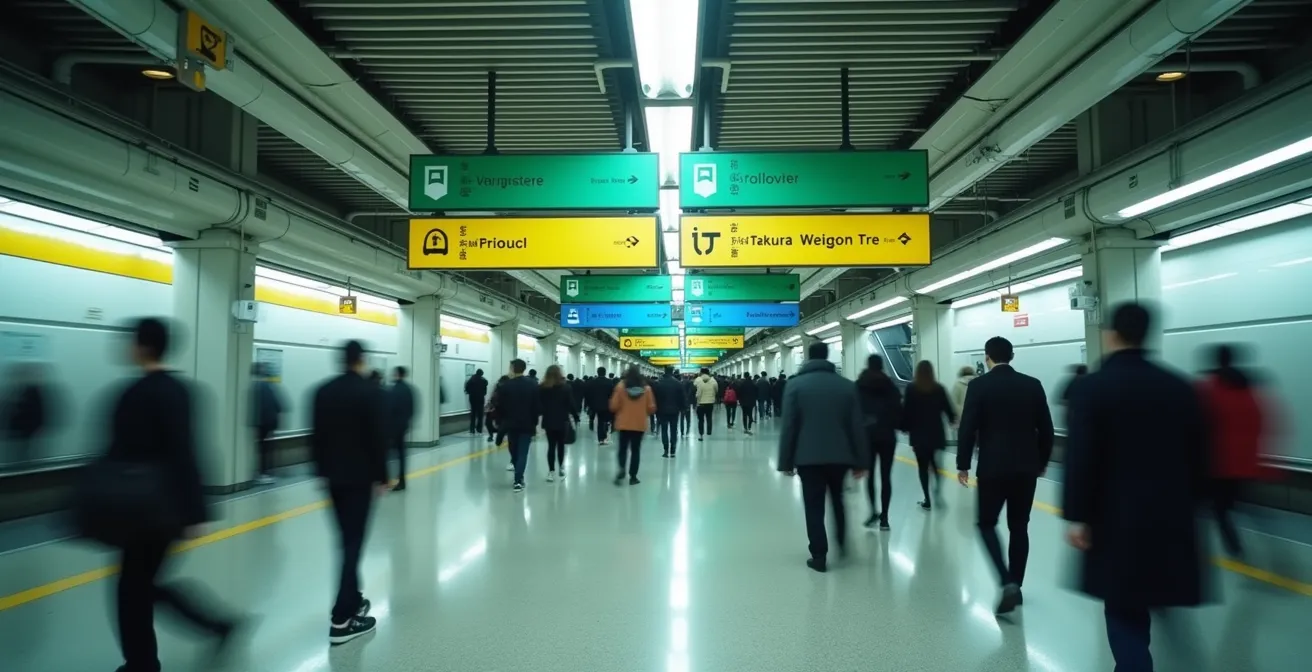
Most guides tell you to memorize Tokyo’s dizzying subway map. That’s the wrong approach. To truly master a complex transit system, you must stop trying to memorise the layout and start thinking like a system designer. This guide reveals the hidden logic behind the chaos, showing you how to decode the rules of the station, from exit numbering to cultural etiquette, so you can navigate not just Tokyo, but any mega-city’s transit, with ease.
The first time you see a map of the Tokyo Metro, a sense of awe mixed with pure terror is a perfectly normal reaction. It’s a beautiful, intricate web of coloured lines that promises to connect you to everything, but also threatens to swallow you whole. This feeling is amplified a thousand times when you step into Shinjuku station, a gargantuan labyrinth that funnels a staggering 3.6 million passengers daily, making it the world’s busiest transport hub. The common advice you’ll hear is to “buy an IC card” and “follow the signs.” While not wrong, this advice is woefully incomplete. It treats you like a passive user, not an intelligent navigator.
The real secret to conquering such a complex environment doesn’t lie in memorising every line or platform. It’s about a paradigm shift in your thinking. Instead of seeing a confusing mess, you need to learn to see the underlying system, the logic and the cultural overlays that dictate its flow. What if the key wasn’t about knowing the map, but about understanding the principles of systemic decoding? What if you focused on your exit first, and the train line second? This is the core of our approach.
This guide will equip you with that mindset. We will dissect the anatomy of urban transit systems, using Tokyo as our primary case study but drawing parallels with London, Paris, and other global cities. We will transform you from an intimidated tourist into a confident urban explorer, ready to tackle any subterranean challenge the world throws at you.
To help you navigate this new perspective, we’ve broken down the core concepts of urban transit mastery. From the financial mechanics of travel cards to the unspoken rules of passenger etiquette, each section will add another tool to your navigation toolkit.
Summary: A System-Decoder’s Guide to Urban Transit Mastery
- Oyster vs Contactless: Is there still a cap benefit to the physical card?
- Talking on phones: Why is it rude in Japan but normal in Italy?
- Citymapper offline: How to navigate without data in a subway tunnel?
- Women-only carriages: How to find them on Indian or Japanese trains?
- Paris Metro strikes: How to plan alternative routes instantly?
- Why taking the local bus is better than a hop-on hop-off tour
- Single-sex vs mixed zones: What is standard in German vs UK spas?
- How to spot a ‘tourist trap’ restaurant within 30 seconds?
Oyster vs Contactless: Is there still a cap benefit to the physical card?
For any Londoner, the Oyster vs contactless debate is a familiar one, revolving around capping and convenience. When you land in Tokyo, you’re faced with a similar choice: Suica or Pasmo? But the underlying financial logic is completely different and reveals a key aspect of the Japanese system. Unlike Transport for London’s daily capping, which is a lifesaver for tourists, Tokyo’s IC cards operate on a pure pay-per-journey basis. This is a critical piece of system information for budgeting your travel.
However, what the Tokyo system lacks in daily capping, it makes up for in sheer utility. An IC card like a Suica or Pasmo is far more than just a travel pass; it’s a city-wide debit card. You can use it to pay at convenience stores, vending machines, and even for station lockers. This integration demonstrates a different design philosophy: the card isn’t just for transit, it’s for seamless movement through the entire urban ecosystem. For tourists, this means less fumbling for cash and a much smoother experience. While you can get multi-day tourist passes, understanding the fundamental difference between London’s ‘safety-net’ capping and Tokyo’s ‘utility-focused’ pay-as-you-go model is the first step in decoding the local system.
The table below breaks down these key differences, providing a clear comparison for anyone familiar with London’s transport payment system. Notice how features are prioritised differently, reflecting the unique needs and design choices of each city’s network.
This comparative data, adapted from an analysis of Tokyo’s transit options, highlights the crucial differences in philosophy between the two systems.
| Feature | London Oyster/Contactless | Tokyo Suica/Pasmo |
|---|---|---|
| Daily Cap | Yes (£8.50 Zone 1-2) | No daily cap – pay per journey |
| Multi-day passes | 7-Day Travelcard available | 24-, 48-, or 72-hour Tokyo Subway Ticket available |
| Usage beyond transport | Limited to TfL services | Works at vending machines, convenience stores, lockers |
| Refundable deposit | No deposit for contactless | 500-yen refundable deposit |
| Coverage | Greater London only | Works across most major Japanese cities |
Talking on phones: Why is it rude in Japan but normal in Italy?
Navigating a city’s transit is also about navigating its social codes. A loud phone conversation that goes unnoticed on the London Underground could earn you severe glares on the Tokyo Metro. This isn’t just arbitrary; it’s a powerful cultural overlay that is as much a part of the system as the tracks themselves. Understanding the ‘why’ behind these rules is key to moving through the city with respect and ease.
In Japan, the rule is rooted in deep-seated cultural values. As one cultural etiquette expert from the official Tokyo Metro guidelines explains, it’s not just about noise, but about maintaining social harmony and avoiding inconvenience to others. This perspective transforms the rule from a simple prohibition into a logical extension of the local culture.
The Japanese ‘no phone calls’ rule is based on the cultural concept of ‘wa’ (和 – group harmony) and ‘meiwaku’ (迷惑 – bothering others), which is a collective default, not an opt-in service like the UK’s Quiet Coach.
– Cultural etiquette expert, Tokyo public transport guidelines
For a British traveller, the best analogy is the ‘Quiet Coach’ on a national train, but with a crucial difference: in Japan, every carriage is the Quiet Coach by default. It’s an opt-out system, not an opt-in one. This contrasts sharply with the unwritten rules of other major subways. On the NYC Subway, loud conversations are part of the daily symphony. On the Paris Métro, a polite ‘bonjour’ is appreciated in less crowded carriages. Recognising these unwritten rules is a form of systemic decoding that goes beyond reading a map.
Citymapper offline: How to navigate without data in a subway tunnel?
We’ve become incredibly reliant on apps like Citymapper and Google Maps. They are phenomenal tools, but their Achilles’ heel is the moment you lose signal deep in a subway tunnel. This is where the concept of analogue resilience becomes your most valuable asset. It’s the ability to navigate effectively even when your high-tech gear fails, a skill that separates the novice from the master urban explorer.
The Analogue Backup Success Story
The ultimate test of this was documented by a UK family travelling in Tokyo. After their phones died on the first day, they were forced to rely entirely on the physical, analogue systems in place. They discovered that every station is filled with clear, colour-coded physical maps. By adopting the simple rule of matching the line colour on their paper map to the colours on the platform signs, they successfully navigated the entire, vast network for a week. They proved that the system is designed to be navigable without digital assistance, a testament to its robust design. According to their experience, most stations are within 30 minutes of each other, making any potential navigation error a minor detour rather than a major disaster.
This case study is not an argument against technology, but a powerful reminder to have a backup. Before entering a station, screenshot your route, especially the exact exit number. Inside the station, the physical maps and signs are your gospel. They are designed with a logic that predates smartphones and remains beautifully effective. Learning to trust and read these analogue signs is a core skill.
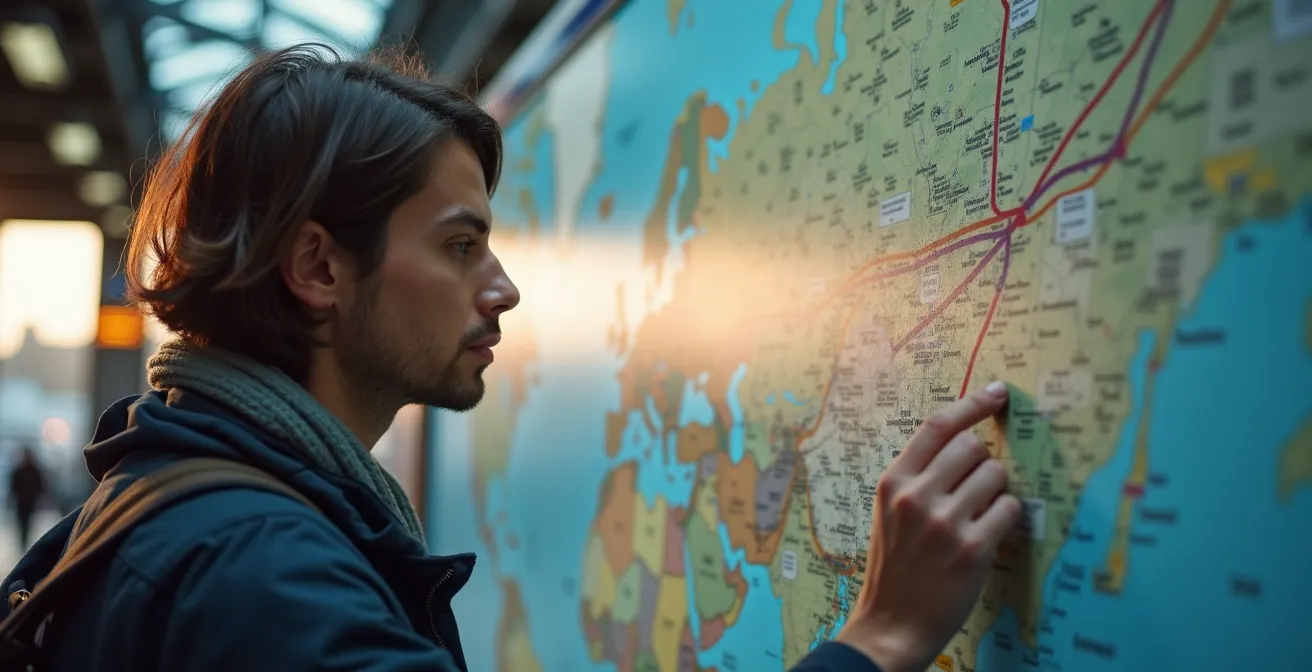
The act of studying a physical map on a station wall, tracing the route with your finger, connects you to the city in a way a phone screen never can. It forces you to build a mental model of the city’s layout, reinforcing your own internal GPS. This is the art of navigation in its purest form.
Women-only carriages: How to find them on Indian or Japanese trains?
Certain transit systems incorporate features that are a direct response to specific social needs. Women-only carriages, found in countries like Japan, India, and Brazil, are a prime example. For visitors, knowing not only that they exist but *how* to find and use them correctly is a practical matter of comfort and cultural awareness. These aren’t just special sections; they are a fully integrated part of the system’s daily operation, with their own rules and visual language.
In Japan, these carriages are typically only operational during morning and evening rush hours on weekdays. The system for identifying them is highly visual and consistent. You need to look for specific cues on the platform *before* the train even arrives. Pink stickers on the platform floor mark exactly where the doors of the women-only car will open. The cars themselves are also clearly marked with pink “Women Only” signs on the windows. It’s a simple, effective system, but you need to know what to look for. This level of detail extends to the global context, where implementation varies significantly.
The following table shows how this safety feature is implemented differently around the world, which is crucial information for a global traveller. The absence of such a system in the UK, despite ongoing discussions, highlights the different approaches to public safety and social space.
The specifics of this feature can vary greatly, as shown in this global comparison of women-only carriages.
| Country | Implementation | Operating Hours | Coverage |
|---|---|---|---|
| Japan | 1-2 carriages per train | Rush hours only (weekdays) | Major urban lines |
| India (Delhi Metro) | First car of every train | All operating hours | Entire metro network |
| Brazil (São Paulo) | Dedicated cars marked pink | Rush hours | Some lines only |
| Egypt (Cairo) | Middle cars of train | All day | All metro lines |
| UK | Not implemented | N/A | Under discussion for safety |
Your action plan: Spotting Women-Only Cars in Japan
- Look for pink stickers on the platform floor indicating where women-only cars stop.
- Check platform signs showing operating hours (typically 7:00-9:30 AM and 5:00-7:00 PM weekdays).
- Note that women-only cars are usually at the front or rear of the train (varies by line).
- Confirm with the pink ‘Women Only’ stickers that appear on car windows and doors.
- Remember that during non-designated hours, these cars are open to all passengers.
Paris Metro strikes: How to plan alternative routes instantly?
Every transit system has its unique point of failure. In London, it might be a signal failure; in Paris, it’s often the infamous ‘grève’ (strike). Being able to adapt to these disruptions is the hallmark of a truly seasoned urban navigator. The skills you learn dealing with one city’s chaos are surprisingly translatable to another’s. A Londoner who can navigate a Tube strike already has the foundational mindset to handle a Paris Metro shutdown.
The key is a multi-layered approach to route planning. First, you need a reliable, real-time information source, like the official RATP app in Paris or the TfL website in London. Second, you need a smart routing app like Citymapper, which excels at incorporating live disruption data. Third, you must have a mental map of alternative transport modes: buses, regional trains (like the RER in Paris or the Elizabeth Line in London), bike-sharing schemes, and even river boats. This is not just about finding an alternative route; it’s about having a flexible, multi-modal strategy ready to deploy at a moment’s notice.
London to Paris: Applying Strike Navigation Skills
The transferability of these skills is not just theoretical. During major London Underground strikes, commuters who were also familiar with the Parisian system intuitively applied their ‘grève’ strategies. As a study on transport flexibility shows, they instinctively switched to Santander Cycles for short journeys, relied on the more resilient Elizabeth Line for cross-city travel, and used apps in ‘strike mode’ to maintain their normal commute times. It proves that learning to navigate disruptions in one city effectively trains you for a dozen others.
This proactive, adaptive mindset is the pinnacle of urban transit mastery. You no longer just ‘use’ the system; you anticipate its weaknesses and have a plan B, C, and D already in your pocket. It’s about seeing the entire city’s transport network as your toolkit, not just a single, fragile line on a map.
Why taking the local bus is better than a hop-on hop-off tour
One of the biggest mistakes a first-time visitor can make is confining themselves to tourist-centric transport. The hop-on hop-off bus seems convenient, but it’s an expensive, inefficient bubble that separates you from the real city. The true urban explorer knows that the humble local bus is often the superior choice for authentic, cost-effective sightseeing. It’s the difference between watching a film about a city and actually being in it.
The economic argument is staggering. In London, for instance, a 24-hour hop-on hop-off ticket can cost around £35. In contrast, the daily cap for all bus travel using a contactless card is just a fraction of that, at about £5.25. This means you could have nearly a week of authentic bus travel across the entire city for the price of a single day on a tourist bus. This isn’t just about saving money; it’s about gaining freedom. You’re not tied to a predetermined tourist loop; the entire city network is yours to explore.
Moreover, many standard local bus routes are “accidental” sightseeing tours, passing more major landmarks than their expensive counterparts. London’s Route 11 is legendary for this, passing St Paul’s, Trafalgar Square, and Westminster. Similarly, Rome’s Route 64 takes you from the Vatican through the historic centre, and Paris’s Route 69 connects the Eiffel Tower to the Père Lachaise cemetery via the Louvre and Notre Dame. By choosing the local bus, you see the monuments alongside the everyday life of the city—the school runs, the grocery trips, the daily commute. You share a space with locals and see the city through their eyes, from a ground-level perspective that a double-decker tourist bus can’t offer.
Single-sex vs mixed zones: What is standard in German vs UK spas?
The principle of decoding hidden cultural rules extends beyond the transit system. A classic example for any Brit travelling in continental Europe is the spa. What is a relaxing experience in the UK can become a source of major social anxiety in Germany if you don’t understand the local “system.” The difference in etiquette, particularly regarding nudity and gender mixing, is stark and demonstrates another form of cultural systemic decoding.
In most UK spas, the sauna and steam room experience is a swimwear-on, often gender-separated affair. Quiet conversation is generally acceptable. In Germany, the rules are almost the precise opposite. The sauna area is a ‘textilfrei’ (textile-free) zone, meaning swimwear is strictly forbidden for hygiene reasons. It is also almost always mixed-gender. The expectation is for complete silence, especially during the ‘Aufguss’ ritual where a sauna master circulates scented steam. Another crucial rule is that your body must not touch the wooden benches directly; a towel must always be underneath you.
This isn’t a matter of one culture being “right” and the other “wrong.” It’s simply a different system with different rules, born from a different cultural perspective on nudity, hygiene, and social space. For the unprepared Brit, it can be a shock. But for the traveller who has done their homework, it’s just another system to be understood and respected. The table below illustrates these key differences clearly.
| Aspect | UK Spas | German Spas |
|---|---|---|
| Dress Code in Saunas | Swimwear mandatory | Nude only (textilfrei) |
| Mixed Gender Saunas | Rare, usually separate | Standard practice |
| Towel Rules | Optional for sitting | Mandatory on all surfaces |
| Talking in Saunas | Quiet conversation OK | Complete silence expected |
| Children Access | Family hours common | Adult-only areas standard |
| Temperature Range | 60-80°C typical | 80-100°C common |
Key takeaways
- Decode the System: Don’t just follow signs; understand the underlying logic of exit numbers, line colours, and cultural norms.
- Exit-First Navigation: In massive hubs like Shinjuku, identify your final destination’s exit number *before* you enter the station. It’s your most important piece of data.
- Embrace Analogue Resilience: Technology fails. A screenshot of your route and the ability to read a physical station map are your most reliable backup tools.
How to spot a ‘tourist trap’ restaurant within 30 seconds?
Your urban navigation skills are incomplete if they only get you from A to B. True mastery is about navigating the entire urban experience, including one of the most common pitfalls: the tourist trap restaurant. Just like a complex subway station, the restaurant landscape of a major city has its own system of signals and red flags. Learning to decode them can be the difference between an authentic, memorable meal and an overpriced, forgettable one.
The signs are often laughably obvious once you know what to look for. The most egregious is the aggressive host or tout standing outside, trying to physically pull you in. A quality local establishment doesn’t need to beg for customers. Another dead giveaway is the menu itself: if it’s laminated, available in five or more languages, and features sad, faded photos of the food, you should run. These are designed for maximum tourist throughput, not culinary excellence. Also, be wary of any restaurant whose primary selling point is its location directly facing a major attraction’s entrance.
The Three Street Rule Success Story
A food blogger rigorously tested the “Three Street Rule,” a simple but powerful heuristic for avoiding tourist traps. The rule is simple: from any major tourist site, walk at least three blocks in any direction before you even consider looking at a menu. The blogger’s results across ten European cities were dramatic: average meal costs plummeted by 40%, while the proportion of local diners skyrocketed. The rule forces you out of the tourist-saturated “blast radius” of an attraction and into the real neighbourhoods where locals actually eat.
The ultimate test is to observe the clientele during local peak hours. If it’s 8:30 PM in Rome and the restaurant is full of tourists and empty of Italians, you have your answer. Applying this simple pattern recognition is the final layer of your systemic decoding skill set. You’re no longer just navigating the physical city, but its social and commercial landscapes as well.
Now that you are equipped with the mindset of a system decoder, from the mechanics of transit cards to the subtleties of social etiquette, you’re ready to see the urban environment not as a challenge to be feared, but as a fascinating puzzle to be solved. To bring it all back together, it’s essential to never lose sight of the foundational principles we started with.