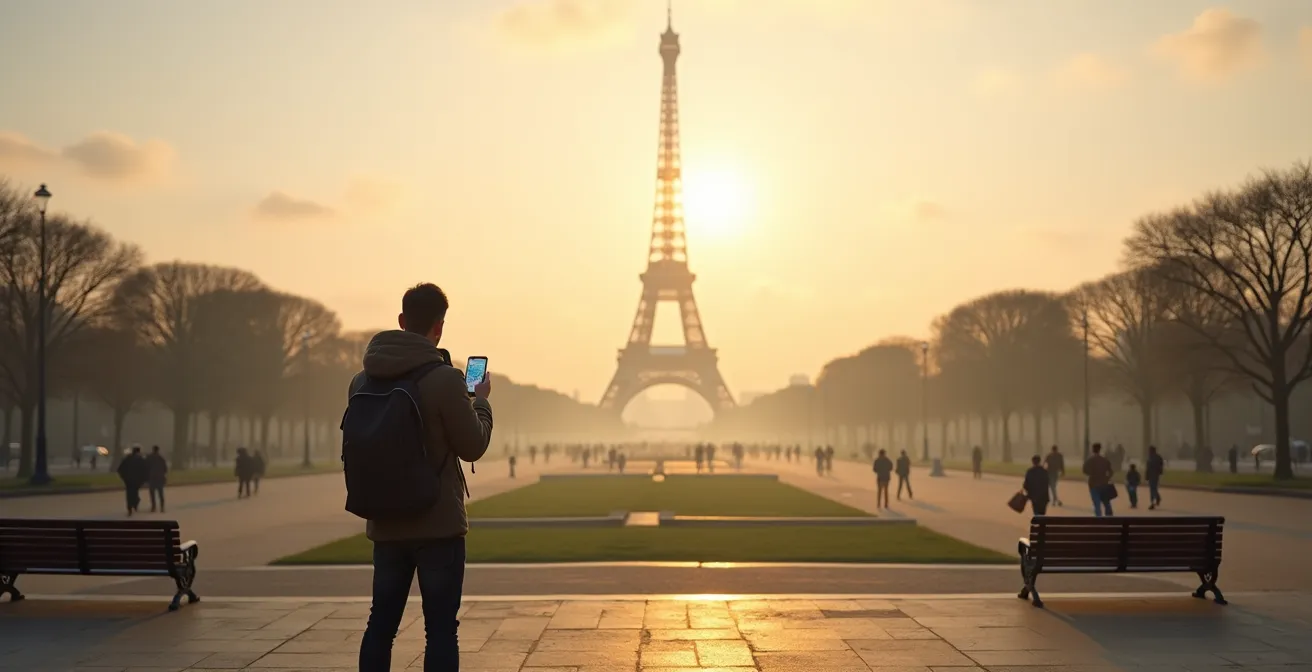
Beating Paris queues is less about finding a single “skip-the-line” ticket and more about strategic timing and knowing the city’s internal rhythm.
- The 2-day Paris Museum Pass pays for itself after just three major sites, saving you money and booking hassle on your UK bank cards.
- Wednesday evenings at the Louvre and off-peak dining (arriving at 7 PM) are your two most powerful, non-negotiable weapons against crowds.
Recommendation: Your most valuable asset is time. For high-stakes sites like the Louvre or Versailles, investing in a private guide is strategic insurance that guarantees a return on your holiday investment.
You have 48 hours in Paris. The fantasy is strolling along the Seine, a croissant in hand. The reality? Two hours in a sweltering queue for the Louvre, another hour shuffling towards the Eiffel Tower lifts, and your precious weekend evaporating under the Parisian sun. Everyone will tell you to “buy tickets online” or “go in the off-season,” but that’s useless advice when you have a specific weekend booked and a long list of sights to see. You’re not a first-timer who’s happy to just see the outside; you’re here to experience the best of the city, and waiting in line is not on the itinerary.
The truth is, the standard tourist advice is broken. It treats every visitor the same and ignores the fundamental currency of a short trip: time. So, what if the real key wasn’t just about pre-booking, but about adopting a completely different mindset? This isn’t a guide about finding one magic ticket. It’s about thinking like a savvy local — making calculated trade-offs, understanding the city’s rhythm, and knowing exactly where the crowd arbitrage opportunities are. It’s about treating your time with the same respect you treat your money.
This guide will walk you through the real strategies for a queue-free Parisian weekend. We’ll analyse the hard numbers on museum passes, reveal the best times to visit key attractions, provide ready-made backup plans for transport strikes, and even explain how to navigate the city’s social codes to your advantage, from getting a table at a hot bistro to dealing with common street scams.
To navigate this guide efficiently, here is a summary of the tactical points we will cover. Each section is designed to give you a specific, actionable strategy to reclaim your time and experience Paris like an insider, not a tourist.
Summary: Your Strategic Guide to a Queue-Free Paris
- Is the Paris Museum Pass worth it for a 2-day trip?
- Why the Louvre is better on a Wednesday evening
- How accessible are the catacombs for wheelchair users?
- What to see just 5 minutes from Notre-Dame to escape the crowds?
- The petition scam and gold ring trick: How to react?
- Paris Metro strikes: How to plan alternative routes instantly?
- Walk-in vs Reservation: How to get into Paris’s hottest bistro?
- Audio guide or Private tour: Which offers better insight for the British Museum?
Is the Paris Museum Pass Worth It for a 2-Day Trip?
Let’s get straight to the point: for a time-crunched UK visitor, the question isn’t just about saving money, it’s about saving hassle. Juggling multiple online bookings, dealing with separate transactions, and racking up 2-3% in foreign card fees for each ticket is a waste of energy. The Paris Museum Pass is a strategic tool. The maths is simple: recent analysis shows that to break even on a 2-day pass, a UK visitor needs to visit just three major attractions. With the Louvre at €22, Versailles at €27, and the Musée d’Orsay at €16, you’re already ahead.
Consider the case of a British traveller earlier this year. They used a 2-day pass for the Louvre, Versailles, Orsay, and the Rodin Museum. The individual ticket cost would have been €79, but the pass was €70. That’s a €9 saving before even considering the four separate UK bank card fees they avoided. More importantly, it meant one booking, one payment, and no need to stand in ticket-buying queues anywhere. It transforms your trip from a series of administrative tasks into a seamless experience.
Case Study: The Real-World Value for a UK Visitor
A UK traveller in 2024 visited the Louvre (€22), Versailles on a fountain day (€27), the Musée d’Orsay (€16), and the Rodin Museum (€14) within their 2-day pass window. The total à la carte value was €79. Compared to the €70 pass cost, they saved €9 in cash, but more critically, they avoided four separate ticket queues and four potential foreign transaction fees on their bank card, saving them both time and administrative friction.
The table below breaks down the costs, showing how quickly the pass provides a return on investment, not just in pounds and pence, but in flexibility and time.
| Option | Cost in EUR | Cost in GBP (approx.) | What’s Included | Savings for 2-Day Trip |
|---|---|---|---|---|
| 2-Day Museum Pass | €70 | £59 | 50+ museums & monuments | Save £31+ with 3 major sites |
| Individual Tickets (Louvre + Orsay + Arc) | €54 | £45 | 3 specific attractions only | No savings, less flexibility |
| Versailles + Louvre + Rodin (separate) | €68 | £57 | 3 specific attractions only | Pass saves £2 but adds 47 more options |
| UK Bank Card Fees (typical) | 2-3% per transaction | £0.50-£1 per ticket | Multiple transactions | Pass = single fee vs 3-4 fees |
Your Queue-Beating Audit: A 5-Point Plan
- Identify Choke Points: List your top 3 “must-see” sites with the worst queue reputations (e.g., Louvre, Eiffel Tower, Orsay).
- Gather Intel: Check official websites for late openings, timed-entry slots, and lesser-known alternative entrances for each site.
- Assess the ROI: Compare the cost of a Museum Pass or private tour against the value of the 2-4 hours of queue time you will save.
- Create a Pivot Plan: For each day, pre-map one alternative activity or route in case of unforeseen strikes or closures.
- Deploy Local Tactics: Schedule your visits to exploit the “local rhythm”—late museum entries and early dinners—to avoid peak tourist waves.
Why the Louvre Is Better on a Wednesday Evening
Visiting the Louvre during the day is a battle. It’s a chaotic, noisy, and frankly, unpleasant experience for anyone who actually wants to appreciate art. The secret weapon for any savvy visitor is “crowd arbitrage”: going when everyone else is at dinner. The Louvre has late openings until 9:45 PM on Wednesdays and Fridays, and this is your golden ticket. It’s not just slightly less busy; it’s a completely different museum.
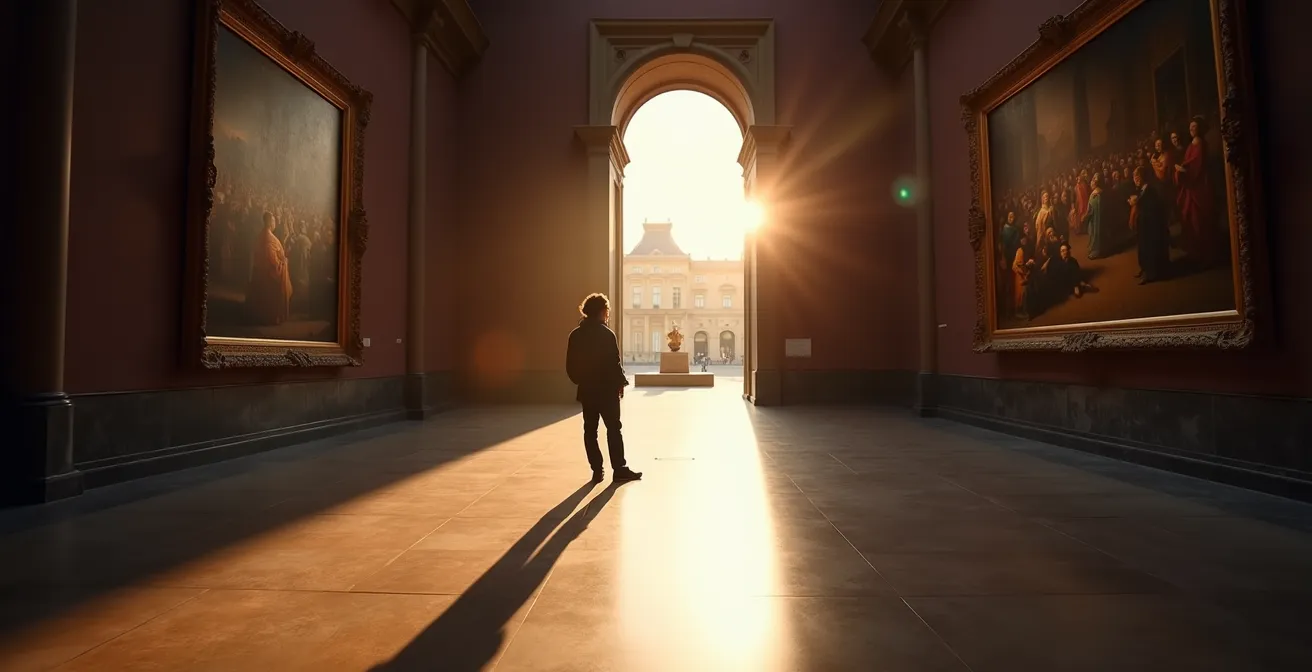
The transformation is dramatic. As the image above suggests, the galleries become quiet, contemplative spaces. Museum attendance data shows that Wednesday evenings after 6 PM see up to 70% fewer visitors compared to the midday rush. This means you can stand in front of the Winged Victory of Samothrace without being jostled, or admire the Grand Gallery’s masterpieces in relative peace. Even the Mona Lisa, a circus during the day, becomes approachable. You can get close, take your picture, and move on in minutes, not half an hour.
To maximise this opportunity, book a timed entry slot for around 6:30 PM. This gives you over three hours to explore. Don’t rush to the big-name pieces. Start in the quieter wings like Richelieu, with its magnificent French sculptures in the Cour Marly, which are spectacularly lit at night. Save the Denon wing (home of the Mona Lisa) for later in the evening, around 8 PM, when the last of the day-trippers have finally departed. It’s a strategic move that turns a stressful obligation into a genuinely magical experience.
How Accessible Are the Catacombs for Wheelchair Users?
Let’s be blunt: they are not accessible at all. There is no polite way to phrase it. The very nature of this 18th-century ossuary, located 20 meters underground, makes it impossible for wheelchair users or anyone with significant mobility issues. There is no lift, no ramp, no alternative. The official accessibility information confirms the site requires navigating 131 steps down and 112 steep, winding steps back up.
For a visitor who has come all the way from the UK, discovering this on arrival is a trip-ruining moment. Don’t waste your time. Instead of focusing on what you can’t see, pivot to superior, and fully accessible, underground experiences that offer a similar sense of history and mystery. Paris has a wealth of subterranean sites that are far more welcoming and just as fascinating. This isn’t about settling for second best; it’s about choosing a better-designed experience.
Here are four excellent, fully or partially accessible alternatives that give you a taste of underground Paris without the exclusionary staircase:
- Crypte Archéologique (Notre-Dame forecourt): Located directly beneath the square in front of Notre-Dame, this archaeological crypt is fully wheelchair accessible via a lift and showcases the foundations of Paris from Roman times.
- Paris Sewer Museum (Musée des Égouts): It may not sound glamorous, but this recently renovated museum is a fascinating feat of engineering and is partially accessible, with an elevator providing access to the main exhibits.
- Medieval Louvre Foundations: When visiting the Louvre, don’t miss the foundations of the original medieval fortress in the basement. Access is step-free via the museum’s main elevators.
- Musée Carnavalet Crypts: The museum of Paris history has accessible sections within its crypts that display historical artifacts and architectural remains from the city’s past.
What to See Just 5 Minutes From Notre-Dame to Escape the Crowds?
The area around Notre-Dame is ground zero for tourist crowds. It’s a stressful bottleneck of tour groups, selfie sticks, and souvenir stalls. The smart move is to use the cathedral as an anchor point and immediately pivot to the peaceful enclaves just a stone’s throw away. Resisting the pull of the main thoroughfare is key. Instead, cross the small bridge, Pont Saint-Louis, and you’re in another world.

You’ve arrived on Île Saint-Louis, the quieter, more residential island next to the bustling Île de la Cité. This is your sanctuary. The main street is lined with charming boutiques and, most famously, the original Berthillon ice cream shop. But the real prize is the quayside. Grab a bottle of wine, some cheese, and a baguette from a local *épicerie* and find a bench along the Quai de Bourbon or Quai d’Anjou. Here, you can have an impromptu picnic with a stunning, crowd-free view back towards Notre-Dame, as the scene above perfectly captures.
If you head in the other direction from the cathedral, you’ll find the legendary Shakespeare and Company bookstore. While the ground floor is often busy, most tourists miss the quiet reading room and library on the first floor. It’s a perfect little haven to rest for 20 minutes, browse old books, and watch the chaos unfold from a peaceful vantage point. The adjacent café also offers a great spot for people-watching that’s set back from the main tourist trail. These small, strategic retreats are the difference between a frantic tour and a memorable Parisian experience.
The Petition Scam and Gold Ring Trick: How to React?
In high-traffic areas like Montmartre or near the Eiffel Tower, you will be approached by scammers. The two most common are the ‘gold ring’ trick (someone “finds” a ring at your feet and tries to give it to you for a reward) and the ‘petition’ scam (groups of people, often feigning to be deaf or mute, aggressively soliciting signatures and “donations” for a fake charity). Your British politeness is your biggest liability here. Hesitation is seen as an opening.
The only effective strategy is immediate, firm disengagement. You need to adopt the “London Underground commuter” mindset: look straight ahead, maintain your pace, and offer no verbal or non-verbal invitation to engage. The renowned travel expert Rick Steves puts it perfectly:
The most effective deterrent is a firm, direct ‘No, thank you’ while maintaining eye contact and continuing to walk – British visitors often hesitate due to politeness, but Parisian scammers exploit this hesitation.
– Rick Steves, Paris Travel Guide
Do not stop. Do not apologise. Do not try to reason with them. A simple, sharp “No” or ignoring them completely is your best defence. If someone is persistent, a louder, firmer “Laissez-moi tranquille!” (Leave me alone!) will usually do the trick. It signals you are not an easy target. It feels rude, but it’s a necessary cultural adjustment for staying safe. Below are a few key phrases and numbers to have ready.
- Say ‘Laissez-moi tranquille!’ (Leave me alone!) firmly if approached persistently.
- Call 17 for police or 112 for the general emergency services (this works across Europe and operators often speak English).
- Note the British Consulate Paris number: +33 1 44 51 31 00, located at 35 rue du Faubourg St-Honoré.
- Keep walking with purpose; don’t break your stride to engage.
- If you do lose anything, report it to the nearest police station (*commissariat*) to get a report for your travel insurance.
Paris Metro Strikes: How to Plan Alternative Routes Instantly?
Parisian transport strikes (*grèves*) are not a rare disaster; they are a predictable part of city life, especially in spring. For a tourist with a timed-entry ticket to a museum, a strike can cause serious disruption. Transport disruption analysis reveals that even during ‘minimum service’ strikes, around 40% of tourists with pre-booked tickets are affected by reduced service. Having a backup plan isn’t optional, it’s essential.
Your first step is to check the RATP app or website the evening before for any announced disruptions. If your line is affected, don’t panic. Paris is a surprisingly compact city with multiple overlapping transport systems that are often immune to Metro strikes. The key is to know your options and be ready to pivot instantly. Ride-sharing apps like Uber and Bolt will work, but expect surge pricing to double or triple the fare. Official G7 taxis are a more reliable, if expensive, option.
However, the most resilient and often most pleasant alternatives are human-powered or water-based. The Vélib’ bike-sharing system is excellent and unaffected by strikes. For a weekend visitor, a day pass is cheap and allows you to make short, scenic journeys across the city centre. And don’t forget the Seine itself. The Batobus river shuttle connects key riverside attractions from the Eiffel Tower to the Jardin des Plantes and runs normally during strikes. It’s slower, but it’s a guaranteed, scenic way to travel.
This matrix outlines your best alternatives, focusing on compatibility with UK cards and their resilience during strikes.
| Transport Option | Cost | UK Card Compatible? | Strike Impact | Best For |
|---|---|---|---|---|
| Vélib’ Bikes | €5/day pass | Yes – Visa/Mastercard | None – always available | Short distances, good weather |
| Uber/Bolt | €15-30 typical | Yes – link UK account | Surge pricing 2-3x | Direct routes, groups |
| G7 Taxi App | €20-35 typical | Yes – English interface | High demand, longer waits | Official rates, receipts |
| Batobus River | €19/day | Yes – online booking | None – runs normally | Seine-side attractions |
| Walking | Free | N/A | None | Central Paris, fitness lovers |
Walk-in vs Reservation: How to Get Into Paris’s Hottest Bistro?
Unlike London, where almost every restaurant is on OpenTable or TheFork, many of Paris’s most authentic and sought-after bistros operate on an old-school system. They either don’t take reservations at all, or they prioritise phone calls over online booking platforms. This cultural difference is a major stumbling block for UK visitors who are used to booking everything digitally. Relying solely on apps will mean you miss out on the best places.
The key is to tap into the local rhythm. Parisians dine late, often sitting down at 8:30 PM or 9:00 PM. This creates a golden window of opportunity for you. By booking for 19:00 (7 PM), you’re taking a slot that most locals don’t want, which dramatically increases your chances of success. For those highly-desirable, walk-in-only spots, your strategy is to arrive 15 minutes before they open, usually at 18:45 for a 19:00 service. You’ll be first in the queue.
A British food blogger recently highlighted this disparity perfectly: they found that calling the popular bistro L’Ami Jean directly in the afternoon for a same-evening reservation had an 80% success rate, even when TheFork showed it as “fully booked” for weeks. The crucial factor? Attempting to speak even a few words of French. It shows respect and immediately separates you from the mass of tourists. If your French isn’t up to it, ask your hotel concierge to call on your behalf; their established relationships can often work wonders.
- Call directly instead of using apps. A simple “Bonjour, je voudrais réserver une table pour [number] personnes pour [date], s’il vous plaît” goes a long way.
- Book for the 19:00 (7 PM) service, which is early for Parisians but perfect for UK dinner timing.
- For walk-in-only spots, arrive 15 minutes before opening time.
- Have your hotel concierge call if you’re not confident with your French.
- Try the lunch service (12:00-14:00) for an easier-to-get table at places that are impossible to book for dinner.
Key Takeaways
- Your time is the most valuable currency on a short trip. Any cost that saves you hours in a queue has a positive return on investment.
- Exploit the city’s rhythm. Late museum nights (Louvre on Wednesday) and early dinner times (7 PM) are your best tools to avoid the peak tourist bubble.
- Always have a backup plan. For every Metro route, know the walking or Vélib’ alternative. For every inaccessible site, have a superior, accessible option ready.
Audio Guide or Private Tour: Which Offers Better Insight for the British Museum?
To understand the value proposition in Paris, let’s first put it in terms a Londoner understands by looking at the British Museum. Entry is free. You can wander in, grab a £7 audio guide, and explore at your own risk. If the guide is boring or you get lost, you’ve only lost the price of a pint. The stakes are low. In Paris, the financial and temporal stakes are exponentially higher.
With entry to the Louvre at €22 and Versailles costing up to €32, you are making a significant upfront investment before you even step inside. As travel writer Sophie Nadeau notes, a guide in Paris is a strategic tool:
At the free British Museum, an audio guide is low-risk experimentation. At the Louvre with its €22 timed entry, a private guide becomes strategic insurance for your holiday investment – you’re not just buying expertise, you’re buying time, sanity, and guaranteed access to must-see works.
– Sophie Nadeau, solosophie Travel Blog
A good private guide doesn’t just provide commentary; they provide queue-jumping logistics, crowd navigation, and thematic coherence in a building the size of a small town. They ensure you see the key works you came for without spending hours backtracking through crowded rooms. An audio guide can’t do that. The table below compares the value proposition directly. The “Queue-Jump Value” is where a Paris tour provides a massive return on investment that simply doesn’t exist at the free-to-enter British Museum.
| Factor | British Museum | Louvre/Versailles | Winner For Value |
|---|---|---|---|
| Entry Cost | Free | €20-32 (£17-27) | Private tour better in Paris – protects investment |
| Audio Guide Cost | £7 | €5 (£4) | Similar value both cities |
| Private Tour Cost | £150-200 | €150-250 (£125-210) | Paris – includes queue-jumping value |
| Queue-Jump Value | Minimal – no entry queue | Saves 1-3 hours | Paris tour adds time value |
| Crowd Navigation | Helpful but optional | Essential for efficiency | Paris tour crucial for experience |
Ultimately, navigating Paris efficiently is a game of strategy. By applying these insider tactics, you trade frustration and wasted hours for memorable experiences. Now that you have the right mindset, the next step is to start building your own smart, queue-free itinerary.