
The belief that Greek wine tastes better on holiday isn’t just a psychological trick of being relaxed. It’s a tangible phenomenon rooted in the scientific principle of ‘terroir’—a complex ecosystem of place, climate, culture, and biology. The perceived drop in quality back home isn’t a failure of the wine, but a result of removing it from the specific environmental and cultural context that allows its full character to emerge.
There’s a universal experience for anyone who has holidayed in the Greek islands. It’s the moment you take a sip of a crisp, local white wine at a seaside taverna. The liquid seems to contain the very essence of the place: the briny air, the warmth of the sun, the scent of wild herbs. You vow to bring a case home to England, only to find that when uncorked in your kitchen, the magic has vanished. The wine is still good, but it’s a ghost of its former self. The common explanation is psychological – you’re simply not on holiday anymore.
While mood certainly plays a role, this explanation is incomplete and dismisses the profound, tangible science of place. The truth is far more fascinating. That superior taste isn’t just in your head; it’s in the soil, the air, the microorganisms, and the cultural practices surrounding the bottle. This phenomenon is known as contextual integrity, a concept that goes far beyond the simple notion of terroir. It posits that a product’s true character is only fully expressed within the specific ecosystem where it was created.
This guide delves into the scientific and cultural reasons behind the ‘holiday wine’ effect. We will deconstruct the magic, exploring everything from the logistical challenges of transportation in a post-Brexit world to the subtle physics of cooking at different altitudes. By understanding the intricate web of factors that make that Greek wine taste so perfect on-site, you will not only gain a deeper appreciation for it but also learn how to better preserve and replicate that experience back in the UK.
This article explores the practicalities and the poetics of bringing the taste of Greece home, providing a comprehensive look at the journey from farm to your table. Below is a summary of the key areas we will cover.
Summary: Why That Holiday Wine Never Tastes the Same at Home
- Wine skins vs Bubble wrap: How to pack alcohol in checked luggage?
- Farm to table: How to visit a cheese producer without a tour group?
- What does the red and yellow label actually guarantee?
- Why heavy stew works in the mountains but fails at sea level?
- Buying direct: How to ensure your money goes to the farmer?
- Harvest participation: Is it free labor or a cultural experience?
- Vacuum packing: How to get pungent cheese through airport security?
- Menu in English: Is it always a sign of bad food in Rome?
Wine skins vs Bubble wrap: How to pack alcohol in checked luggage?
The first practical hurdle in transporting your liquid memories is navigating both baggage handler indifference and Her Majesty’s Revenue and Customs. The romance of a sun-drenched vineyard fades quickly when faced with the stark reality of post-Brexit regulations. For travellers arriving in Great Britain from the EU, the rules have become more stringent. You can now bring in up to 18 litres of still wine (the equivalent of 24 bottles) without paying any duty. This is a significant reduction from the previous, more lenient personal use guidelines, and exceeding this limit means you could be liable for tax on the entire amount.
Once you’ve calculated your allowance, the physical protection of the bottles becomes paramount. “Wine skins” or specialised inflatable protectors offer excellent security but can be bulky. A more DIY and cost-effective method is using bubble wrap, which is best brought from home. The key is to create a core of well-padded bottles in the centre of your suitcase, using your clothes as a shock-absorbing buffer. Think of your suitcase as a protective capsule, with the wine as its precious cargo. Using packing cubes can help create rigid compartments, further preventing bottles from shifting and clinking against each other during transit.
This logistical challenge is the first ‘shock’ the wine experiences, a journey from a place of slow creation to one of rapid, occasionally violent, transit. It is the first step in stripping the wine of its native context.
Farm to table: How to visit a cheese producer without a tour group?
To truly understand a wine, you must understand the food it grew up with. In Greece, this often means cheese. Bypassing organised tours and connecting directly with a small-scale cheese producer offers a portal into the very soul of the landscape. This isn’t just about tasting; it’s about witnessing the biochemical signature of a place. You see the same hardy shrubs the goats feed on that give the Feta its peppery notes. You feel the cool, humid air of the cellar that nurtures the specific mould cultures responsible for its character. This is where the abstract concept of terroir becomes a sensory reality.
Making a direct visit often requires little more than a polite phone call or email in advance. Many smaller, family-run operations are proud to share their craft, even if their English is limited. The goal is to observe the alchemy: the transformation of milk from local, indigenous breeds of sheep and goats into a product that speaks of its origin. This experience fundamentally changes your relationship with the food, turning it from a simple commodity into a story.
Case Study: The Inseparable Bond of PDO Feta and Assyrtiko
The Roussas Dairy’s Barrel-Aged Feta from Thessaly is a perfect illustration of this principle. Made from the milk of sheep and goats grazing in the mountainous region and aged in traditional wooden barrels, it develops a creamy, tangy profile. When paired with a crisp Assyrtiko wine from Santorini, a magical synergy occurs. The wine, grown in volcanic soil, has a distinct minerality and saline quality that echoes the saltiness of the cheese. According to food pairing experts, this harmony is born from shared Greek soil, a ‘conversation’ between two products of the same land that is impossible to replicate with a generic feta from a UK supermarket.
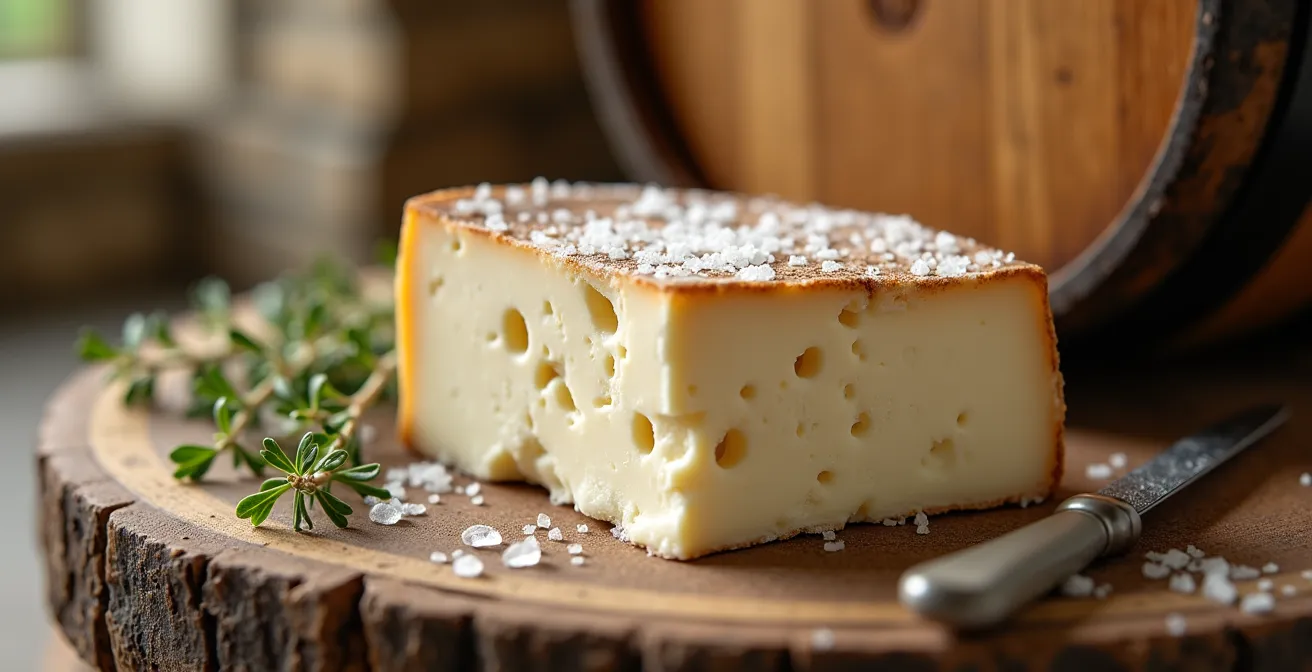
As you can see, the traditional methods—the wooden barrels, the stone walls of the cellar—are not just for show. They are active participants in flavour development, contributing to the microbial environment that makes each cheese unique. It is an experience that imbues the product with a meaning that travels with it, even if the flavour profile subtly shifts on its journey home.
Ultimately, visiting the source provides the memory and understanding that become a new, essential ingredient when you taste that cheese back home.
What does the red and yellow label actually guarantee?
On a shelf in a Greek delicatessen, you’ll see a small, circular red and yellow logo on certain products. This is the Protected Designation of Origin (PDO) seal, and it is your most reliable link back to the authentic taste you experienced. It is not a marketing gimmick; it’s a legally binding guarantee of contextual integrity. For a cheese to be labelled as “Feta” PDO, for example, it must meet a precise set of criteria that anchor it to its specific Greek origin. This is a promise that what you are buying is not an imitation.
The PDO rules are incredibly strict. As noted by experts on Greek food, the guarantee is extensive. Alpha Omega Imports clarifies that for Feta, this means, ” production exclusively in mainland Greece and Lesvos, milk from indigenous sheep and goats, and a minimum of two months’ aging in brine.” This legal framework protects the consumer from ‘feta-style’ cheeses made with cow’s milk in Denmark or Germany, which lack the specific flavour profile derived from Greek flora and animal genetics. For the UK consumer, there is good news: these protections remain robust. Following the Brexit transition, all EU PDO products that were protected at the end of 2020 were automatically granted protection under UK law, ensuring that the Feta you buy in England, if it bears the PDO logo, is the real article.
Therefore, when you’re trying to recapture that holiday flavour, seeking out the PDO label is the single most important step you can take. It’s your assurance that the fundamental building blocks of the product are the same ones you enjoyed under the Greek sun.
Why heavy stew works in the mountains but fails at sea level?
The concept of contextual integrity extends beyond wine and cheese into the very physics of cooking. You may have brought back a recipe for a rich lamb ‘Kleftiko’ from a mountain village in Crete, but find it turns out stodgy and bland in your London flat. This isn’t a failure of your cooking skills; it’s a demonstration of sensory dissonance caused by a change in environment. The physical properties of your surroundings—altitude, humidity, and atmospheric pressure—are invisible but powerful ingredients in any recipe.
At high altitudes, water boils at a lower temperature (below 100°C). This means that foods in a stew simmer more gently and for longer, allowing complex flavours to meld without the meat becoming tough. The air is also typically drier, which affects evaporation rates. At sea level in the damp UK climate, water boils at a higher temperature, and the high humidity slows evaporation from the pot. This can lead to harsher cooking, diluted flavours, and a different texture. The robust stew that was perfect for a cool evening in the mountains feels heavy and out of place at a lower, more humid altitude. It’s a scientific reminder that recipes are not just lists of ingredients, but formulas deeply intertwined with their specific environment.
Your Action Plan: Adapting Greek Mountain Recipes for a UK Kitchen
- Cooking Times: Adjust for the UK’s damp climate. Plan for 15-20% longer simmering times for stews to allow flavours to deepen without boiling too aggressively.
- Wine Selection: You may not find the exact local village wine, so choose a robust, widely available Greek varietal like Agiorgitiko or Mandilaria that can be found in UK wine shops to maintain the flavour profile.
- Temperature Compensation: Increase the initial searing heat for meats. This helps create a good crust and deep flavour (Maillard reaction) to compensate for the higher humidity which can otherwise ‘steam’ the meat.
- Altitude Adjustment: Be cautious with liquids. Since evaporation is slower at sea level, start with slightly less stock or water than the recipe calls for. You can always add more later.
- Wine Pairing Temperature: Serve red wines slightly cooler than you would in the mountains. The perception of alcohol is greater at sea level, and a cooler temperature will make the wine feel more refreshing and less ‘heavy’.
By making these small but crucial adjustments, you are not just following a recipe; you are actively translating it from one context to another.
Buying direct: How to ensure your money goes to the farmer?
Another crucial element of the ‘holiday wine’ experience is the story of its origin, often told by the producer themselves at a ‘laiki agora’ or local farmers’ market. This direct transaction feels authentic and ensures your money supports the family who grew the grapes. However, replicating this direct-to-consumer chain from the UK is fraught with complexity, a situation exacerbated by Brexit. The dream of ordering a case directly from that small winery you visited runs into a wall of customs declarations, VAT registration, and excise duty. It’s a prime example of logistical shock.
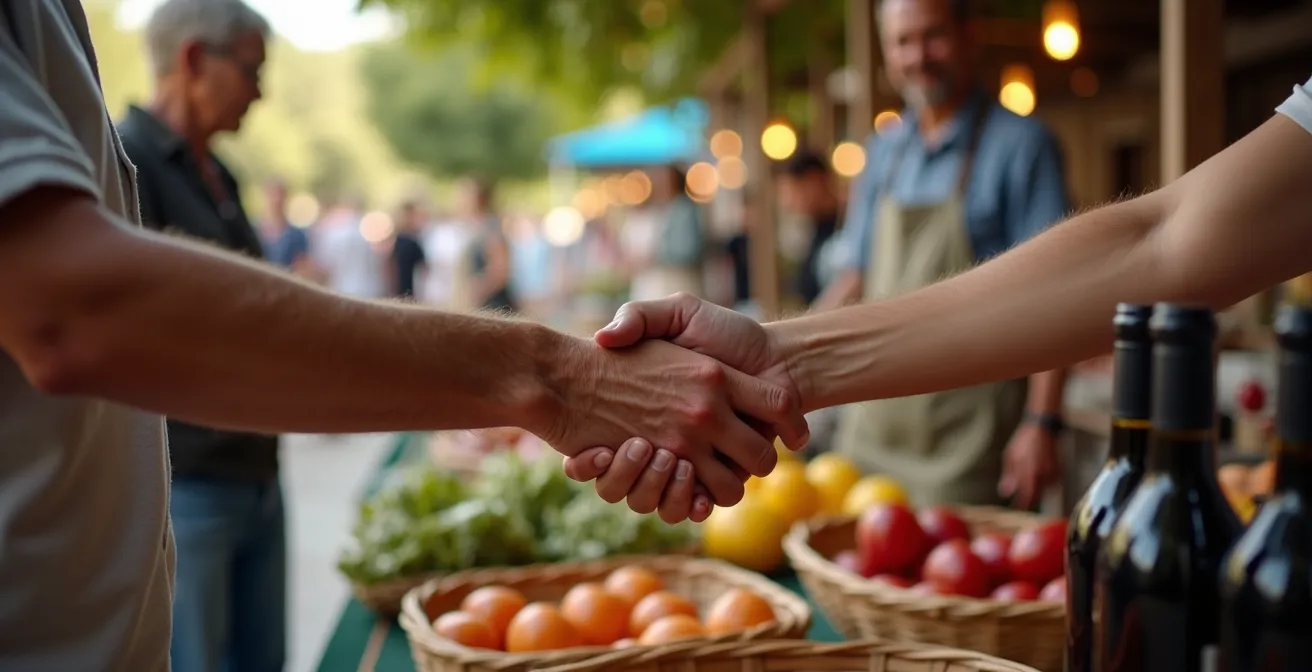
The most effective way to support the producer from the UK is often through a specialist importer. These importers build relationships with small, quality-focused wineries and handle the formidable administrative burden of bringing their wines into the country. While it adds a layer between you and the farmer, a good importer is more of a curator and a partner than a simple middleman. They seek out the authentic, terroir-driven wines that larger distributors ignore and are often passionate about telling the producer’s story.
Case Study: The Post-Brexit Import Maze
The journey of a wine bottle from a small Greek vineyard to a UK doorstep has become significantly more complex. As detailed in analyses of post-Brexit wine importing, the challenges are numerous. EU sellers now need to register for UK VAT, and customs declarations are required at French ports, often necessitating the use of physical customs agents. While direct-from-grower models are appealing as they bypass multiple intermediaries, they now face administrative costs and complexities that traditional importers are better equipped to absorb through volume. This new reality makes the role of dedicated, small-scale UK importers even more vital in preserving the link to authentic Greek producers.
So, while you may not be handing your cash directly to the farmer, buying from a reputable, specialist UK importer who champions their wines is the next best thing, ensuring the continued viability of the authentic producers you want to support.
Harvest participation: Is it free labor or a cultural experience?
For the truly dedicated, the ultimate way to understand a wine is to participate in its creation. The annual grape harvest, or ‘trygos’, is a cornerstone of rural Greek culture. Participating in it can be a profound experience, connecting you to the land, the rhythm of the seasons, and the community in a way that simple tasting never can. However, the line between an authentic cultural pairing and informal labour can be blurry, especially for UK citizens in the post-Brexit era. What was once a simple arrangement can now involve questions of visas and work permits.
Organised agritourism programmes offer a structured and legally sound way to engage. These are paid experiences, but they provide insurance, guidance, and a curated cultural immersion. You’ll work alongside seasoned pickers, share communal meals, and learn first-hand the difference between picking grapes for a zesty white versus a robust red. This is far from ‘free labour’; it is an educational exchange. Unofficial arrangements, like those offered by platforms such as WWOOF (World Wide Opportunities on Organic Farms), operate in a greyer area, involving work in exchange for lodging and food. While often rewarding, it’s crucial to understand the legal and insurance implications before committing, as these activities may not be covered under the 90-day visa-free tourist allowance for UK citizens.
Ultimately, participating in the harvest, even for a day, provides the ultimate context. The wine you drink afterwards is no longer just a beverage; it’s a repository of your own effort, of shared laughter, and of the sun on your back.
Vacuum packing: How to get pungent cheese through airport security?
Bringing back a truly authentic, pungent Greek cheese presents a unique challenge: odour control. The very aromatic compounds that make a barrel-aged feta or a sharp Kefalotyri so delicious can become a liability in the confines of a suitcase or an airport cabin. The goal is to contain the cheese’s powerful personality without damaging its delicate structure. Your choice of packing method can make the difference between a treasured souvenir and a bag that needs to be permanently quarantined. Fortunately, there are established best practices for this aromatic contraband.
Vacuum packing is by far the superior method. Many Greek delicatessens and even supermarkets offer this service for a small fee. It removes most of the air, dramatically reducing odour leakage and inhibiting the growth of mould. It is so effective that it has become the preferred method for travellers, a fact acknowledged even by airport officials. Storing cheese in its original brine is best for long-term preservation but is impractical and often prohibited in hand luggage due to liquid restrictions. Multiple layers of cling film are a last resort; they offer some protection but are far from foolproof. For strong cheeses, combining an airtight container with a well-wrapped piece is a good belt-and-braces approach, especially for items in your hand luggage.
This table compares the main methods for transporting cheese by air, with a focus on what is most acceptable for UK customs.
| Method | Effectiveness | UK Customs Acceptance |
|---|---|---|
| Vacuum packing | 95% odor suppression | Preferred by UK Border Force |
| Multiple cling film layers | 60% odor suppression | Acceptable if well-wrapped |
| Airtight containers | 80% odor suppression | Good for hand luggage |
| Original brine packaging | Best for preservation | Must be in checked luggage |
Once you arrive in the UK, it’s vital to unwrap the cheese from its travel packaging and store it correctly—refrigerated and either in its brine or a new, lightly salted water solution—to allow it to breathe and recover from its journey.
Key Takeaways
- The ‘holiday wine’ phenomenon is a real effect rooted in the science of terroir and context, not just psychology.
- Post-Brexit rules have changed how much alcohol and which products UK residents can bring back, making planning essential.
- Authenticity is guaranteed by legal frameworks like PDO, which protect the unique geographical and cultural origin of products like Feta.
Menu in English: Is it always a sign of bad food in Rome?
The old traveller’s wisdom, often cited for tourist-heavy cities like Rome, is: “if the menu is in English, run.” The logic is that an establishment catering primarily to tourists is likely to prioritise convenience over quality, offering a generic, watered-down version of the local cuisine. But does this rule hold true everywhere, especially in the nuanced culinary landscape of Greece? The answer is complex. While a picture-menu in five languages is rarely a good sign, the presence of English alone is not an automatic red flag. It is the *exclusivity* of the local language that often guards the greatest treasures.
This is where the concept of cultural pairing becomes most apparent. An authentic taverna is an extension of its community. The wine list may be short, featuring carafes of unnamed village wine that is simply ‘white’ or ‘red’. This wine is made for the local palate, designed to be drunk with the specific dishes on the menu. Seeking out these places, even with the challenge of a language barrier, is an act of cultural and gastronomic exploration. As the Director of New Wines of Greece, Sofia Perpera, notes, the pairings are intuitive and deeply ingrained: ” Feta would go well with a fresh aromatic white wine with crisp acidity to match the acidity of feta.” This is a pairing born of centuries of co-existence, not a sommelier’s intellectual exercise.
Case Study: The Language Barrier as a Quality Filter
In his explorations of Greece, Master of Wine Tim Atkin describes the deliberate search for authentic tavernas with Greek-only menus. He found that these establishments, often hidden away from the main tourist drags, were the ones serving the true expressions of local terroir. A taverna offering regional specialities like yellow fava from Santorini or white aubergine from Naxos, paired with a local Aidani wine, provides a genuine experience. He argues that the tourist-focused restaurants pushing international varietals like Sauvignon Blanc miss the point entirely. In this sense, the language barrier acts as a natural filter, guarding the most authentic wine and food selections for those willing to make the effort to cross it.
Ultimately, learning a few words of Greek—enough to order a ‘kilo krasi’ (a litre of house wine)—is not just polite; it is your key to unlocking a more authentic and delicious world, one that exists far beyond the English menu.
Frequently Asked Questions on Harvest Experiences in Greece
What visa requirements exist for UK citizens post-Brexit?
UK citizens can stay in the Schengen Area, which includes Greece, for up to 90 days within any 180-day period for tourism without a visa. However, any form of work, including paid or unpaid agricultural activities, typically requires a specific work permit. It is crucial to verify the nature of your participation, as ‘agritourism experiences’ may have different rules than informal work-for-lodging arrangements.
Does standard travel insurance cover harvest activities?
Generally, no. Most standard travel insurance policies explicitly exclude any form of manual labour, including agricultural work like grape picking. If you plan to participate in a harvest, you must obtain specialised insurance that covers this activity to ensure you are protected in case of an accident.
What’s the difference between WWOOFing and agritourism?
Agritourism typically refers to structured, paid experiences offered by farms or wineries. These are commercial activities where you are a paying guest, and the operator has a duty of care and appropriate insurance. WWOOFing (World Wide Opportunities on Organic Farms) is a non-monetary exchange network where volunteers work a set number of hours in exchange for food and accommodation. This is an informal arrangement and carries different legal and insurance implications.