In summary:
- Volunteering on a dig in England is less about finding treasure and more about contributing to historical knowledge under a strict legal framework (the Treasure Act 1996).
- Success as a volunteer requires developing “landscape literacy”—learning to read historical clues in fields, churches, and ruins.
- The most valuable experience comes from understanding the ethical responsibilities of handling finds, from pottery shards to human remains.
- Modern tools like Augmented Reality and digital databases supplement traditional methods, offering new ways to interpret sites.
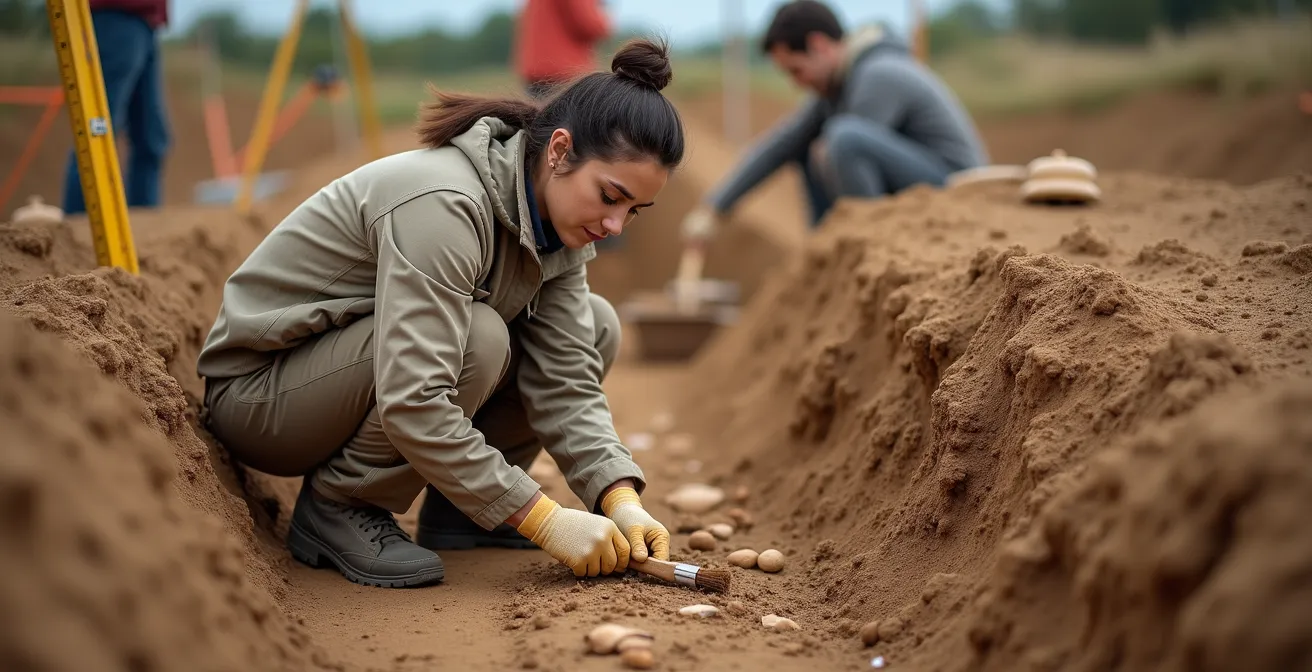
For the amateur historian, the call of the past is a powerful one. It’s a desire to move beyond the glass cases of museums and feel the texture of history itself. The idea of joining an archaeological dig—of kneeling in a trench, trowel in hand, and unearthing something last touched centuries or millennia ago—feels like the ultimate hands-on experience. Many guides will tell you to check online listings or pack sturdy boots, and while that advice is sound, it barely scratches the surface.
This practical approach often misses the fundamental shift in mindset required. Participating in a dig is not a treasure hunt; it’s an intellectual apprenticeship. It’s about learning to see the subtle swell of a Bronze Age barrow in a farmer’s field, to understand the profound ethical weight of a single pottery shard, and to recognise your role as a custodian of a shared story. The true thrill isn’t just in the finding, but in the understanding. It’s about becoming a contributor to the historical record, not just a consumer of it.
But if the goal is to think like an archaeologist, what does that mean in practice? It means shifting your perspective from objects to context. This guide will walk you through the core principles that separate a tourist from a true field volunteer. We’ll explore the strict ethics of discovery in England, the methods for decoding the symbolic language written on ancient stones, the debates surrounding the display of human remains, and how to choose the right tools—from a simple guidebook to augmented reality—to bring a site to life.
This article provides a structured path for the aspiring field volunteer. Each section addresses a critical question, moving from the practicalities of a find to the philosophical and technological tools that enrich the archaeological experience. The following summary outlines the key areas we will explore to prepare you for your first day in the trench.
Summary: From Enthusiast to Field Volunteer: A Practical Framework
- Pottery shards: Can you keep what you find on the ground?
- Augmented Reality vs Guidebooks: Which brings Pompeii to life better?
- Hieroglyphs for beginners: How to spot royal names on walls?
- The ethics of visiting mummies: Is it respectful to the dead?
- DNA tourism: Visiting the region your ancestors came from?
- Why is the eight-pointed cross everywhere in Valletta?
- Why high heels are banned at ancient Greek sites?
- Audio guide or Private tour: Which offers better insight for the British Museum?
Pottery shards: Can you keep what you find on the ground?
The moment of discovery is electrifying—the edge of a Roman pot or a fragment of worked flint appearing from the soil. The first, instinctive question for many is, “Can I keep it?” In England and Wales, the answer is a firm and resounding no. This isn’t a rule designed to spoil the fun; it’s the cornerstone of ethical archaeology. An object’s true value lies not in its material worth, but in its context. Once removed, 90% of the historical information it carries is lost forever.
The legal framework is governed by the Treasure Act 1996. Any find of gold or silver over 300 years old, or groups of prehistoric metal objects, must be reported to the local coroner within 14 days. This system ensures that nationally significant finds, like the famous Staffordshire Hoard, become part of public heritage. The scale of public contribution is immense, with a record-breaking 1,540 treasure finds reported in 2024 alone, according to government statistics.
For items not classified as treasure, the Portable Antiquities Scheme (PAS) provides a voluntary system for recording finds. Reporting your discovery to a regional Finds Liaison Officer allows your find to be photographed, measured, and added to a national database. This act of “data contribution” is a volunteer’s most crucial task. While museums may ultimately disclaim an object and return it to the finder—as was the case for 54% of treasure cases in 2023—the information is preserved. The object without its data is just a curio; with its data, it’s a piece of history.
Your Action Plan for Reporting Archaeological Finds in England
- Report all gold and silver objects over 300 years old to your local coroner within 14 days.
- Contact your regional Finds Liaison Officer for help with identification and reporting.
- Record non-treasure finds voluntarily through the Portable Antiquities Scheme to advance archaeological knowledge.
- Wait for the coroner’s inquest to determine if your find qualifies as treasure.
- If declared treasure, the find must be offered for sale to museums at a price set by the Treasure Valuation Committee.
Augmented Reality vs Guidebooks: Which brings Pompeii to life better?
While Pompeii offers a dramatic backdrop, the question of how to best resurrect a silent ruin is just as relevant at a windswept fort on Hadrian’s Wall or a quiet Roman villa in the Cotswolds. The traditional guidebook, with its detailed maps and scholarly text, has long been the historian’s trusted companion. It provides a solid, factual foundation, forcing you to use your own imagination to bridge the gap between the weathered foundation stones and the bustling life they once supported. This act of mental reconstruction is a valuable exercise in itself.
However, technology offers a new form of interpretive dialogue. Augmented Reality (AR) apps, used on a tablet or phone, can overlay digital reconstructions directly onto the physical landscape. Standing in the ruins of a barrack block at Vindolanda, you can see a virtual Roman soldier walk past or watch the stone walls rebuild themselves on your screen. This isn’t about replacing imagination, but about enriching it with data. It helps answer the fundamental archaeological question: “What did this place *feel* like?”
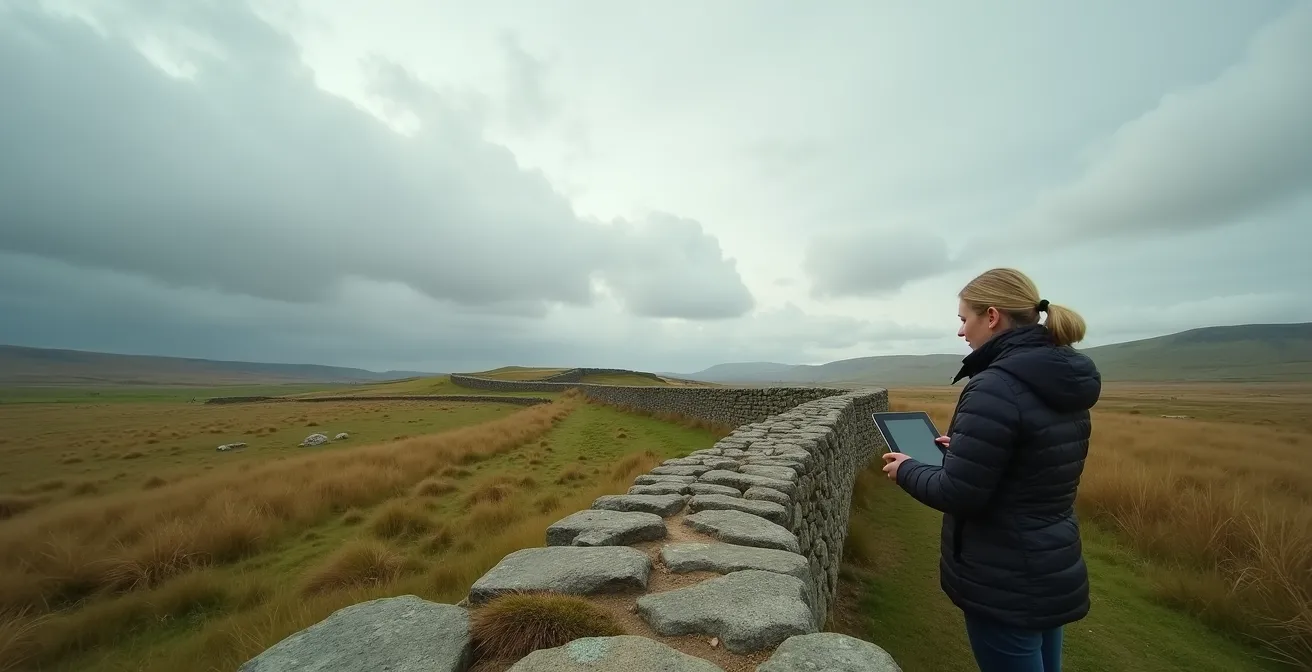
Neither tool is inherently superior; they serve different intellectual purposes. A guidebook encourages a slow, deep reading of the physical evidence, while AR provides an immediate, visceral connection to the past. The ideal approach for a serious volunteer is often to use both. Start with the guidebook to understand the layout and the known facts. Then, use an AR app to test those facts against a visual hypothesis. This combination turns a passive visit into an active investigation, allowing you to engage with the site as a dynamic, layered space rather than a static monument.
Hieroglyphs for beginners: How to spot royal names on walls?
While the cartouches of Egyptian pharaohs are a world away, England has its own complex language written into the fabric of its ancient landscapes and buildings. For a volunteer archaeologist, learning to read this language is a fundamental skill. It’s an exercise in “landscape literacy”—the ability to spot the subtle clues that reveal centuries of human activity. Instead of hieroglyphs, you are looking for the faint undulations of medieval ridge and furrow in a field, a sign of ancient farming practices.
You might search for the unnaturally straight line of a Roman road, still fossilised in modern property boundaries, or the distinctive circular mounds of Bronze Age barrows crowning a hilltop. These features are the grammar of the English landscape. Learning to identify them transforms a simple country walk into a journey through time. You begin to see the land not as a natural canvas, but as a document shaped by human hands.
This literacy extends to the buildings themselves. As Matthew Champion of the Norfolk Medieval Graffiti Survey highlights, there is a hidden world of symbols to uncover:
The Norfolk Medieval Graffiti Survey has documented thousands of protective marks in churches, revealing a hidden layer of folk belief and personal devotion carved into England’s sacred spaces
– Matthew Champion, Norfolk Medieval Graffiti Survey Report
These apotropaic marks, or “witches’ marks,” were carved to ward off evil. Finding them requires a keen eye and an understanding of where to look: near doorways, windows, and fireplaces. They are a deeply personal form of archaeology, a direct link to the fears and beliefs of ordinary people. By learning to spot these symbols, alongside Roman military abbreviations like “LEG” (Legion) on a dedication stone, you move beyond observing history to actively decoding it.
The ethics of visiting mummies: Is it respectful to the dead?
The debate around displaying Egyptian mummies raises a universal and deeply personal question for archaeology: how do we treat the dead? As a volunteer, particularly on sites involving burials, this is not an abstract concept. You may be the first person in centuries to encounter human remains. This is a profound responsibility, demanding the utmost respect and a strict, methodical process.
The British context is powerfully illustrated by the case of “Lindow Man,” a 2,000-year-old body preserved in a peat bog. His display at the British Museum has been a focal point for evolving ethical practices. The museum now actively consults with modern pagan and other community groups about the most respectful way to present him, balancing scientific value with human dignity. This shift from seeing remains as mere “specimens” to recognising them as “ancestors” is central to modern archaeology.
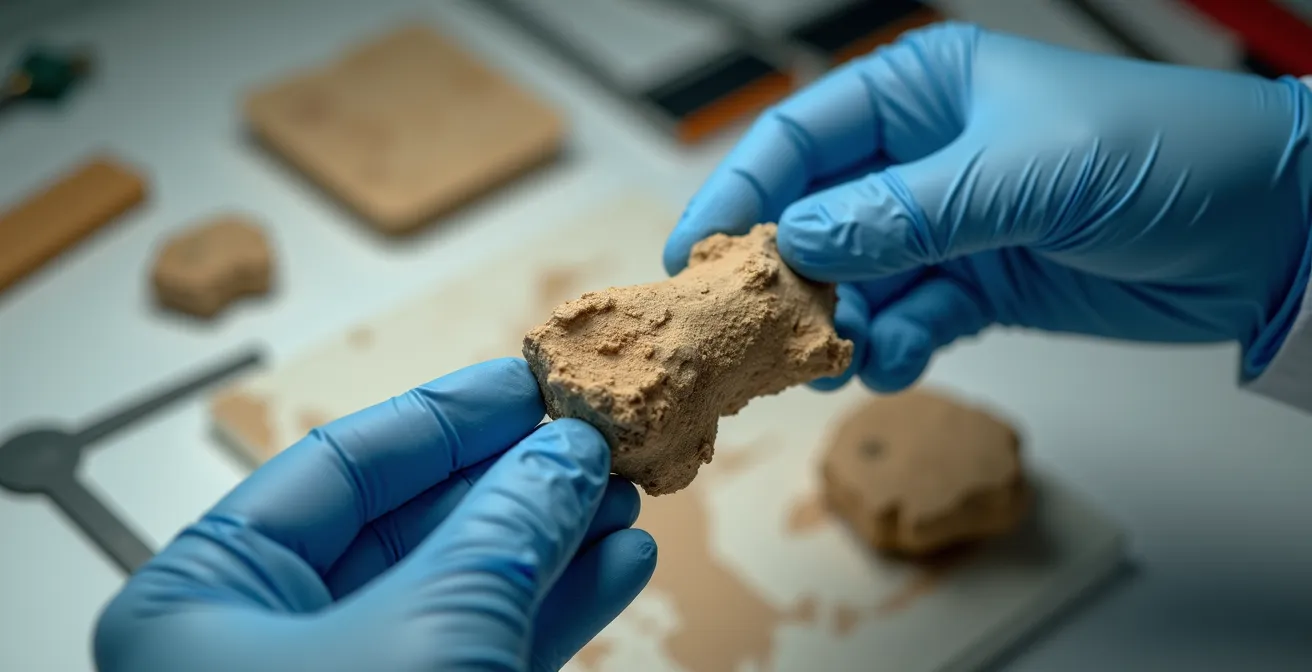
This ethical training is a core part of the volunteer experience on many projects. The Vindolanda Trust, for example, reports that over 8,000 volunteers have been trained in respectful excavation protocols since its inception. On-site, this means treating every bone fragment with care, documenting its position meticulously, and understanding that you are at a graveside, not just a data point. The goal is not just to excavate, but to do so with empathy and an understanding of the individual whose story you are helping to tell. This ethical framework is the true heart of an archaeological apprenticeship.
DNA tourism: Visiting the region your ancestors came from?
The rise of commercial DNA testing has created a new form of tourism, where people visit a region based on their genetic makeup. For the amateur historian, this can feel like the ultimate personal connection to the past. However, ancient DNA (aDNA) analysis in archaeology offers a much deeper, and often more complex, narrative. It’s not just about “your” ancestors; it’s about rewriting the entire story of a population.
The groundbreaking analysis of Cheddar Man, Britain’s oldest complete skeleton, is the perfect example. Found in a cave in Somerset, the 10,000-year-old Mesolithic man was long assumed to be fair-skinned. However, aDNA research in 2018 revealed he likely had dark brown to black skin and blue eyes. This single discovery fundamentally challenged popular and even academic assumptions about the appearance of the first modern Britons after the last Ice Age. It demonstrated that the link between “Britishness” and skin colour is a recent and fluid construct.
For a volunteer, this science has profound implications. The small bone sample you might help to excavate could contain the genetic data that completely alters our understanding of a historical period. It connects the physical act of digging with the cutting edge of scientific research. It also teaches a crucial lesson in historical humility: our vision of the past is a constantly evolving hypothesis, not a fixed story. Your personal genealogical quest becomes part of a much larger scientific one, transforming a search for identity into a contribution to our collective human story.
Why is the eight-pointed cross everywhere in Valletta?
Just as the eight-pointed cross tells the story of the Knights of St. John in Valletta, England’s ancient structures are covered in a secret language of symbols. Decoding them is a key part of the volunteer’s role, turning a passive observer into an active interpreter. This symbolic literacy begins with understanding the signatures of the people who built these places.
In the great cathedrals of Canterbury and York Minster, for example, hundreds of unique masons’ marks are carved into the stonework. These weren’t decorative; they were a practical system of quality control and payment. Each master mason had a personal symbol, and by tracking these marks, modern researchers and volunteers can trace the careers of individual craftsmen—some from as far as France and Germany—as they moved between major construction projects. Finding one is like shaking hands with a medieval artisan.
The symbolic landscape also includes powerful cultural emblems. The “Green Man,” a face made of foliage, is found in over 100 English churches. It’s a fascinating example of pre-Christian nature symbolism being absorbed into Christian iconography, likely representing rebirth and resurrection. Similarly, spotting the Tudor Rose—a combination of the red and white roses of Lancaster and York—on a building or tomb instantly dates the context to the period after 1485, a clear political statement of Tudor authority. On Hadrian’s Wall, Roman military symbols tell another story: the eagle (Aquila) representing the legion’s soul and Chi-Rho monograms indicating the presence of early Christians among the soldiers. Each symbol is a concentrated piece of data, waiting to be read.
Why high heels are banned at ancient Greek sites?
The rule against high heels at the Acropolis isn’t just about preventing a twisted ankle; it’s a stark reminder of a universal principle: human presence damages fragile history. The concentrated pressure from a stiletto heel can chip and fracture ancient marble that has survived millennia. This concept of visitor impact is a critical concern for every heritage site in the world, including those in England.
The sheer scale of the issue is staggering. For example, English Heritage reports that the 2 million annual visitors to Stonehenge require strict access controls just to prevent the ground from being worn away. As a volunteer, you are on the front line of this conservation effort. Your training will emphasise how to move around a site, where to place your tools, and how to handle objects in a way that minimises your own footprint.
Some sites present even more extreme challenges. At Flag Fen, a Bronze Age site near Peterborough, a 3,000-year-old timber causeway is preserved in the wet peat. The wood is so fragile that if it were exposed to air and allowed to dry, it would crumble to dust within hours. Consequently, visitor access is restricted to elevated walkways, and the site’s water levels are constantly managed. This demonstrates that conservation isn’t just about preventing deliberate damage; it’s about managing the very environment. Understanding these principles of preservation is a non-negotiable part of the volunteer’s creed. You are there not just to discover, but to protect.
Key takeaways
- Ethical responsibility is paramount: Understanding and adhering to the Treasure Act and PAS guidelines is more important than any single discovery.
- Think like a cartographer of time: The goal is not just to find objects, but to read the historical layers of the English landscape and its architecture.
- You are a data contributor: Every recorded find, every carefully drawn plan, is a valuable piece of a larger scientific puzzle that helps write our collective history.
Audio guide or Private tour: Which offers better insight for the British Museum?
Your intellectual apprenticeship as an amateur historian doesn’t end when you leave the field. A visit to a collection like the British Museum is the other half of the equation—it’s where you learn to understand the objects that come out of the ground. But how you approach the museum determines the depth of insight you gain. The choice between a standard audio guide and a more focused tour is a choice between breadth and depth.
An audio guide offers flexibility, allowing you to wander at your own pace and dip into information on demand. However, it often directs you to the same handful of “greatest hits”—the Rosetta Stone, the Parthenon Marbles, the Mummies. A true student of British archaeology should look for more. As noted in the museum’s own visitor guide, there are hidden worlds to explore. For instance, the British Museum’s gallery guide points out that “Room 49’s extensive collection of Roman-British artifacts offers a world-class view into the province but is often missed by those focusing on the Rosetta Stone and Mummies”.
This is where alternative options offer superior insight for the serious enthusiast. The museum’s free “EyeOpener” talks, led by passionate volunteers, provide focused 30-45 minute deep dives into specific collections, such as Roman Britain or Anglo-Saxon England. For the most dedicated, a private academic tour, though costly, allows for a Socratic dialogue, drawing thematic connections across galleries that a standard tour would miss.
| Tour Type | Cost | Duration | Advantages | Best For |
|---|---|---|---|---|
| Audio Guide | £7 | Self-paced | Multi-language, flexible timing | Independent explorers |
| EyeOpener Volunteer Talks | Free | 30-45 min | Passionate experts, specific collections focus | Deep dives into Roman Britain or Anglo-Saxon England |
| Private Academic Tour | £150-300 | 2-3 hours | Socratic dialogue, cross-gallery thematic connections | Serious students and researchers |
| Digital Self-Tour | Free | Unlimited | Personalized to niche interests using online resources | Tech-savvy visitors with specific research goals |
Ultimately, whether in a muddy trench or a polished museum hall, the goal is the same: to ask better questions. Armed with an understanding of ethics, landscape, and interpretation, you are no longer just an amateur historian. You are an active participant in the great, ongoing conversation with the past. The next step is to find an opportunity through organisations like the Council for British Archaeology and put these principles into practice.