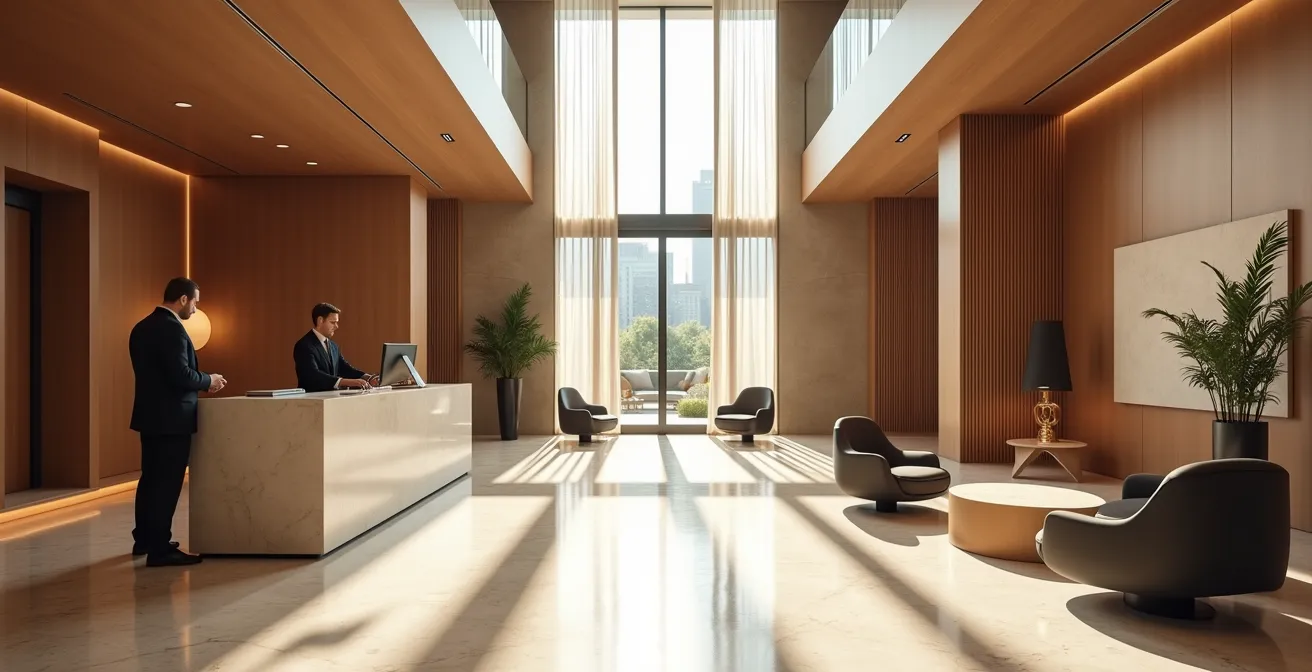
The promise of “hotel-level service” in a premium aparthotel often masks crucial service gaps that can impact a business traveller’s stay.
- Service is not a single standard but a spectrum of compromises, from 24/7 on-site staff to remote-only support.
- Critical areas like emergency response, housekeeping frequency, and loyalty benefit recognition are where the most significant differences lie.
Recommendation: Adopt a hospitality auditor’s mindset. Instead of taking marketing at face value, proactively verify the operational reality of key services before booking to ensure the property aligns with your specific needs for comfort, convenience, and security.
For the discerning business traveller, the rise of the premium aparthotel in the UK presents a compelling proposition: the space and autonomy of a private residence combined with the convenience of hotel services. The marketing language is seductive, promising the ‘best of both worlds’. Yet, beneath this glossy veneer lies a complex and often inconsistent reality. The term ‘service’ is not a monolith; it’s a spectrum, and the difference between a property with a fully-staffed concierge desk and one with a ‘virtual’ assistant can be the difference between a seamless trip and a logistical headache.
The challenge is that these properties are not simply hotels with kitchens. They represent a fundamental shift in the hospitality model, one that often deliberately trades on-demand human interaction for digital efficiency and guest independence. While this can be liberating, it also creates potential ‘service gaps’ that are rarely advertised. These gaps can be as minor as an inflexible grocery delivery policy or as critical as a delayed response to a midnight maintenance emergency. Understanding where these potential shortfalls lie is not about finding fault, but about making an informed choice.
This guide moves beyond the brochure. It adopts the discerning, comparative lens of a hospitality auditor to dissect the true service levels you can expect. We will analyse the unstated compromises and provide a framework for scrutinising everything from housekeeping protocols to the real value of your elite hotel status. The goal is to equip you with the right questions to ask, enabling you to identify the operators who genuinely deliver a premium, reliable service versus those who merely offer style over substance. It’s time to learn how to audit your stay before you even book it.
This article provides a detailed framework for evaluating the true service level of premium aparthotels in the UK. The following summary outlines the key areas of investigation we will cover.
Summary: Concierge or Reception: What service level to expect in premium aparthotels?
- How to get Ocado or Waitrose delivered to your reception desk?
- Daily clean vs Weekly service: What is standard in luxury lets?
- Gym and pool access: Are they included in your long-stay rate?
- Who fixes the boiler at 2am in an unstaffed building?
- Do hotel chains honor status points for their residence brands?
- Meet & Greet service: Why is it essential for non-English speakers?
- How to arrange a private in-room dining experience that isn’t just a burger?
- Style over substance: How to spot boutique hotels that compromise on comfort?
How to Get Ocado or Waitrose Delivered to Your Reception Desk?
One of the primary attractions of an aparthotel is the kitchen, but its utility is directly tied to the building’s ability to manage grocery deliveries—a crucial logistical detail in the UK. The core issue is the cold chain management for fresh and frozen items from services like Ocado or Waitrose. A standard hotel reception can accept a package, but can they refrigerate it for hours? This is a prime example of a ‘service gap’ where operational reality may not meet guest expectations. The level of service varies dramatically, from properties with no solution to those with sophisticated systems.
The most basic service level involves a reception desk staffed during limited hours, where they may hold deliveries but offer no cold storage. This forces guests to schedule deliveries within a narrow window, negating much of the convenience. A superior approach, and a key indicator of a premium operator, is the provision of dedicated cold storage. However, the gold standard is an automated, accessible solution.
Case Study: Native Aparthotels’ Modern Approach to Guest Deliveries in UK Cities
Native aparthotels have implemented a comprehensive delivery management system across their UK properties. They offer ‘service when you need it’ with staff who can handle grocery deliveries, while some newer London and Manchester locations have introduced refrigerated secure parcel lockers. This modern solution allows guests to receive Ocado or Waitrose deliveries even outside traditional reception hours, addressing the cold chain challenge while providing 24/7 access flexibility.
Before booking, the discerning traveller must audit the property’s delivery logistics. The following table illustrates the common models you will encounter, highlighting the trade-offs between convenience and security.
| Service Model | Reception Hours | Cold Storage | Guest Access |
|---|---|---|---|
| 24/7 Manned Reception | Round the clock | Usually available | Immediate collection |
| Limited Hours Reception | Typically 7am-11pm | During staff hours only | Restricted to reception hours |
| Smart Locker System | 24/7 automated | Temperature-controlled options | Independent access anytime |
| Virtual Concierge | Remote assistance | Not guaranteed | May require scheduling |
Ultimately, a property’s investment in solving the delivery dilemma is a strong proxy for its overall commitment to genuine, practical guest service beyond the superficial aesthetics.
Daily Clean vs Weekly Service: What Is Standard in Luxury Lets?
The frequency of housekeeping is one of the most significant operational differences between a traditional hotel and an aparthotel. While a hotel guest expects daily service as standard, the norm in the UK serviced apartment sector is quite different. This is not necessarily a sign of inferior quality but reflects a different service philosophy that prioritises guest privacy and autonomy, particularly for long-stay residents who wish to treat the space as their own home.
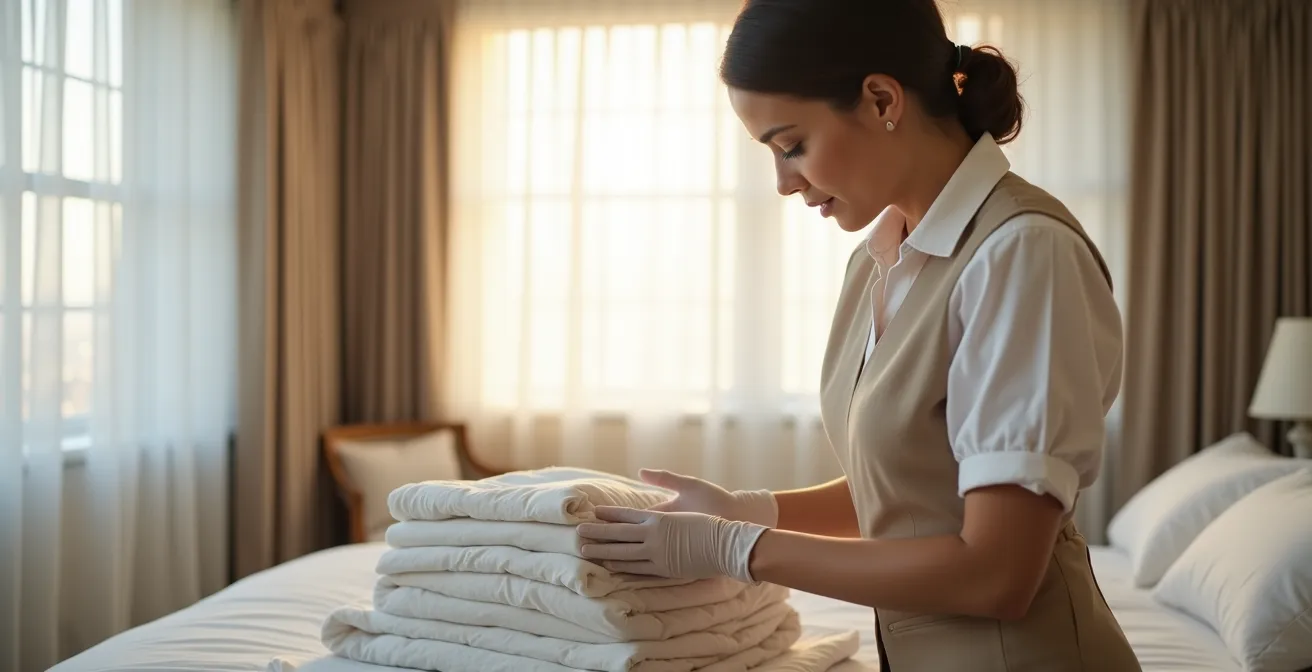
The industry benchmark in the UK is set by trade bodies like The Association of Serviced Apartment Providers (ASAP). To be accredited, operators must provide a minimum level of service. According to ASAP’s official Code of Conduct requirements, this includes “at least once weekly cleaning” within the advertised rate. Anything less is a red flag, while anything more should be considered a premium feature. Top-tier properties will offer more flexible arrangements, allowing guests to schedule additional cleans (often for a fee) or opt out entirely.
Case Study: Wilde Aparthotels’ Flexible Housekeeping Model
Wilde Aparthotels exemplifies the modern approach to cleaning services in premium aparthotels. They prioritize guest privacy with the philosophy ‘we want you to feel right at home with us, with the space and privacy to unwind,’ offering flexible housekeeping schedules rather than daily intrusion. This model represents the growing trend toward respecting long-stay guests’ autonomy while maintaining cleanliness standards.
Therefore, the auditor’s approach is to look for clarity and flexibility. Does the property clearly state its cleaning schedule? Do they offer paid upgrades for more frequent service? A transparent policy is the hallmark of a well-managed, guest-focused operation.
Gym and Pool Access: Are They Included in Your Long-Stay Rate?
Wellness facilities like gyms and swimming pools are often highlighted in marketing materials to project a luxury image. However, for the business traveller, the mere existence of these amenities is not enough. The crucial questions revolve around quality, accessibility, and cost. In the world of aparthotels, it’s common to find that advertised facilities are either not what they seem or come with hidden charges, especially for long-stay rates which are sometimes discounted on the assumption of lower amenity usage.
A ‘tick-box’ gym—a small, windowless room with a single treadmill and a set of mismatched dumbbells—technically allows a property to advertise a fitness centre, but it offers little practical value. Similarly, a pool might be part of an adjacent health club with restricted hours or require a separate daily fee. Some of the most practical solutions come from properties that establish partnerships with high-quality local gyms, such as PureGym or Nuffield Health, offering guests a superior experience to a token on-site facility.
As part of a thorough ‘amenity audit’, it is essential to verify these details. As the team at Sanctum London highlights with their clear offer, premium operators are transparent: “For those staying 7+ nights at our Belsize Road property, enjoy complimentary access to a fully equipped health club and gym, complete with a pool, sauna, and steam room.” This level of specificity is what to look for. Vague promises of “gym access” should be treated with skepticism.
Before committing to a long stay where fitness is a priority, use the following checklist to ensure the facilities meet your standards and won’t come with unexpected costs or limitations.
- Verify if gym/pool access is fully inclusive in your rate – some properties charge separately for wellness facilities.
- Check the actual quality and size via Google Maps Street View and recent guest photos to avoid ‘tick-box’ amenities.
- Ask about partnership arrangements with local gyms if no on-site facilities exist.
- Confirm operating hours for on-site facilities, as some have restricted access times.
- Request specific equipment lists if fitness is a crucial part of your routine.
This verification process separates properties that use amenities as a marketing gimmick from those that genuinely invest in the well-being of their long-stay guests.
Who Fixes the Boiler at 2am in an Unstaffed Building?
This question cuts to the heart of the service compromise in the aparthotel model. While a 24/7 reception provides an immediate human point of contact in a traditional hotel, many aparthotels—even premium ones—operate with limited or no on-site staff. When a critical failure occurs, such as a loss of heating in a London winter or a major plumbing leak, the property’s emergency response protocol is the ultimate test of its service commitment and its legal ‘duty of care’.
The operational reality can range from excellent to dangerously inadequate. Best-in-class operators maintain 24/7 on-call maintenance teams or have robust contracts with third-party firms that guarantee a rapid response time. They also have clear procedures for relocating guests to an equivalent property if the issue cannot be resolved swiftly. At the other end of the spectrum, some unstaffed buildings rely on an offshore call centre or an automated chatbot, which acts as a frustrating barrier to getting real help. This is the most critical ‘service gap’ to audit.
Case Study: UK Legal ‘Duty of Care’ Standards for Emergency Response
Reputable UK aparthotel operators understand their legal duty of care obligations. Properties like Sanctum London demonstrate best practice by offering ’24-hour reception and security service,’ ensuring immediate human response to emergencies. This contrasts with unstaffed buildings relying solely on remote assistance, highlighting the importance of verifying emergency protocols before booking.
Before booking, especially for a long winter stay, posing direct questions about emergency procedures is not just prudent; it is essential. An operator’s inability to provide clear, confident answers is a major red flag.
Your Action Plan: Critical Emergency Response Audit
- Ask directly: ‘Can you describe your out-of-hours emergency procedure and confirm you have a 24/7 maintenance contract with a guaranteed response time?’
- Request documentation or confirmation of their emergency call-out contracts with reputable third-party firms like British Gas.
- Verify their policy on immediate relocation to an equivalent or superior property for unresolved critical emergencies.
- Check if the emergency contact number leads to a human-staffed phone line versus an automated system or chatbot.
- Confirm their Service Level Agreements (SLAs) for critical issues, especially for heating or hot water loss.
A property’s preparedness for a crisis is the truest measure of its “premium” status and its fundamental respect for guest safety and comfort.
Do Hotel Chains Honor Status Points for Their Residence Brands?
For the frequent business traveller, loyalty status with major hotel chains like Marriott, Hilton, or IHG is a hard-won and valuable asset. It translates into tangible perks such as suite upgrades, executive lounge access, and complimentary breakfast. A common assumption is that these benefits will seamlessly transfer to the chains’ aparthotel-style brands, such as Residence Inn, Homewood Suites, or Staybridge Suites. This assumption is often incorrect, representing a significant financial and experiential ‘service gap’.
While stays at these residence brands typically earn loyalty points at the full rate, the on-property elite benefits are almost always diluted. The core reason is structural: these properties are not designed with the same infrastructure as full-service hotels. They rarely have executive lounges, and their standard ‘suite’ layout means ‘suite upgrades’ are meaningless. Breakfast, if offered, is often a limited continental offering, not the full restaurant experience elite members might expect.
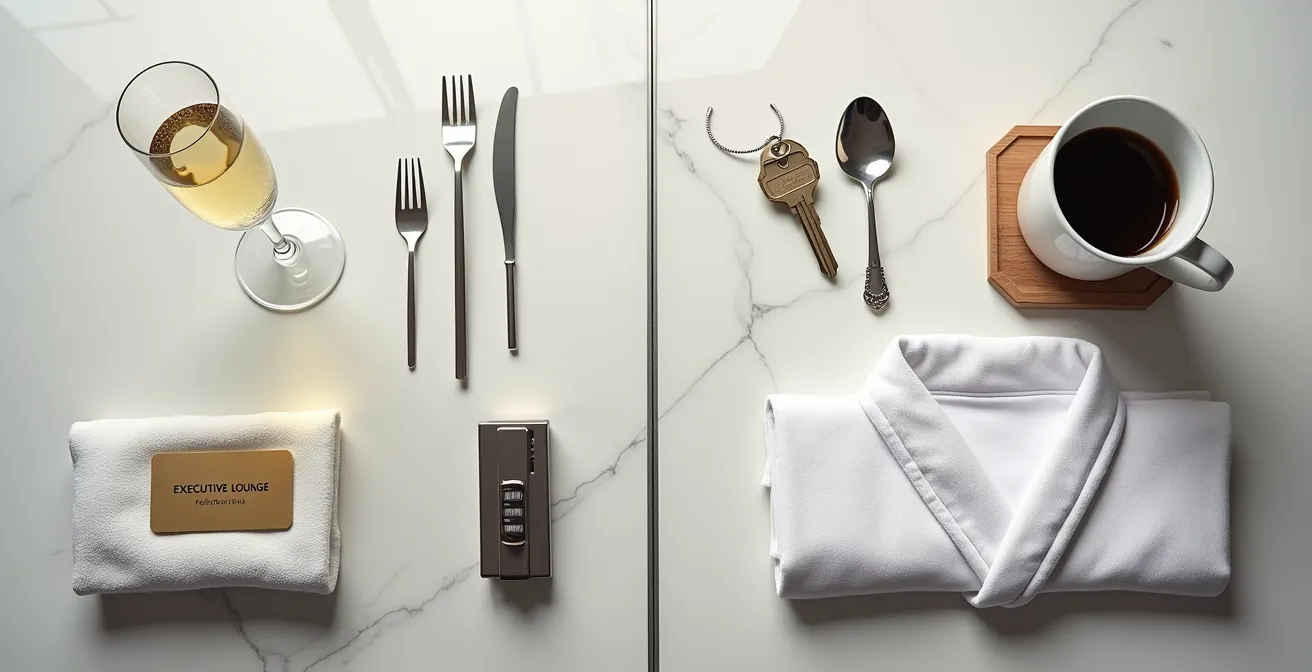
This dilution of benefits has a quantifiable cost. For a top-tier elite member, the combined value of a room upgrade, lounge access with evening hors d’oeuvres, and a full breakfast at a central London hotel can easily be worth a significant amount per day. Forgoing these perks is a major financial compromise that must be weighed against the benefits of having a kitchen and more space.
The following table, based on information from major loyalty programs, illustrates the common disparity. As a discerning auditor, you should always check the specific brand’s policy before booking, as it can vary.
This comparative data is essential for any elite status holder. As a review of Marriott Bonvoy’s benefits shows, while points are earned, key on-site perks are explicitly excluded at residence-style properties.
| Hotel Chain | Residence Brand | Points Earned | Elite Benefits NOT Available |
|---|---|---|---|
| Marriott Bonvoy | Residence Inn | Yes – Full points | Suite upgrades, lounge access, breakfast |
| IHG One Rewards | Staybridge Suites | Yes – Full points | Room upgrades, club lounge |
| Hilton Honors | Homewood Suites | Yes – Full points | Executive lounge, premium breakfast |
The decision to stay at a residence brand, therefore, becomes a strategic choice: are the apartment’s space and kitchen more valuable to you on this specific trip than the accumulated value of your hard-earned hotel status perks?
Meet & Greet Service: Why Is It Essential for Non-English Speakers?
In an increasingly automated hospitality landscape, the human touch of a ‘Meet & Greet’ service can feel like a throwback. For international business travellers, particularly non-English speakers arriving in the UK, it is far from a simple luxury. It is a vital service that bridges the gap between a stressful arrival and a smooth, welcoming check-in experience. Its value extends far beyond a simple airport pickup, offering crucial navigational and practical support.
The Value of Personal Meet & Greet at Major UK Transport Hubs
Meet & Greet services at UK aparthotels go beyond simple airport pickups. For non-English speakers arriving at complex hubs like Heathrow or King’s Cross, these services eliminate navigation stress through the Tube and Heathrow Express systems while helping them avoid unlicensed minicabs. The in-apartment handover extends this support, with personal demonstrations of UK-specific appliances like boiler controls and induction hobs, preventing confusion that could otherwise mar the stay experience.
This initial personal interaction sets the tone for the entire stay. It replaces the anxiety of navigating a foreign city with a sense of security and care. As one UK hospitality expert noted in an analysis for Boutique Hotelier, the psychological impact is immense.
Seeing a representative with their name on a sign provides immediate reassurance and a sense of being cared for, setting a positive tone for the entire stay.
– UK Hospitality Expert, Analysis of International Guest Services in Premium Aparthotels
For a business traveller on a tight schedule, this service is an investment in efficiency. It saves time, prevents costly transport mistakes, and ensures they can settle into their apartment and focus on their work without the distraction of trying to figure out unfamiliar technology. When auditing a property for an international stay, inquiring about the availability and scope of their meet and greet service is a key indicator of their understanding of global travellers’ needs.
It transforms the arrival from a moment of potential stress into a seamless transition, demonstrating a level of care that automated check-in processes simply cannot replicate.
How to Arrange a Private In-Room Dining Experience That Isn’t Just a Burger?
The promise of a full kitchen in an aparthotel is often associated with the ability to cook for oneself. However, for a time-poor business traveller or someone hosting a client, the real luxury is the ability to have a gourmet dining experience within the privacy and comfort of the apartment. This goes far beyond a standard Deliveroo order. It involves leveraging the aparthotel’s concierge service to facilitate a truly elevated in-room meal, a service that separates genuinely premium properties from the rest.
The first step is to audit the kitchen itself. A high-end experience requires more than a basic microwave and two pans. Discerning travellers should inquire about the quality of cookware, the availability of proper serving platters, and sufficient workspace. The second step is to probe the capabilities of the concierge. A truly connected concierge will have established partnerships with private chef services or high-end restaurant meal kit providers, offering options that far surpass a typical takeaway.
As noted by a leading provider, a top-tier concierge acts as a well-connected facilitator. In their guide to premium services, the team at Luxury Serviced Apartments London explains how they add value:
With long established contacts, our partner concierge services offer clients an exclusive restaurant booking service for some of the world’s finest restaurants. This service enables you to access priority reservations and preferred seating, often at the shortest of notice.
– Luxury Serviced Apartments London, Premium Concierge Services Guide
While this quote refers to external bookings, the principle of leveraging established contacts is the same for private dining. The best concierges can coordinate everything from hiring a private chef via services like ‘La Belle Assiette’ to arranging delivery from premium meal kit companies like ‘Dishpatch’ or ‘Hawksmoor at Home’, which provide restaurant-quality meals for home finishing. Before booking, ask the concierge for their curated list of preferred private dining providers and confirm that their insurance covers external chefs accessing the apartment.
This level of service transforms the apartment from just a place to stay into a versatile venue for both relaxation and professional entertainment.
Key Takeaways
- Service levels are not standardised; audit the specifics of reception hours, emergency support, and cleaning schedules before booking.
- Advertised amenities like gyms and pools require scrutiny. Verify quality, access hours, and hidden fees to avoid disappointment.
- Loyalty status benefits are often diluted at residence-style brands. Quantify the value of lost perks like lounge access and upgrades.
Style Over Substance: How to Spot Boutique Hotels That Compromise on Comfort?
In a competitive market, many aparthotels prioritise photogenic design over functional comfort—a classic case of ‘style over substance’. For the business traveller, a beautifully designed but impractical space can be a significant hindrance. A weak Wi-Fi signal, poor water pressure, or a mattress chosen for its looks rather than its ergonomic support can undermine the entire purpose of the stay. With the UK hotel market showing strong performance, such as the 73% occupancy rate in December 2023 with an average daily rate of £172, the temptation for operators to cut corners on non-visible comforts is high.
The hospitality auditor, therefore, must learn to look past the professional photography and scrutinise the fundamentals. This involves looking for ‘green flags’ that signal a commitment to quality and ‘red flags’ that suggest a focus on aesthetics over guest experience. Accreditations, detailed guest reviews, and management transparency are far better indicators of quality than a slick Instagram feed.
For instance, an operator proudly displaying their ASAP accreditation is committing to a public code of conduct regarding safety and service. Conversely, a property that relies heavily on computer-generated images (CGI) instead of actual photos, or provides no floor plans with specific square meterage, may be hiding something. The most effective auditors use a combination of direct questioning and digital sleuthing to build a complete picture before making a booking decision.
The following checklist provides a framework for identifying properties that prioritise genuine comfort and service over superficial style. It’s a final audit to ensure your chosen aparthotel will be a productive and restful base, not just a pretty picture.
Your Action Plan: The Style vs. Substance Audit Checklist
- Visuals vs. Reality: Identify red flags like heavy use of CGI renders, no floor plans with square meterage, and vague descriptions like ‘concierge service’ without specifics.
- Look for Trust Signals: Prioritise green flags such as ASAP accreditation, guest reviews mentioning staff by name, and detailed, constructive management responses to negative feedback.
- Digital Reconnaissance: Use Google Street View to check the property’s immediate surroundings for potential noise from pubs, main roads, or construction sites.
- Question the Fundamentals: Ask directly about non-visual comforts: ‘What is the brand and quality of the mattress?’, ‘Can you guarantee strong water pressure?’, and ‘Are there true blackout curtains?’.
- Verify Connectivity: Demand more than ‘free Wi-Fi’. For remote work, ask for recent Wi-Fi speed test results to ensure it meets your professional needs.
Ultimately, the most luxurious amenity is not a designer chair or a trendy light fixture; it is a seamless, comfortable, and reliable experience. To find it, you must look beyond the surface and audit the core components of a quality stay, ensuring your choice is based on a foundation of substance, not just style.