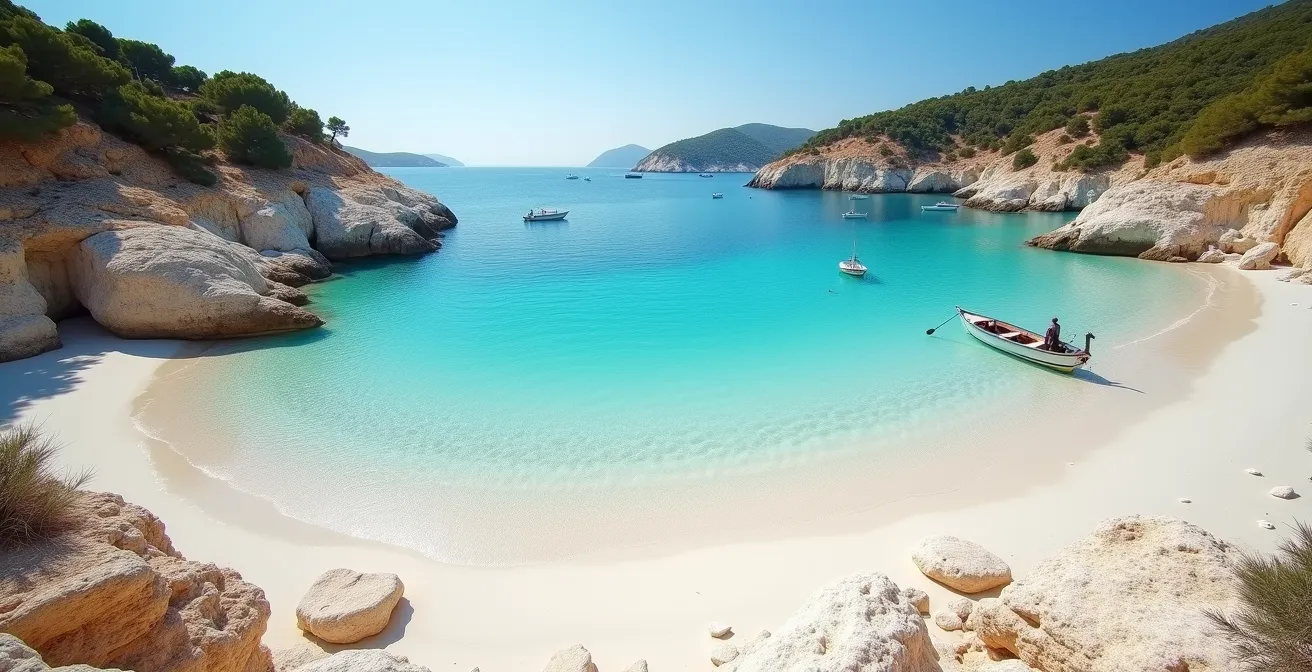
The perfect Caribbean-style beach is closer than you think, but the “best” choice depends more on practical realities than just water colour.
- Sardinia and Menorca offer genuine turquoise waters, but your total “door-to-beach” time and on-site costs vary significantly.
- Local rules on beach safety flags, pop-up tents, and even your choice of sunscreen can make or break your trip.
Recommendation: Look beyond flight duration. Analyse the total journey time, local regulations, and off-season potential (like September) to find your true short-haul paradise.
The allure of the Caribbean is potent: powdery white sand, water in fifty shades of turquoise, and the gentle rustle of palm trees. For the London-based beach lover, this dream usually comes with the daunting reality of a nine-hour flight, jet lag, and a significant dent in the annual leave. The question then becomes: is it possible to capture that paradise-found feeling without the long-haul commitment? The short answer is yes, but the travel brochures often tell only half the story.
Many guides will point you towards the Mediterranean’s most photogenic coves, showcasing images that could easily be mistaken for Barbados or Antigua. Yet, the true measure of a successful short-haul escape isn’t just the colour of the water. It’s the total “door-to-beach” time, the nuances of local culture and regulations, and understanding how to maximise your experience on a UK-friendly timetable. This isn’t just about finding a pretty beach; it’s about engineering the perfect, frictionless escape.
This guide moves beyond the postcard fantasy to provide a strategic reality check. We will dissect the top European contenders not just on their beauty, but on the practical factors that matter most to a savvy traveller from the UK. From the genuine cost of a beach day to the unwritten rules of the sand, this is your blueprint for finding a slice of the Caribbean, just a short flight away.
To help you navigate your options, this article breaks down the key questions and comparisons. We will analyse specific destinations, decode local rules, and even challenge the conventional wisdom about the best time to travel, giving you the tools to plan a genuinely relaxing and informed getaway.
Summary: Your Guide to Finding a Caribbean-Style Getaway in Europe
- Sardinia vs Menorca: Which has the bluest water in June?
- What do the red and yellow flags actually mean in Spain?
- Why your SPF 50 might be killing the coral reefs?
- Boat rental without a license: Is it safe in the Greek islands?
- Pop-up tents: Are they allowed on Italian beaches?
- Flight socks: Do they really work to prevent blood clots?
- Caribbean in September: Is the hurricane risk worth the discount?
- Train vs Plane for UK-Europe travel: Which is truly faster door-to-door?
Sardinia vs Menorca: Which has the bluest water in June?
The debate for Europe’s most Caribbean-like water often comes down to two titans: Sardinia’s Costa Smeralda and Menorca’s southern calas. Aesthetically, both deliver spectacular turquoise and cerulean hues, especially in the bright light of early June before the peak-season crowds descend. The Mediterranean Sea’s temperature is also surprisingly inviting, with recent ocean temperature data showing that the average of 23.86°C in the Mediterranean in June comfortably rivals some Caribbean spots. However, the “best” choice for a Londoner depends entirely on your definition of paradise.
Sardinia’s Costa Smeralda offers a more polished, high-end experience. The sand is often finer, feeling like pure white powder underfoot, which contributes to that luminous water quality. This is the stuff of superyachts and celebrity spotting, and the price tags reflect that. Menorca, on the other hand, presents a more rustic, family-friendly charm. The coves, like the famous Cala Macarella, are stunningly beautiful but the sand can be a mix of fine grains and shingle. The real differentiator, however, is the holistic travel experience from London.
This comparative analysis from Euro-Viajar’s travel experts breaks down the practical realities beyond the Instagram filter. It weighs factors from the critical “door-to-beach” time to the average cost of a pint, providing a more realistic “Caribbean Feel Score”.
| Factor | Sardinia (Costa Smeralda) | Menorca (Cala Macarella) |
|---|---|---|
| Water Temperature June | 22°C (72°F) | 21°C (70°F) |
| Sand Quality | Fine white powder | Mix of sand and shingle |
| Crowd Level (UK Half-term) | High – Celebrity hotspot | Moderate – Family-friendly |
| London Door-to-Beach Time | 5.5 hours total | 4.5 hours total |
| Average Pint Price | €6-8 | €4-5 |
| Caribbean Feel Score | 8.5/10 | 8/10 |
While Sardinia may edge out Menorca on pure sand quality, Menorca wins on accessibility and affordability. A shorter total travel time and lower on-the-ground costs make it a more practical choice for a quick getaway, especially during the expensive UK half-term. Ultimately, the decision comes down to your priorities: flawless luxury or accessible beauty.
What do the red and yellow flags actually mean in Spain?
Arriving at a stunning Spanish beach only to be met by a flapping red flag can be a frustrating experience. For many UK tourists, the beach flag system is an unfamiliar set of rules that can seem overly cautious on a calm-looking day. However, ignoring them is not only dangerous but can also be expensive. Spanish coastal authorities take safety seriously, and understanding this simple colour code is a crucial piece of local beach etiquette.
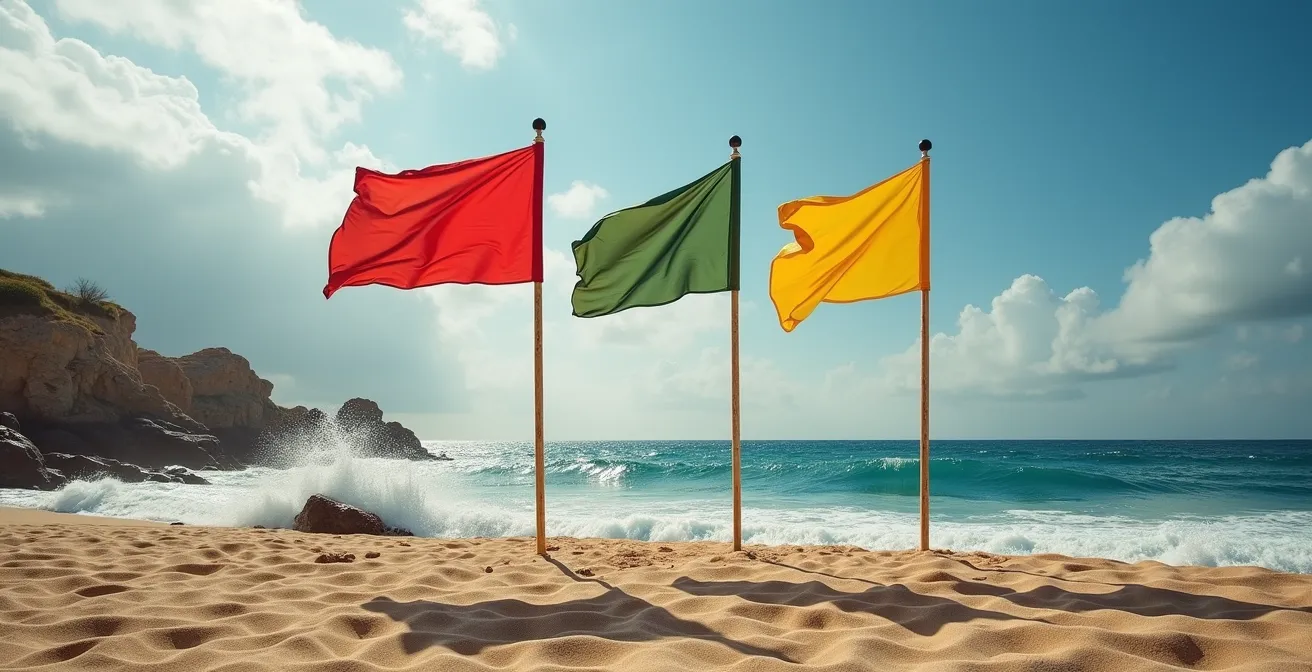
The flags are not just recommendations; they are legally binding instructions. A red flag (`bandera roja`) means swimming is strictly forbidden due to dangerous conditions like strong currents, riptides, or poor water quality. Venturing into the water can result in a hefty fine, which can be as high as €750. A yellow flag (`bandera amarilla`) signals that you should swim with caution, as conditions are not ideal. It’s a warning to stay close to the shore and be aware of your surroundings. The much-welcomed green flag (`bandera verde`) indicates that conditions are safe for all swimming and water activities.
Beyond the primary colours, other regulations are becoming common. The prestigious “Blue Flag” status, for example, doesn’t just certify water quality but also the availability of facilities like toilets and first aid. Furthermore, local rules are tightening. Since 2022, smoking is banned on all of Barcelona’s beaches, with a €30 fine for violators. Wild camping near the coast is also heavily penalised across Spain. Knowing these rules ensures your beach day remains relaxing and fine-free.
- Red flag: No swimming allowed. A fine of up to €750 can be issued for entering the water.
- Yellow flag: Swim with caution. It is advised to stay within 200m of the shore.
- Green flag: Safe conditions. All water activities are permitted.
- Blue Flag beaches: An EU certification for excellent water quality, safety, and environmental management.
Why your SPF 50 might be killing the coral reefs?
You’ve found the perfect beach with crystal-clear water. You diligently apply your high-factor sunscreen, believing you’re doing the right thing for your skin. But what if that very act of protection is harming the fragile ecosystem that creates the beautiful environment you came to enjoy? This is the uncomfortable truth behind many popular sunscreens. The concept of “conscious sunbathing” is gaining traction as scientific evidence mounts against certain chemical ingredients.
The main culprits are two common UV-filtering chemicals: oxybenzone and octinoxate. When these wash off your skin into the sea, they can cause significant damage to marine life. They are known to induce coral bleaching, damage the DNA of young corals, and disrupt the development of fish and other organisms. In places with calm, shallow waters like the coves of the Balearic Islands, the concentration of these chemicals can become particularly high, posing a direct threat to vital ecosystems like seagrass meadows.
These underwater meadows, such as the vast Posidonia oceanica fields off Formentera, are the lungs of the Mediterranean. They filter the water, keeping it clear and blue, and produce enormous amounts of oxygen. Protecting them is essential to preserving the very “Caribbean” quality of these beaches. This has led to proactive measures in some of Europe’s most pristine locations.
Case Study: Posidonia Protection in Formentera’s Waters
Formentera’s famously clear waters are a direct result of its healthy Posidonia oceanica seagrass meadows. Recognising the threat from chemical sunscreens, local marine protection initiatives have been actively promoting the use of mineral-based alternatives since 2023. As a study on Caribbean-style beaches in Europe highlights, these initiatives recommend sunscreens that use zinc oxide or titanium dioxide as their active ingredients. These minerals create a physical barrier on the skin rather than a chemical one and are considered “reef-safe.” For UK travellers, this is an easy switch, as popular brands like Green People and Tropic, readily available at high-street stores like Boots, offer effective and environmentally-friendly options.
Boat rental without a license: Is it safe in the Greek islands?
One of the ultimate Caribbean fantasies is to charter your own boat and discover secluded, empty coves that are inaccessible from the land. This dream is surprisingly achievable in Europe, particularly in the Greek islands, where you can often rent a small motorboat (typically up to 30hp) without a boating license. It offers an unparalleled sense of freedom and is the key to finding your own private patch of paradise, even in the height of summer. But is it truly safe for a novice?
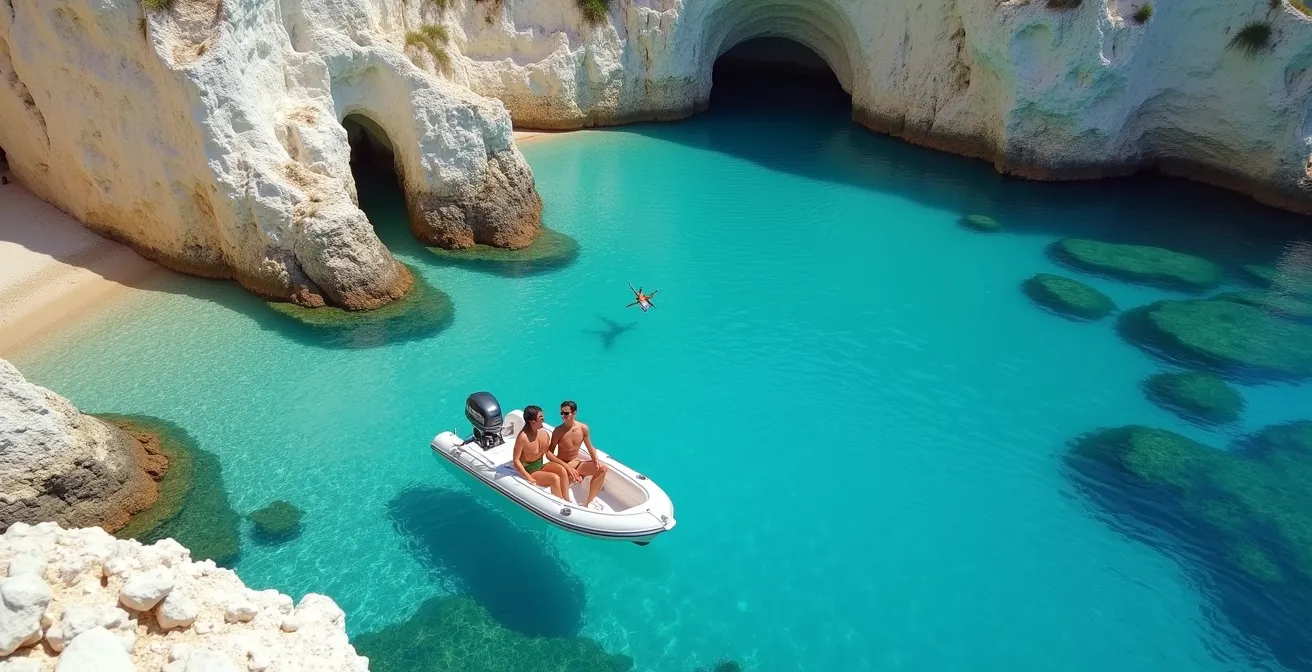
The answer is yes, provided you are prepared and respect the local conditions. Rental companies provide a brief but essential tutorial on operating the boat, anchoring, and understanding the basic rules of the sea. The primary restriction for unlicensed boaters is a 3-nautical-mile (around 5.5km) limit from the coastline, which still provides a vast area to explore. The biggest variable, however, is the weather. The infamous Meltemi wind, which can pick up suddenly in the afternoons during July and August, can turn a calm sea into a choppy challenge. For this reason, many experienced locals recommend the Ionian islands like Paxos and Antipaxos, known for their calmer waters, as a better starting point for beginners than the windier Cyclades like Mykonos or Naxos.
Proper preparation is the key to a safe and enjoyable day on the water. Before you even leave the harbour, there are several checks and simple steps you can take to mitigate risks and ensure you’re in control. A quick audit of your equipment and digital tools can make all the difference.
Your Action Plan: UK Boating Novice’s Greek Island Safety Checklist
- Fuel Check: Visually inspect the fuel gauge and confirm the location of the extra 5L jerry can that should be provided as standard.
- Boundary Awareness: Ask the rental agent to point out the 3-nautical-mile limit on a physical map and understand your designated exploration area.
- Weather Wisdom: Check the local wind forecast (apps like Windy are excellent) and plan to be back in the harbour before the afternoon, especially in July and August when the Meltemi peaks.
- Digital Navigation: Download an offline maps app like Maps.me and ensure the Greek coastal charts for your area are pre-loaded on your phone. Don’t rely on mobile signal.
- Emergency Contacts: Save the Greek Coast Guard number (108) and the rental company’s number into your phone’s contacts before setting off.
Pop-up tents: Are they allowed on Italian beaches?
For the budget-conscious UK traveller, a pop-up beach tent is a genius piece of kit. It’s light enough for a budget airline’s cabin bag, provides welcome shade from the intense Mediterranean sun, and saves you the €20-€50 daily cost of renting a sunbed and umbrella. However, arriving on a pristine Italian beach and pitching your Decathlon or Argos special can earn you some unwelcome attention. Italy’s beach culture is highly structured, and the rules around personal tents are surprisingly strict and vary by beach type.
The key is to understand the difference between a `Spiaggia Libera` (free beach) and a `Stabilimento Balneare` (private beach club). On a private club’s concession, bringing your own equipment, especially a tent, is strictly forbidden. You are paying for the use of their sun loungers and umbrellas, and they will quickly ask you to take your tent down. On the free public beaches, pop-up tents are generally tolerated, but with an important caveat. It is illegal to place any obstruction, including tents, towels, or chairs, on the first 5 metres of sand from the shoreline. This area, known as the `bagnasciuga`, must be kept clear for transit and for emergency services. Placing your tent there can result in a fine of around €150.
This nuanced system can be confusing for tourists. The safest bet is to observe what the locals are doing. If you see no other personal tents or umbrellas on a stretch of sand, it’s likely a private concession. The type of beach often dictates the rules, as this breakdown shows.
| Beach Type | Pop-up Tent Allowed? | Cost | Example Locations |
|---|---|---|---|
| Spiaggia Libera (Free Beach) | Yes, with restrictions | Free | Sardinia: Cala Goloritze, Puglia: Torre dell’Orso |
| Stabilimento Balneare (Private) | No – umbrellas only | €20-50/day for lounger set | Sardinia: Costa Smeralda beaches |
| Bagnasciuga (Waterline) | Illegal everywhere | €150 fine | All Italian beaches |
| Spiaggia Attrezzata (Equipped) | No – rental equipment only | €15-30/day | Most tourist beaches |
In essence, your pop-up tent is a great money-saver, but only on a `Spiaggia Libera` and only if you set it up well back from the water’s edge. On most of the easily accessible and popular beaches, you will likely have to pay for the privilege of shade. As a report from Off-Campers highlights, knowing these distinctions is key to a hassle-free Italian beach experience.
Flight socks: Do they really work to prevent blood clots?
The term “flight socks” often conjures images of long-haul travel to Australia or the Far East. For a short 2-4 hour hop to the Mediterranean, they can seem like overkill. Yet, the risk of developing Deep Vein Thrombosis (DVT), a blood clot that forms in a deep vein, is present on any flight where you remain seated and immobile for an extended period. While the risk is lower on short-haul flights, it is not zero. For a traveller focused on maximising relaxation, arriving with swollen, achy legs is hardly the ideal start to a holiday.
Compression socks work by applying gentle pressure to your lower legs, helping to maintain blood flow and reduce swelling. This simple mechanical aid can make a noticeable difference to your comfort levels upon landing. The risk of DVT increases with flight duration, but other factors like age, medical history, and dehydration also play a part. As medical studies from British Airways indicate, the absolute risk on a 4-hour flight is about 1 in 6,000, compared to 1 in 1,000 for a 9-hour flight. While the odds are low, the potential consequences are serious, making a £15 pair of socks from Boots a very sensible and low-cost insurance policy.
Beyond wearing socks, a few simple pre-flight and in-flight habits can significantly improve your travel wellness. Staying hydrated is paramount; aim to drink about 250ml of water for every hour you’re in the air and avoid alcohol, which has a dehydrating effect. Simple in-seat exercises, like rotating your ankles and flexing your feet, encourage circulation. On flights over three hours, making a point to walk the aisle at least once an hour can also make a significant difference. These small actions contribute to you stepping off the plane feeling fresh and ready for the beach, not stiff and lethargic.
- Buy flight socks: They are readily available at airport pharmacies like Boots at Gatwick or Heathrow for around £12-£25.
- Hydrate strategically: Drink 250ml of water per flight hour.
- Perform ankle rotations: Do 10 repetitions in each direction every 30 minutes to keep blood flowing.
- Walk the aisle: On any flight over 3 hours, get up at least once per hour.
- Consider a supplement: Taking a magnesium supplement the night before travel can help reduce the likelihood of leg cramps.
Key Takeaways
- The “best” European beach is a balance of beauty, total travel time, and on-site costs, not just flight duration.
- Understanding and respecting local rules (beach flags, tent placement) is crucial for a stress-free trip and avoiding fines.
- Your travel choices, from sunscreen to transport, have an environmental impact that is worth considering for a truly conscious holiday.
Caribbean in September: Is the hurricane risk worth the discount?
September is a tempting month for a Caribbean holiday. As the European summer season winds down, flight and hotel prices to destinations like Barbados and St. Lucia drop significantly. But this discount comes with a major caveat: September is the absolute peak of the Atlantic hurricane season. For a UK traveller, this poses a serious question: is the financial saving worth the risk of your holiday being disrupted or even cancelled by a major storm?
When you compare the conditions side-by-side, the Mediterranean in September emerges as a far more reliable and strategic choice. While the Caribbean is contending with its highest rainfall and a 15% statistical chance of a named storm, Southern Europe is enjoying what many consider its “sweet spot.” The sea temperatures in places like Crete and Cyprus are at their annual peak, often warmer than they were in June, and the intense heat of August has subsided. The summer crowds have thinned, yet all the restaurants and amenities are still fully operational. This was confirmed by an analysis of UK travel patterns from September 2024, which showed a 40% increase in Mediterranean bookings compared to the Caribbean, with travellers explicitly citing weather reliability as the primary reason.
The comparison becomes even starker when you factor in the travel logistics. A trip to the Med involves a simple 4.5-hour flight with zero hurricane risk, while a Caribbean trip requires an 8.5-hour flight into a region on high alert. For a traveller seeking relaxation, the peace of mind offered by the Med is invaluable.
| Factor | Mediterranean (Crete) | Caribbean (Barbados) |
|---|---|---|
| Average Sea Temperature | 25°C (77°F) | 29°C (84°F) |
| Rainfall Days | 2 days | 11 days |
| Flight Cost from London | £180-250 return | £450-600 return |
| Flight Duration | 4.5 hours | 8.5 hours |
| Hurricane Risk | Zero | Peak season (15% chance) |
| Hotel Occupancy | 60% (post-August rush) | 45% (off-season) |
While the Caribbean sea might be a few degrees warmer, the overall proposition for a September break is overwhelmingly in favour of the Mediterranean. It offers superior weather reliability, lower costs, and a significantly shorter journey, making it the smarter choice for a guaranteed sunny escape.
Train vs Plane for UK-Europe travel: Which is truly faster door-to-door?
For a Londoner heading to a beach on the French Riviera, flying from Gatwick to Nice seems like the obvious choice for speed. A flight time of just two hours is hard to beat. However, the metric that truly matters is not “flight time” but the total “door-to-beach” time. When you factor in the journey to a London airport, the recommended two hours for check-in and security, and the transfer at the other end, the picture changes dramatically.

Train travel, while having a much longer core journey time, offers significant time savings at both ends. Departing from St Pancras International in central London is far more convenient for most than trekking out to Gatwick or Stansted. Train station security and check-in is a swift 45-minute affair, a stark contrast to the often stressful and lengthy airport process. Furthermore, major train stations in Europe, like Nice-Ville, are typically located in the city centre, making the final transfer to your beachside hotel much quicker and cheaper than from an out-of-town airport.
This detailed analysis breaks down a typical journey from South West London to a beach near Nice, revealing a surprising result. While the flight itself is faster, the total door-to-beach time by train is not as far behind as one might assume, especially when you consider the more relaxed and productive nature of the journey.
| Journey Component | Flight (Gatwick-Nice) | Train (Eurostar+TGV) |
|---|---|---|
| Home to Terminal (SW London) | 90 min | 45 min |
| Check-in/Security | 120 min | 45 min |
| Travel Time | 120 min | 420 min |
| Beach Transfer | 30 min | 15 min |
| Total Door-to-Beach | 6 hours | 8h 45min |
While the plane still wins on total time for this specific journey, the gap is smaller than expected. When you add the environmental factor—where the train’s CO2 emissions are a fraction of the plane’s (14kg vs 285kg)—the train becomes a compelling alternative for the conscious traveller. It challenges us to redefine “efficiency” not just as raw speed, but as a blend of time, comfort, and environmental impact.
Your perfect short-haul paradise is waiting. By looking beyond the obvious and considering all the practical factors, from door-to-beach time to local beach etiquette, you can engineer an escape that is not only beautiful but truly relaxing and rewarding. The next step is to start planning your own “reality-checked” getaway.