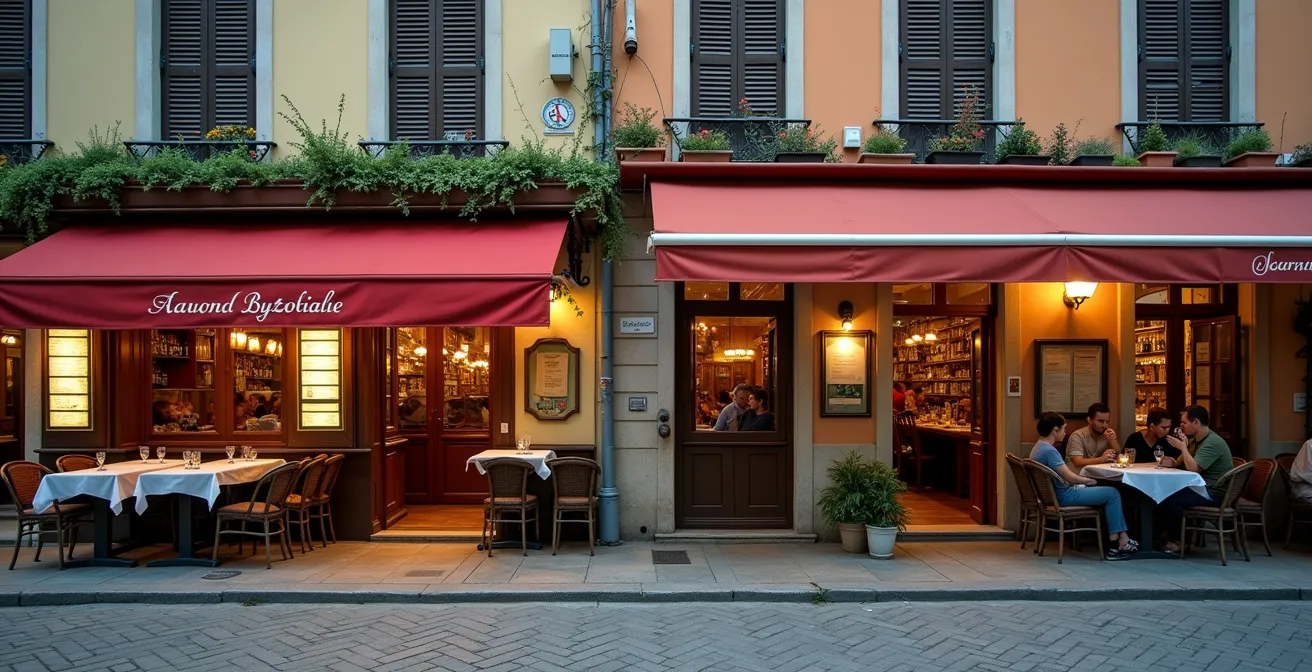
Contrary to popular belief, an English menu or photos are not automatic signs of a tourist trap; the real giveaway is a restaurant that ignores its own country’s ‘cultural operating system’.
- Authenticity lies in respecting local rhythms, seasonality, and service protocols—not just avoiding glossy menus.
- Understanding these unwritten rules, from Spain’s late lunch hours to France’s mandatory service charge, is more effective than following a simple checklist.
Recommendation: Instead of spotting ‘red flags’, learn to read the cultural context of a restaurant to find truly local experiences that resonate with the rhythm of the city.
There’s a universal moment of travel disappointment: sitting down to a meal you’ve been dreaming of, only to be served a pale, watery Caprese salad in the middle of a Roman winter. You’ve been caught. You’re in a tourist trap. For the discerning foodie travelling from the UK, the quest for authenticity is a serious one. We’re taught to look for simple red flags: menus with pictures, locations next to monuments, or an overeager host trying to lure you in from the street.
While these tips have a grain of truth, they are often oversimplified. They fail to capture the nuances of a country’s culinary soul. A menu in English near a major business hotel in Milan is a sign of international courtesy, not necessarily a trap. The real key to unlocking authentic dining is not to follow a rigid checklist, but to become a temporary culinary anthropologist. It’s about understanding the deep-seated cultural rules—the ‘operating system’—that govern how people eat, shop, and socialise around food.
This guide moves beyond the clichés. We will deconstruct the cultural codes of European dining, contrasting them with British habits to give you a practical framework. By learning to read the cultural context, from the rhythm of mealtimes in Spain to the legalities of tipping in France, you will not only avoid the traps but also discover the most memorable and genuine food experiences. It’s time to stop being a tourist and start dining with intent.
This article will guide you through the essential cultural cues that separate an authentic meal from a tourist-oriented performance. We will explore the unwritten rules of dining across Europe, giving you the confidence to eat like a local on your next trip.
Summary: A Foodie’s Guide to Europe’s Unwritten Dining Rules
- Why ordering Caprese salad in winter marks you as a tourist?
- The 2pm lunch rule: Why you will starve in Spain if you stick to UK hours?
- Photos on the menu: Is it a warning sign or just helpful for foreigners?
- Walk-in vs Reservation: How to get into Paris’s hottest bistro?
- Service Compris: Why tipping 20% in France is unnecessary?
- Cooking class or food tour: Which offers better cultural insight?
- What does the red and yellow label actually guarantee?
- 10 tastings or 3 full dishes: How to choose a food tour that doesn’t leave you hungry?
Why Ordering Caprese Salad in Winter Marks You as a Tourist?
In the UK, the year-round availability of produce at supermarkets like Tesco and Sainsbury’s has disconnected us from the seasons. We can buy strawberries in December and asparagus in October. In Italy, however, the food culture is governed by a strict adherence to seasonality, a concept known as “stagionalità”. This philosophy is deeply ingrained in the nation’s psyche and is a non-negotiable aspect of authentic cuisine. Ordering a Caprese salad, a dish celebrating the peak-summer marriage of sun-ripened tomatoes and fresh basil, during a winter trip to Rome is an immediate signal that you are disconnected from this fundamental rhythm.
This isn’t about food snobbery; it’s about a commitment to quality and the ‘Kilometre Zero’ philosophy, where ingredients travel a minimal distance from farm to plate. A winter tomato in Italy is considered a pale, flavourless imitation of its summer self, and no self-respecting chef would build a star dish around it. True local restaurants build their menus around what is currently being harvested. In winter, this means embracing earthy, robust flavours. You’ll find dishes celebrating artichokes (carciofi), bitter greens like chicory (cicoria), and hearty root vegetables.
To eat like a local, you must sync with the agricultural clock. Before you travel, a quick search for “seasonal produce in [region] in [month]” will arm you with the knowledge to spot an authentic menu. A restaurant that proudly serves a wide array of fresh tomato dishes in January is not catering to locals; it is catering to tourist expectations, often at the expense of quality.
The table below clearly illustrates the seasonal divide in Roman cuisine, offering a simple guide to ordering like a seasoned visitor, not a first-time tourist.
| Season | Authentic Roman Dishes | Tourist Trap Orders |
|---|---|---|
| Winter | Carciofi alla Romana, Puntarelle salad | Caprese salad, Bruschetta with tomatoes |
| Summer | Fresh tomato dishes, Supplì | Heavy meat stews, Winter vegetables |
By aligning your choices with the season, you are not just ordering a meal; you are participating in a deep-rooted cultural tradition that prioritises flavour and respect for the land above all else.
The 2pm Lunch Rule: Why You Will Starve in Spain if You Stick to UK Hours?
For a Brit, lunch is typically a swift affair between 12 and 1 pm, often a sandwich eaten “al desko” to maximise the working day. Attempting to apply this schedule in Spain will leave you hungry and confused, staring at the closed shutters of the best local eateries. The Spanish “rhythm of life” operates on a completely different timetable. Lunch (la comida) is the main meal of the day, a substantial, social event that takes place between 2 pm and 4 pm. It is a protected time for family, colleagues, and friends to connect.
A Spanish dining culture expert perfectly captures this distinction in a European dining customs analysis:
The 2-4 pm lunch is not ‘late’, but the main social and family meal, structurally different from a quick ‘al desko’ sandwich.
– Spanish dining culture expert, European dining customs analysis
Showing up at a restaurant at 12:30 pm expecting a full menu is a classic tourist mistake. You might find a few places open in heavily touristed areas, but they are almost certainly catering to foreigners. The authentic spots will still be in preparation mode. To survive and thrive, you must adapt to the local meal-timing system, which is structured with small meals to bridge the long gaps.
The period between the end of lunch (around 4 pm) and the start of dinner (9:30 pm at the earliest) is a culinary ‘dead zone’ for restaurants. This is where the merienda (afternoon snack) comes in, and where food markets (mercados) become your best friend, often offering continuous service at their tapas bars. Adjusting to this rhythm is the single most important step to eating authentically in Spain.
Your Action Plan: Spanish Meal Timing Survival Guide
- Embrace ‘almuerzo’: Have a mid-morning snack around 11 am, like a classic pincho de tortilla (a small slice of potato omelette).
- Time your main lunch: Aim to sit down at a proper restaurant between 2 pm and 4 pm for the main meal of the day.
- Take ‘merienda’: Around 6 pm, enjoy a light afternoon snack, such as a bocadillo (small sandwich), to tide you over.
- Visit the ‘mercados’: Use the 4 pm to 8 pm restaurant ‘dead zone’ to explore vibrant food markets which often have stalls with continuous service.
- Dine with the locals: Book your dinner reservations for 9:30 pm or later to experience the true evening buzz.
By understanding that meals are not just about sustenance but are structural pillars of the day, you can sync your appetite with the heartbeat of the city.
Photos on the Menu: Is It a Warning Sign or Just Helpful for Foreigners?
“Never eat at a restaurant with pictures on the menu” is one of the most repeated pieces of travel advice. The logic is that establishments needing to visually display their food are catering to tourists who don’t know the language or the cuisine, often sacrificing quality for convenience. While there is a strong correlation, declaring every pictured menu a “trap” is an oversimplification. The context is everything. A faded, laminated menu with sun-bleached photos of spaghetti bolognese is almost certainly a red flag. However, the world of dining is evolving.
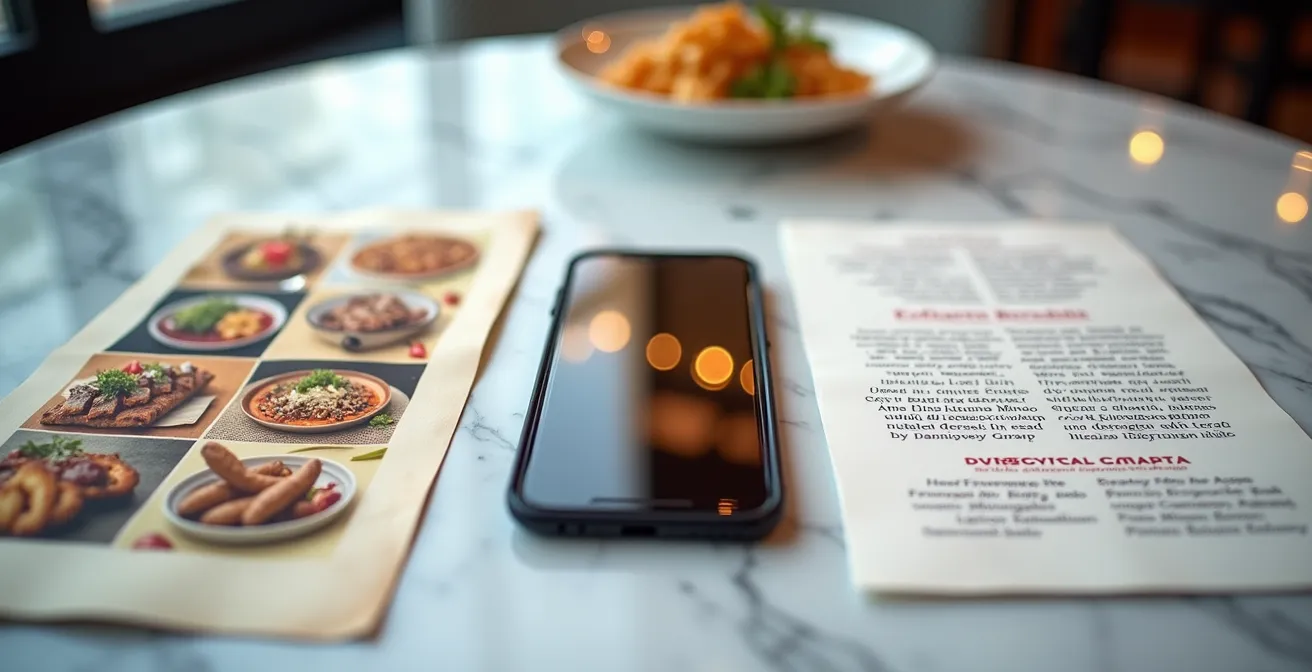
In some countries, particularly in Asia, photos are a standard and helpful part of the menu culture, even in high-quality establishments. In Europe, the rise of QR code menus has also changed the game. A sophisticated digital menu might include tasteful, professionally shot photos as a way to enhance the ordering experience, not as a crutch for bad food. The key is to assess the quality and intent behind the visuals. Are the photos a garish, desperate plea for attention, or an elegant, helpful guide? Is the restaurant relying solely on images, or do they supplement a well-written menu in the local language?
Falling into a genuine tourist trap can sour a trip. It’s not just about an overpriced, mediocre meal; it’s about the feeling of being misled. Indeed, a recent study found that for a significant number of travellers, the experience can be a major blight on their holiday. The PhotoAiD study confirms that 70% of travelers say tourist trap visits diminished their trip enjoyment. This highlights the importance of learning to read the subtle cues beyond the obvious ones.
Ultimately, trust your instincts. A restaurant’s overall presentation, the attitude of the staff, and the presence of local diners are far more reliable indicators of authenticity than the mere existence of a photograph.
Walk-in vs Reservation: How to Get Into Paris’s Hottest Bistro?
In London, booking a hot new restaurant often involves a high-tech battle on apps like Resy or OpenTable, weeks or even months in advance. In Paris, securing a table at a sought-after bistro requires a different, more analogue strategy. Many of the most beloved, classic Parisian establishments operate on a system that can seem opaque to outsiders, often favouring a direct phone call over a slick booking platform. For a UK traveller accustomed to planning everything online, this can be a barrier.
The key to cracking the code is understanding the “two-service system” that governs the evening rhythm of many popular bistros. This is a fundamental difference from the rolling bookings common in the UK. By understanding this structure, you can use it to your advantage.
Case Study: The Two-Service System in Parisian Restaurants
Many in-demand Parisian bistros structure their evening around two distinct seatings: an early service around 7:30 pm and a later one around 9:30 pm. This rigid structure creates two strategic opportunities for diners. UK travellers, who typically dine earlier than Parisians, can easily book the first service, which is often less competitive. Alternatively, for those who prefer to be spontaneous, arriving as the first service is winding down (around 9:15-9:45 pm) can be a great time to snag a walk-in table from early diners who have finished. Another excellent option is to ask for a seat at the ‘comptoir’ (the counter), which is often reserved for walk-ins and offers a more dynamic, local experience without any booking.
This system requires a slight shift in mindset. Instead of relying on technology, the most effective tools are a phone and a few polite French phrases like “Je voudrais réserver une table pour deux personnes, s’il vous plaît.” Calling the restaurant directly shows a level of intent and personal connection that many Parisian restaurateurs still value. Don’t be discouraged if the line is busy; persistence is part of the game.
By learning to work with the Parisian reservation culture rather than against it, you can gain access to the city’s most coveted dining rooms.
Service Compris: Why Tipping 20% in France is Unnecessary?
Tipping culture is one of the most confusing aspects of international travel, and the contrast between the UK and France is particularly stark. In the UK, a “discretionary” service charge of 12.5% is often added to the bill, but the etiquette around whether to pay it, or add more, remains ambiguous. In the US, a 20-25% tip is practically mandatory. Applying either of these customs in France is a clear sign of a tourist and is entirely unnecessary due to a simple, legally mandated system: “service compris” (service included).
By French law, every restaurant bill must include a service charge to cover the wages of the staff. This is not an optional extra; it is built into the price of every item on the menu. A government decree ensures that a 15% service charge is legally included in all French restaurant bills. This means the price you see is the price you pay. Leaving an additional 15-20% tip on top is effectively paying the service charge twice. While locals might leave a small extra amount for exceptional service, it is a gesture of appreciation, not an obligation.
This cultural difference is a common point of confusion for visitors. The proper etiquette in France is to simply round up the bill to the nearest euro or leave a few extra euro coins (€1-5) on the table if you were particularly happy with the experience. It is a small token, not a percentage-based calculation. Over-tipping, while well-intentioned, can create awkwardness and immediately marks you as someone unfamiliar with the local ‘service protocol’.
The following table provides a clear comparison of the tipping practices, helping to demystify the process for UK travellers.
| Country | Service Charge | Additional Tip Expected | Typical Amount |
|---|---|---|---|
| France | 15% legally included | Optional for exceptional service | Round up or €1-5 |
| UK | 12.5% often added (discretionary) | Sometimes expected on top | 10-20% if not included |
By respecting the local custom, you demonstrate cultural awareness and avoid the common pitfall of unnecessary over-tipping.
Cooking Class or Food Tour: Which Offers Better Cultural Insight?
To truly get under the skin of a destination’s food culture, many travellers look beyond restaurants to more immersive experiences like food tours and cooking classes. Both promise a deeper connection, but they offer fundamentally different kinds of insight. The choice between them depends on whether you prefer to be an observer or a participant. A food tour positions you as a curated observer, led by a guide to taste the best a city has to offer. A cooking class transforms you into an active participant, learning the techniques and traditions hands-on.
Food tours, like the popular Secret Food Tours which operates in over 100 destinations including London, excel at providing context and access. A great guide is a food historian, weaving stories about a neighbourhood’s history through its iconic tastes, from birria tacos in Camden Market to gin tastings in a hidden distillery. You get to sample a wide variety of foods from places you might not have found on your own. The experience is about consumption and narrative.
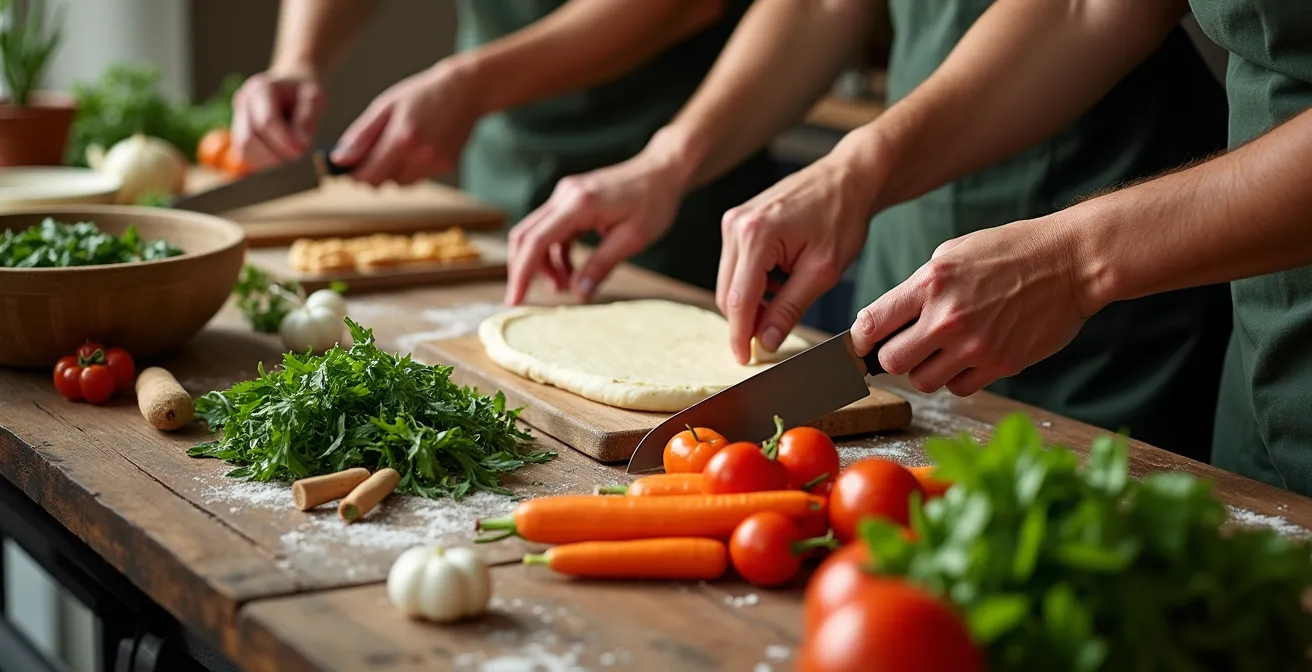
A cooking class, conversely, is about creation and skill transfer. The value lies in the tactile experience: learning to knead dough correctly, understanding the feel of perfectly ripe produce, or mastering a specific knife skill. The best classes, often led by professional chefs, start with a trip to a local market to source ingredients, connecting the raw product to the finished dish. This provides a profound insight into how locals shop and cook. The question to ask is simple: do you want to learn about the dish, or do you want to learn how to make the dish? Can you replicate what you’ve learned back home?
The most enriching experiences often combine both elements: a market tour led by a chef to select ingredients, followed by a hands-on class to cook them. This hybrid model offers the best of both worlds—the context of the observer and the practical knowledge of the participant.
Ultimately, the best choice aligns with your personal learning style and travel goals. Do you want to collect stories and tastes, or do you want to take home a new set of skills?
What Does the Red and Yellow Label Actually Guarantee?
Navigating a European deli or reading a high-end restaurant menu can feel like deciphering a code. You might see terms like “Prosciutto di Parma DOP” or “Parmigiano Reggiano DOP” and wonder what those letters signify. These aren’t just fancy marketing terms; they are legally protected seals of quality and authenticity issued by the European Union. Understanding these labels is like having a secret key to ingredient provenance, allowing you to identify products with a guaranteed origin and traditional production method.
The most important of these is the PDO (Protected Designation of Origin) label, distinguished by its red and yellow sunburst logo. For a product to earn PDO status, it must be entirely produced, processed, and prepared within a specific geographical area using recognised, traditional methods. This guarantees that the product’s unique character is inextricably linked to its region of origin. A great UK example is Blue Stilton cheese; only cheese produced in the counties of Derbyshire, Leicestershire, or Nottinghamshire to a specific recipe can legally be called Stilton.
Similarly, when you buy Prosciutto di Parma with the PDO seal, you are guaranteed it comes from the Parma region and has been aged according to centuries-old traditions. On a menu, a chef who specifies “Parmigiano Reggiano DOP” instead of just “formaggio” (cheese) is signalling a commitment to authentic, high-quality ingredients. Other important labels include:
- PGI (Protected Geographical Indication): This blue and yellow label guarantees that at least one stage of production, processing, or preparation took place in the specific region. Cornish pasties are a famous UK example.
- TSG (Traditional Speciality Guaranteed): This label doesn’t protect the origin but rather the traditional method of production or composition. Neapolitan pizza (Pizza Napoletana) is a classic example.
By looking for these seals, you can be confident that you are purchasing a product with a true sense of place and a story, not a generic imitation.
Key Takeaways
- Shift Your Mindset: Stop hunting for simple ‘red flags’ and start learning the ‘cultural operating system’ of a country’s dining scene.
- Respect the Rhythm: Align your mealtimes with local customs, whether it’s Spain’s 2 pm lunch or Paris’s two-service dinner system. Authenticity is often a matter of timing.
- Understand Provenance: Look beyond ‘fresh’ and learn to recognise official quality labels like PDO and PGI to guarantee authentic, regional ingredients.
10 Tastings or 3 Full Dishes: How to Choose a Food Tour That Doesn’t Leave You Hungry?
Food tours are a fantastic way to explore a city’s culinary landscape, but they come in many shapes and sizes. One of the most common points of confusion is portion size, leading to the dreaded scenario of finishing a three-hour tour and immediately needing to find a restaurant for a proper meal. To avoid this, it’s crucial to understand the language that tour operators use and to set your expectations accordingly. The main distinction is between a “tasting” tour and a “dinner” tour.
As one food tour evaluation expert from the London Food Tours Guide notes, there’s a simple rule of thumb:
A ‘tasting’ tour is often equivalent to one full meal, spread out over time. A ‘dinner’ or ‘supper’ tour should be a full, multi-course meal.
– Food tour evaluation expert, London Food Tours Guide
A “tasting tour” or a “Snack & Stroll” is designed to provide a series of small bites from various vendors. While the cumulative amount of food might equal a single meal, it’s delivered in a grazing format. These are perfect for exploring a market or getting a broad overview of a neighbourhood’s offerings, but they should be treated as a pre-dinner activity or a light lunch, not a substantial meal replacement. Look for reviews with keywords like “light,” “snack,” or “had to eat afterwards” as potential indicators.
If your goal is a full, satisfying meal, you should look for tours explicitly labelled as “dinner tours” or “progressive dinners.” These experiences are structured to function as a multi-course meal, with each course enjoyed at a different venue. You might have an appetizer at a wine bar, a main course at a traditional bistro, and dessert at a patisserie. These tours are designed to leave you feeling “stuffed” or “generously fed,” and reviews will often reflect this. Always check the tour description and reviews to match the experience with your level of hunger.
By applying this discerning, anthropological mindset to every food decision on your trip, from choosing a restaurant to booking a tour, you can move beyond the surface-level tourist experience and connect with the true culinary heart of your destination.