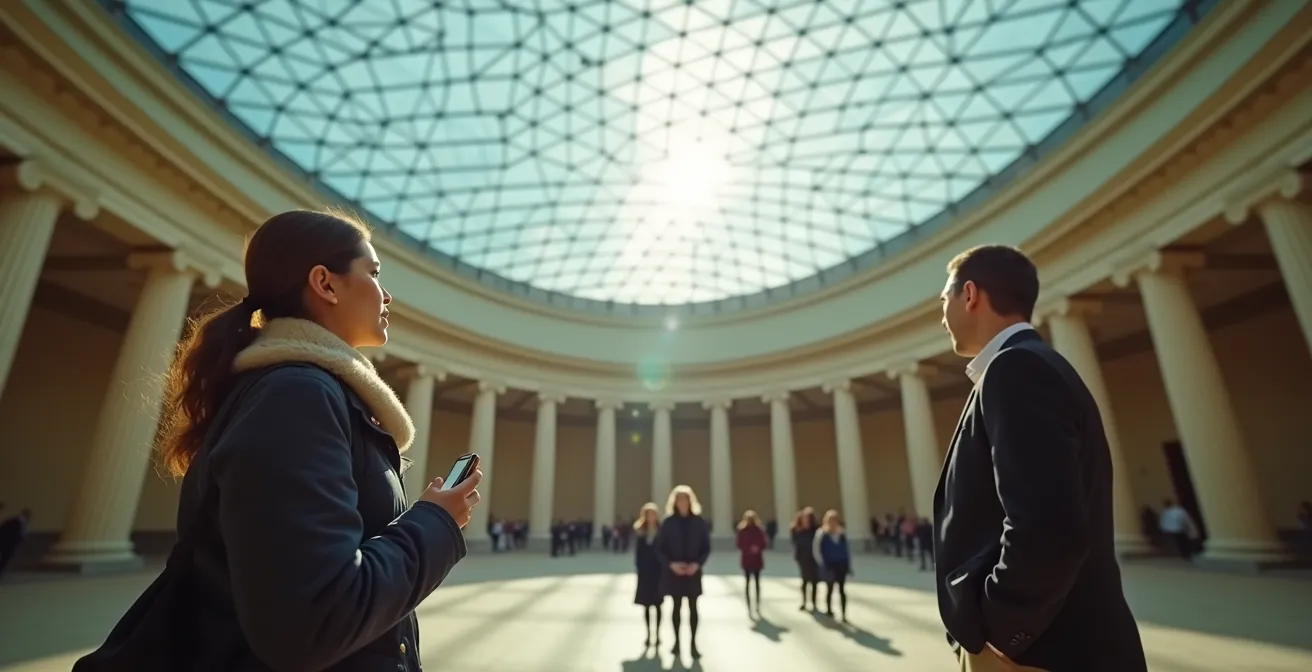
The choice between an audio guide and a private tour is secondary; true insight comes from curating a narrative for your visit, not just following a checklist.
- Shorter, focused visits (around 90 minutes) dramatically improve information retention and enjoyment.
- Atmosphere and context, found in smaller museums or during special late openings, often provide more memorable insight than seeing crowded ‘highlights’.
Recommendation: Define the story you want to uncover before you arrive, then choose the tool—be it a guide, an app, or a simple map—that best helps you follow that narrative thread.
The sheer scale of the British Museum can be overwhelming. Faced with over two million years of human history, the discerning visitor confronts a fundamental choice: how to navigate this ocean of artifacts? The debate often defaults to a simple binary: the affordability and freedom of an audio guide versus the expertise and expense of a private tour. This dilemma, however, presumes that the goal is simply to ‘see’ as much as possible, a strategy that often leads to exhaustion rather than enlightenment.
Many guides and blogs will offer a straightforward cost-benefit analysis, weighing the price of a personal guide against the convenience of a pre-recorded commentary. They focus on logistical efficiency, promising to shepherd you through the ‘must-see’ objects. But what if the key to a truly profound museum experience lies not in the tool you choose, but in the mindset you adopt? What if the most valuable insight is not about collecting facts, but about constructing a personal narrative?
This article proposes a different approach. We will move beyond the superficial comparison of audio guides and private tours to explore the very philosophy of a museum visit. We will argue that a well-curated experience—one that prioritizes cognitive retention, atmospheric immersion, and thematic coherence—is the true measure of a successful visit. It is not about what you see, but how you are taught to see it.
To help you craft a more meaningful journey through the British Museum and beyond, this guide examines the strategic layers of a visit. We will cover everything from highlight strategies and ticketing nuances to the science of light damage and the surprising power of shorter, more focused explorations.
Contents: Audio guide or Private tour: Which offers better insight for the British Museum?
- The ‘Highlights’ strategy: How to see the best of the Louvre in 2 hours?
- Timed entry vs Flexible tickets: Is the extra cost worth the freedom?
- Flash vs No Flash: Why does light damage ancient pigments?
- Why the Sir John Soane’s Museum beats the big nationals for atmosphere?
- Why the Louvre is better on a Wednesday evening
- The 90-minute rule: Why shorter visits lead to better retention?
- Reciprocal rights: How your UK Art Fund card gets you into foreign museums?
- Why you can no longer touch Stonehenge and how to get closer access?
The ‘Highlights’ strategy: How to see the best of the Louvre in 2 hours?
While the title references the Louvre, the principle of a ‘highlights’ strategy is universal and particularly relevant to the British Museum. The common approach is a frantic dash between iconic objects—the Rosetta Stone, the Parthenon Marbles, the Egyptian mummies. This transforms a visit into a scavenger hunt, sacrificing understanding for a mere checklist. A more sophisticated approach involves narrative curation: defining a theme or story to follow. This is not about seeing the ‘best’ objects, but about seeing objects that connect to tell a coherent story.
The success of thematic exhibitions demonstrates this power. The British Museum itself saw great success with narrative-driven temporary shows. These events prove that visitors are hungry for a story, not just a collection of famous artefacts. Unlike a purely chronological layout, a thematic tour provides context and creates a memorable journey. An audio guide might list facts, but a good private guide—or a well-designed thematic trail—weaves a tale. For the culture enthusiast, the goal is to find or create this thematic coherence, turning a sprawling collection into a focused, insightful experience.
Your 90-Minute British Museum Plan: A Narrative Route
- Immediate Impact: Start in Room 4 to view the Rosetta Stone before the main crowds build, understanding its role as a key to decipherment.
- The Afterlife Narrative: Proceed to Rooms 62-63 for the Egyptian mummies, focusing on the story of Katebet and the rituals of death and burial. Allow 15 minutes.
- Imperial Power: Navigate to Room 10 to witness the sheer scale and narrative drama of the Assyrian Lion Hunt reliefs.
- Athenian Democracy & Art: Move to Room 18 to engage with the Parthenon Sculptures, considering their original context in classical Athens.
- The Birth of England: Conclude in the darkness of Room 41 with the Sutton Hoo treasures, a powerful story of Anglo-Saxon identity and craftsmanship.
Timed entry vs Flexible tickets: Is the extra cost worth the freedom?
The British Museum is famously free to enter, a cornerstone of its public mission. However, ‘free’ does not always mean ‘without friction’. On peak days, queues can be extensive, and while booking a free timed-entry slot is not mandatory, it is highly recommended to guarantee entry and minimise waiting. This presents the first layer of our strategic choice: do you trade flexibility for efficiency? For an indoor institution like the British Museum, weather is not a factor, making a timed slot a low-risk, high-reward choice for most visitors.
The concept of ‘flexibility’ gains more weight when considering paid-for experiences or outdoor heritage sites. Here, the extra cost of a flexible ticket can be a sensible insurance policy against unpredictable British weather or a change in plans. However, for institutions like the British Museum, the ultimate flexibility is found not in a ticket type, but in exclusive, paid-for, out-of-hours tours. These offer a completely different experience, free from the crowds that define a typical visit.
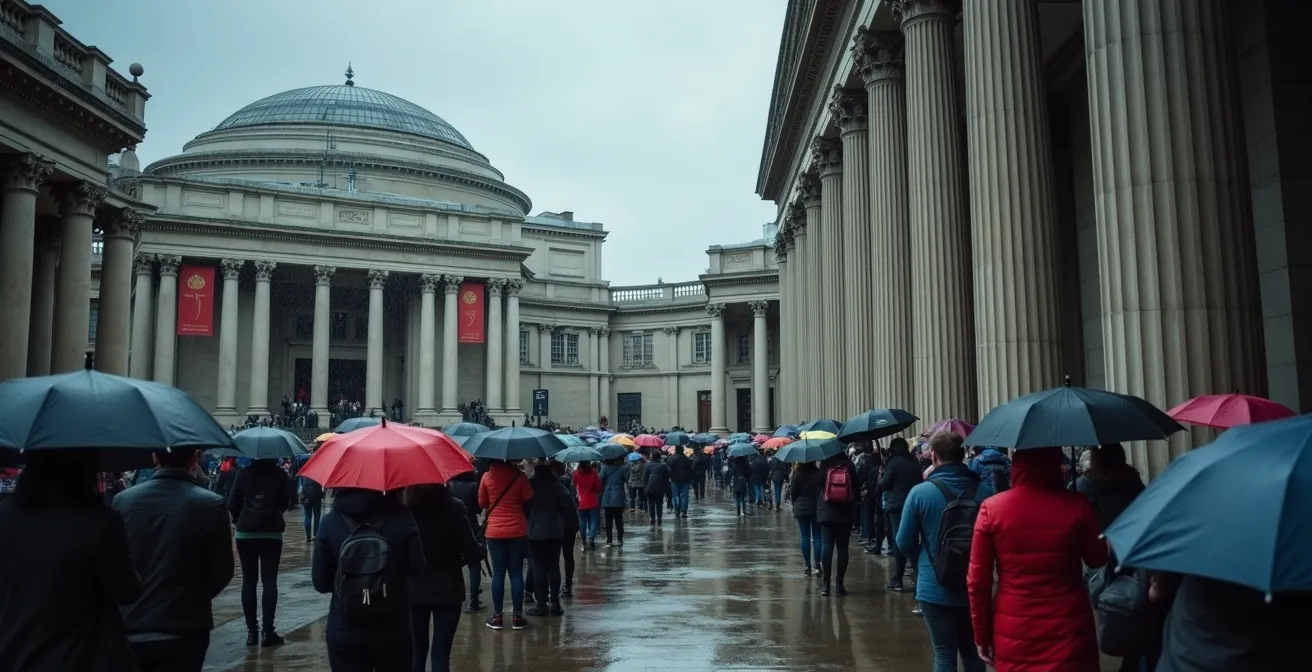
As the image suggests, even a free museum can involve significant waiting, especially on a rainy London day. The real ‘cost’ of a visit is often measured in time and comfort, not just pounds and pence. A private tour often includes expedited entry, but even the solo visitor can reclaim this time by simply booking a free slot in advance. Ultimately, the ‘worth’ of a ticket is defined by what you value most: spontaneity or a guaranteed, smooth experience.
This table compares ticketing approaches across different London heritage sites, putting the British Museum’s options into a wider context.
| Museum Type | Standard Entry | Flexible Options | Weather Impact | Best Value |
|---|---|---|---|---|
| Indoor (British Museum) | Free, booking advised | £35+ out-of-hours tours | None | Standard free entry |
| Outdoor (Tower of London) | £33.60 timed slot | £39+ flexible tickets | High | Flexible in uncertain weather |
| Special Exhibitions | Timed slots only | Not available | None | No choice available |
Flash vs No Flash: Why does light damage ancient pigments?
The ubiquitous ‘no flash photography’ rule in museums is often seen as a mere annoyance by visitors. However, for a curator, it represents a fundamental principle of preservation. The damage is not caused by a single flash, but by the cumulative effect of thousands. Light is energy, and when this energy is absorbed by an object, it can trigger chemical reactions. For ancient pigments, particularly those derived from organic materials like plants or minerals, this energy can break down the chemical bonds that create colour. The result is an irreversible fading, a slow bleaching of history.
This is not limited to two-dimensional works. As the British Museum’s own conservation experts note, the damage extends to three-dimensional artefacts. The delicate garnets and gold filigree of the Sutton Hoo treasure, for instance, are also vulnerable.
The cumulative damage of thousands of micro-flashes on the delicate garnets and gold filigree extends beyond pigments to affect metalwork and gemstones.
– British Museum Conservation Department, British Museum Conservation Guidelines
Some heritage sites have developed innovative compromises. Petworth House, managed by the National Trust, employs timed window shutters and guide-led ‘light-up moments’ to protect its Turner paintings. This ‘low and slow’ lighting policy allows for controlled, dramatic viewing while minimising cumulative exposure. This shows that the issue is not light itself, but its uncontrolled intensity and duration. Both audio guides and private tours must operate within these conservation limits, but a good private guide can integrate this principle into their narrative, explaining *why* an object is dimly lit and thereby turning a restriction into a lesson in materiality and preservation.
Why the Sir John Soane’s Museum beats the big nationals for atmosphere?
While the British Museum offers unparalleled scale, smaller, specialist institutions like the Sir John Soane’s Museum in London provide a different, and arguably more potent, form of insight: atmospheric immersion. This is not just a feeling; it is a measurable phenomenon. According to UK government museum statistics, specialist museums achieve an average 94% visitor satisfaction, compared to 87% for large national institutions. This gap can often be attributed to the sense of intimacy, discovery, and personal connection that a smaller, curated space can foster.
The Soane’s Museum is not a collection of objects in a building; the building *is* the primary artifact. It was designed by the architect Sir John Soane as a pedagogical tool and a home, with every surface, mirror, and skylight intended to create a specific emotional and intellectual effect. Here, the audio guide or private guide’s role is not to explain isolated objects, but to decode the architectural narrative of the space itself. The theatrical play of light and shadow is the main event.
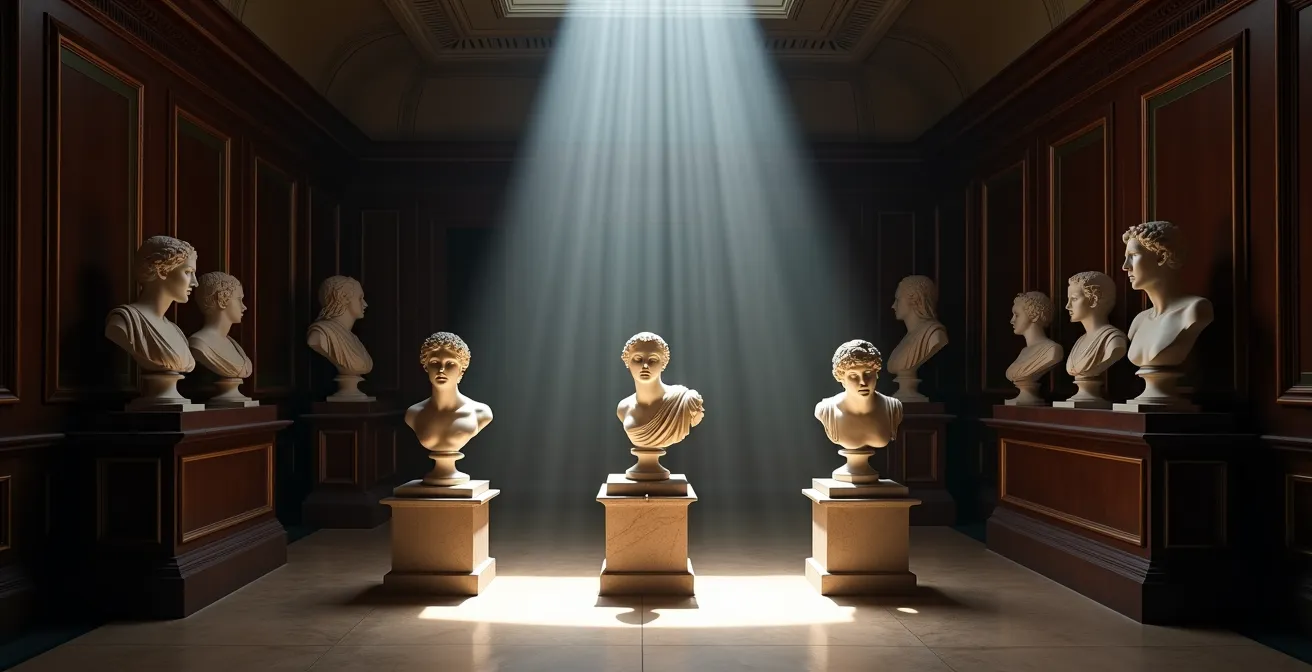
This experience cannot be replicated in the vast, purpose-built galleries of a national museum. The insight gained at the Soane’s is not about the provenance of a single Roman bust, but about the mind of a 19th-century collector and the very nature of collecting. For the culture enthusiast, a visit to such a place is a vital reminder that “insight” is often found in the curated atmosphere of a space, not just its contents. The best private guides for these spaces act as interpreters of the creator’s original vision.
Experiencing the Soane’s unique atmosphere
To truly connect with the museum’s spirit, one must engage with it on its own terms. Booking a spot for the monthly candlelit evening openings offers an authentically 19th-century experience. It’s essential to allow your eyes to adjust to the lower light levels and follow the prescribed route, which reveals Soane’s intended narrative. The true magic lies in noticing how mirrors and skylights create theatrical effects, a dialogue between light, shadow, and object that a phone torch would instantly destroy. Engaging with the volunteer warders, who are steeped in Soane’s philosophy, provides context that a simple audio guide cannot match.
Why the Louvre is better on a Wednesday evening
The strategy of visiting during late openings, long a secret of Parisian museum-goers, is equally potent in London. The British Museum’s Friday late openings, and similar events like the V&A’s ‘Friday Lates’, fundamentally transform the visitor experience. It’s not just about fewer crowds; it’s about a complete shift in atmosphere and demographic. This changes the dynamic of a visit, whether you are with a private guide or using an audio tour.
Data supports this shift. An analysis of British Museum visitor patterns reveals that Friday late openings show a 40% local visitor ratio, compared to just 15% during daytime hours. This creates a less tourist-focused, more relaxed and social environment. The museum ceases to be a stop on a travel itinerary and becomes a cultural destination for an evening out. A private tour in this context can feel more like a conversation, while an audio guide can be enjoyed at a more contemplative pace.
The V&A’s Friday Lates are a masterclass in this transformation, creating an ‘Eat, Drink, Art’ model. By incorporating DJ sets, pop-up bars, and themed food, they turn the museum into a vibrant social hub. This attracts a younger, more local audience and reframes the act of looking at art as part of a broader cultural and social experience. The insight gained here is not purely academic; it’s about seeing the museum as a living, breathing part of the city’s fabric. For the culture enthusiast, these events offer a chance to see the collections through a different, more contemporary lens.
The 90-minute rule: Why shorter visits lead to better retention?
One of the most counter-intuitive truths of museum-going is that shorter visits are often more effective. The desire to ‘see everything’ in a single, marathon session is a recipe for mental and physical exhaustion. This phenomenon is known as museum fatigue, and its effects are well-documented. A private guide might be able to keep you engaged for longer, but even their narrative powers cannot defy cognitive limits. An audio guide, followed exhaustively, can be even more draining.
Research from museum studies provides a clear benchmark. According to Dr. Sarah Mitchell of the UCL Institute of Education, “Museum fatigue sets in after 90 minutes regardless of visitor interest level, with cognitive retention dropping by up to 60% after this threshold.” This is a crucial piece of data for the culture enthusiast seeking genuine insight. Beyond the 90-minute mark, you are merely looking, not learning. The brain becomes saturated and stops processing new information effectively.
The solution is to adopt a ‘masterclass’ approach, as exemplified by institutions like The Wallace Collection. Instead of attempting a comprehensive tour, you select one or two galleries, or even a single collection, for deep engagement. This respects the 90-minute rule and transforms the visit from a sprint into a focused meditation. You leave feeling enriched and inspired, not defeated. This strategy requires discipline, but it yields far greater intellectual and emotional rewards. It means planning multiple, targeted visits over time rather than a single, overwhelming one.
The Wallace Collection 90-Minute Masterclass
To implement this, select a maximum of two galleries (e.g., the Great Gallery and the Armoury). Spend the first five minutes with a map to orient yourself, avoiding decision fatigue later. Aim to engage deeply with only 8-10 objects. Critically, take a five-minute seated break at the 45-minute mark to reset your cognitive load. After 90 minutes, exit through the courtyard restaurant for immediate decompression and discussion, solidifying what you’ve just experienced. The key is to schedule return visits for different collections, treating the museum like a book to be read one chapter at a time.
Reciprocal rights: How your UK Art Fund card gets you into foreign museums?
For the UK-based culture enthusiast, a museum visit strategy extends beyond the walls of a single institution. Membership schemes, particularly the Art Fund, have long provided a passport to culture across the UK and Europe. However, the landscape of these reciprocal agreements has shifted significantly in recent years, a crucial detail that neither an audio guide nor a standard private tour will likely cover.
The post-Brexit reality has complicated these arrangements. As a report from the Art Fund’s policy team highlights, what were once straightforward ‘free entry’ perks for members have often been downgraded. The team notes that “European reciprocal agreements with the Art Fund have been significantly weakened since Brexit, with many ‘free entry’ benefits becoming ‘50% off’ requiring additional verification steps,” a fact confirmed in an Art Fund International Access Report from 2024. This requires the savvy traveller to be more diligent in checking the specific benefits available before an overseas trip.
The following table illustrates the changing nature of these agreements in key European countries. It serves as a practical guide for any Art Fund member planning to leverage their card abroad, providing a layer of practical insight that enhances the value of their cultural investment.
| Country | Pre-Brexit Access | Current Status 2024 | Art Fund Benefit |
|---|---|---|---|
| France | Free entry to nationals | 50% discount only | Priority queue access retained |
| Netherlands | Free reciprocal access | Reduced to partner museums only | Members’ lounge access |
| Italy | EU citizen benefits | Standard tourist rates | Shop discounts only |
| Spain | Youth free entry | Age limit lowered | Exhibition discounts |
Key takeaways
- True museum insight is achieved through narrative curation, not by following a generic checklist of famous objects.
- Respecting the 90-minute rule prevents cognitive museum fatigue and leads to far greater information retention and enjoyment.
- The value of a visit is often found in atmospheric immersion, which smaller museums or special late-openings can provide more effectively than crowded main galleries.
- The best tool—whether an audio guide, a private tour, or a simple map—is the one that best serves your pre-defined narrative goal for the visit.
Why you can no longer touch Stonehenge and how to get closer access?
The case of Stonehenge offers the ultimate lesson in the distinction between access and insight. For centuries, visitors could walk among the stones and touch them. This practice was stopped to protect the monument from erosion and damage caused by millions of hands and feet. While this decision restricted physical access, it paradoxically paved the way for a more profound, and more curated, form of insight. The distant view forces a contemplation of the monument within its wider landscape, a perspective arguably closer to its creators’ intent.
Despite restricted access, the site’s popularity is unwavering; Stonehenge saw over 1.3 million visitors in 2024. Recognising the desire for a more intimate connection, English Heritage has created a two-tier system. Standard admission keeps you at a distance, while exclusive ‘Stone Circle Experience’ tickets allow small groups to walk within the circle outside of regular hours. This is the core of our argument: a restricted, curated experience often provides deeper insight than unfettered access. A private guide on one of these exclusive tours can offer unparalleled interpretation, but even an individual in that quiet space will feel a connection impossible to achieve amidst a crowd.
This model—balancing mass tourism with high-value, low-impact experiences—is a blueprint for the future of heritage management. For the culture enthusiast, it means that “getting closer” is a matter of strategic planning, not simply showing up. There are legitimate routes to inner-circle access, but they require foresight and often a significant investment of time or money.
Alternative Routes to Stonehenge Inner Circle Access
Beyond the official Stone Circle Experience, several other avenues exist. Applying for open access during the Summer or Winter Solstice is free but extremely crowded. For a more academic approach, joining archaeological volunteer programs with universities like Bournemouth or Cardiff can provide access. Specialist astronomy or geology tours often include dawn or dusk visits to the inner circle. Finally, for those with a spiritual interest, participating in Druid or Pagan ceremonies may be an option, though this requires community connection and advance arrangement. Each path offers a different kind of insight, from scientific to spiritual.
By shifting your mindset from that of a tourist to that of a curator, you transform every museum visit. Instead of asking “Audio guide or private tour?”, begin by asking “What is the story I want to discover today?”. Once you have that answer, the right tool will become clear. Plan your next visit to the British Museum not as a task to be completed, but as a narrative to be explored.