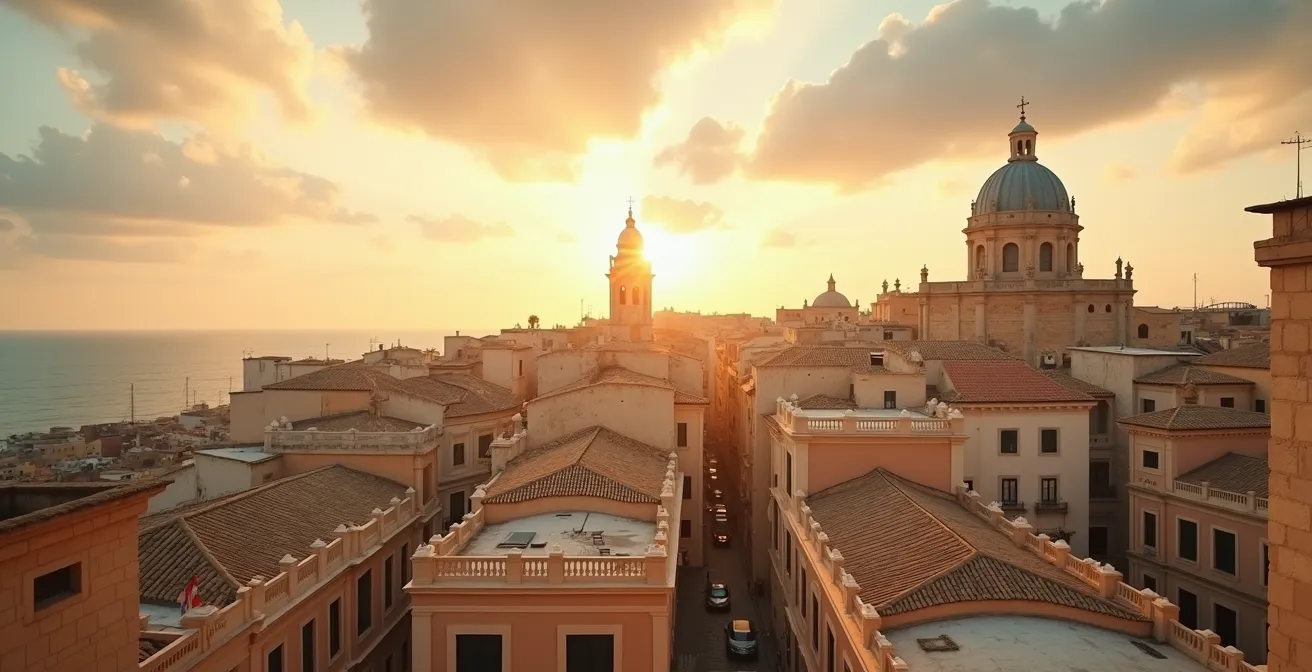
Valletta’s true story is a palimpsest of defiant Baroque grandeur and resilient wartime grit, written directly onto its limestone walls.
- The eight-pointed cross is not just decoration; it is the persistent symbol of the Knights’ ideology, found on everything from cathedrals to manhole covers.
- The city’s opulent surface, epitomised by Caravaggio’s art, is contrasted by a hidden, subterranean world of war rooms that reveal Malta’s WWII resilience.
Recommendation: To truly understand Valletta, learn to read these contrasting layers of history, looking for the narrative connections between its palazzos and its shelters.
For many, particularly the many visitors from the UK, Valletta is a sun-drenched vision of Baroque splendour, a UNESCO World Heritage site famed for its monumental fortifications and staggering views of the Grand Harbour. Standard guides will direct you to the main thoroughfares and postcard viewpoints, and while these are undoubtedly magnificent, they only tell half the story. To treat Valletta as a mere collection of beautiful buildings is to miss its profound, layered narrative. The city is a living manuscript, a stone palimpsest where the defiant opulence of the Knights of St. John is constantly interacting with the stark, subterranean resilience forged during the Second World War.
The key to a truly enriching visit is not simply to see the sights, but to understand how to read the city’s contrasting textures. It lies in recognising the ideology behind a symbol, the drama captured in a single painting, and the history hidden deep beneath the limestone streets. This is not a checklist of photo opportunities. Instead, this is a historian’s guide to deciphering the two great narratives of Valletta: the story of the Knights who built it as a fortress of faith and power, and the story of the Maltese people who defended it from the skies, creating a legacy of courage in its very foundations. We will explore how these two identities are not separate, but are etched one over the other, creating the unique character of this capital city.
This guide provides answers to specific questions that take you deeper into the city’s fabric. We will uncover the meaning behind its most famous symbols, find the best moments to appreciate its art, and navigate its complex historical layers, from magnificent palazzos to secret war rooms.
Summary: A historian’s deep dive into Valletta’s layered identity
- Why is the eight-pointed cross everywhere in Valletta?
- Caravaggio’s masterpiece: When is the best time to view it quietly?
- Lascaris War Rooms: Are they suitable for claustrophobic visitors?
- Which palazzo restaurants offer authentic Maltese rabbit stew?
- Upper Barrakka Lift: How to get from the waterfront to the city easily?
- Hieroglyphs for beginners: How to spot royal names on walls?
- How to link Roman history to modern movies like Gladiator?
- How to make history interesting for teenagers during a cultural trip?
Why is the eight-pointed cross everywhere in Valletta?
The eight-pointed cross you see across Valletta is far more than a mere decorative motif; it is the very emblem of the city’s creators, the Knights of the Order of St. John. Known as the Maltese Cross, its presence is a constant reminder of the military and hospitaller identity of the Order that founded and fortified the city after the Great Siege of 1565. Each of the eight points is said to represent one of the eight ‘langues’ (linguistic-geographic divisions) of the Knights, or alternatively, the eight Beatitudes. Seeing this cross is to see the ideological DNA of Valletta. It signifies a history of chivalry, charity, and fierce defence of Christendom. The cross’s ubiquity, from the grandest façades to the most mundane objects, demonstrates the symbolic persistence of the Knights’ legacy in the city’s daily life.
Once you know what to look for, spotting the cross becomes a fascinating way to engage with the city’s history on a micro-level. It transforms a simple walk into a historical treasure hunt, revealing layers of meaning in plain sight. This exercise sharpens the eye to the deep-rooted heritage that permeates every corner of Valletta, making the city’s past tangible and immediate. The following checklist will guide you to find some of the most interesting and often-overlooked examples.
Your treasure hunt for the Maltese Cross
- St. John’s Co-Cathedral Portal: Begin at the entrance. Look for the cross carved directly into the limestone above the main doors, the official stamp of the Order on their conventual church.
- Republic Street Pavement: As you walk, examine the marble tombstones that form parts of the cathedral’s floor and are replicated in the street. Many original Knights’ tombstones prominently feature the symbol.
- Merchant Street Doorways: Look up as you wander down this historic street. Many of the grand palazzos, former residences of the Knights, display the cross above their main entrances as a sign of allegiance and status.
- Upper Barrakka Gardens: Observe the details. The design is subtly incorporated into the ironwork of benches and railings, blending civic furniture with historic symbolism.
- City Manhole Covers: Look down. Even modern infrastructure pays homage to the city’s founders, with many cast-iron manhole covers bearing the eight-pointed emblem.
This symbol is the fundamental key to unlocking the city’s first great narrative. By tracing its presence, you are following in the footsteps of the Knights themselves and beginning to read the city as they intended it to be read: as a bastion of their Order.
Caravaggio’s masterpiece: When is the best time to view it quietly?
Michelangelo Merisi da Caravaggio’s monumental work, The Beheading of Saint John the Baptist, housed in the Oratory of St. John’s Co-Cathedral, is arguably Valletta’s single most important artistic treasure. It is a work of shocking realism and profound drama, a piece that encapsulates the defiant opulence and brutal piety of the Knights of Malta. The painting, the only one Caravaggio ever signed, was his masterpiece to secure favour with the Order. The dramatic use of chiaroscuro—the stark contrast between light and shadow—is not just an artistic technique; it is a metaphor for the spiritual battle central to the Knights’ ethos. To view it is to come face-to-face with the raw, violent, and theatrical spirit of the Baroque age.
The challenge, of course, is that its fame draws significant crowds, which can detract from the contemplative experience it demands. A quiet viewing is essential to appreciate the sheer scale and psychological depth of the work. Strategic timing, based on the daily ebb and flow of tourist traffic in Valletta, is therefore crucial. According to visitor pattern analysis, there are two key windows for a more serene encounter with the masterpiece.
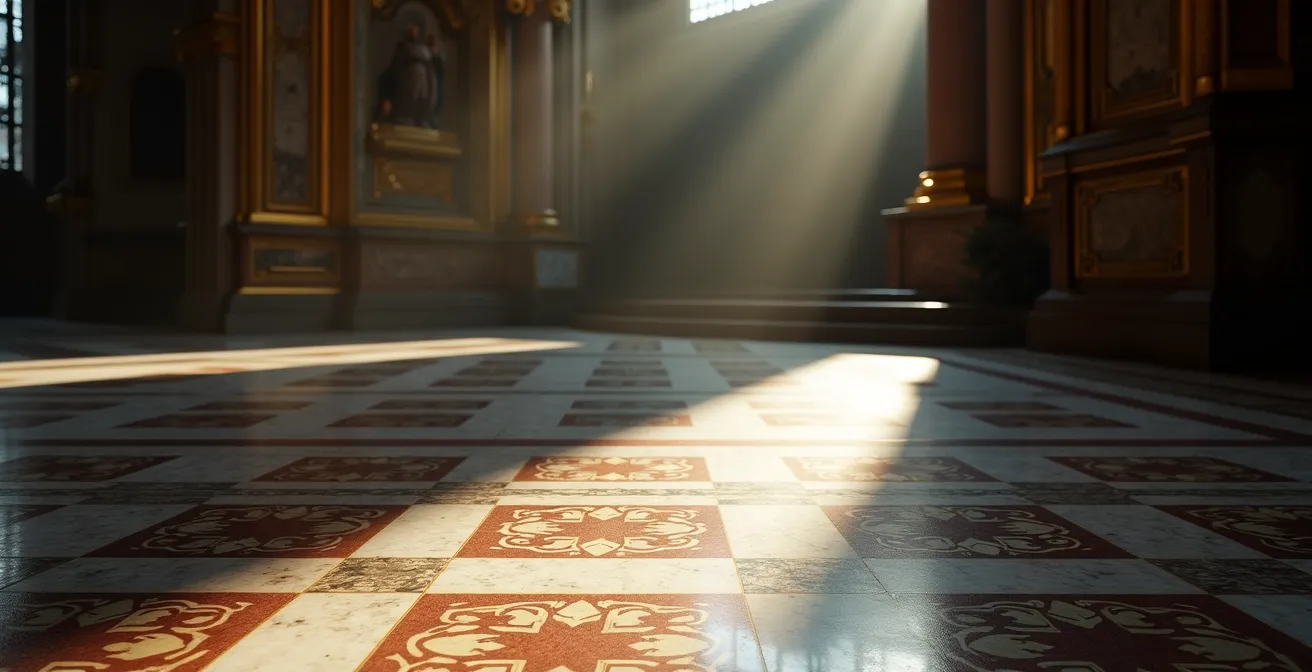
As you can see in the atmospheric light of the cathedral, the environment is as much a part of the experience as the painting itself. The quietest times are typically during the noon Saluting Battery ceremony at the Upper Barrakka Gardens, as many visitors are drawn there, leaving the cathedral relatively empty. An even better, though less predictable, opportunity is during early morning services when the cathedral is open for worshippers before general admission begins. While you cannot tour freely, the sense of peace and place is unparalleled.
Choosing your moment carefully transforms the viewing from a simple tourist stop into a profound artistic pilgrimage, allowing the power of Caravaggio’s vision to be fully absorbed.
Lascaris War Rooms: Are they suitable for claustrophobic visitors?
If the Co-Cathedral represents Valletta’s opulent surface, the Lascaris War Rooms represent its subterranean resilience. This underground complex of tunnels and chambers, buried deep beneath the Upper Barrakka Gardens, was the secret headquarters from which the defence of Malta was coordinated during the Second World War. It was from here that General Eisenhower also directed Operation Husky, the Allied invasion of Sicily, in 1943. Visiting the war rooms provides a stark, powerful contrast to the Baroque splendour above ground, revealing the grit and tension of a Malta under siege. The question of claustrophobia is a valid concern for any underground site, but the nature of this particular complex is often misunderstood.
The core operational areas were designed to house dozens of personnel for long periods, and as such, they are not universally cramped. As the Malta Heritage Trust notes in its official visitor guidance, the key areas are surprisingly accommodating. The main concern is limited to specific, optional routes.
The main operations rooms are surprisingly spacious, comparable in scale and atmosphere to London’s Churchill War Rooms. The potential issue is limited to a few narrow connecting corridors, which can be bypassed.
– Malta Heritage Trust, Official visitor guidance
To provide a clearer picture, it’s helpful to compare the different spaces within Malta’s key war-related sites. An accessibility analysis of these locations offers a practical guide for visitors concerned about enclosed spaces.
| War Site | Space Level | Claustrophobia Rating | Alternative Options |
|---|---|---|---|
| Lascaris Main Ops Room | Large hall | Low concern | Full access recommended |
| Connecting tunnels | Narrow passages | High concern | Can skip via external route |
| Fort St Elmo Museum | Open rooms | No concern | Fully accessible |
| Upper Barrakka Battery | Outdoor | No concern | Open air alternative |
Ultimately, a visit is highly recommended. By understanding that the most critical and impressive rooms are spacious, most visitors can experience this vital piece of Maltese and Allied history without significant discomfort.
Which palazzo restaurants offer authentic Maltese rabbit stew?
Moving from the history of faith and war to the history of the palate, one cannot claim to have experienced Malta without tasting Stuffat tal-Fenek, or traditional rabbit stew. This dish is the heart of Maltese home cooking, a rich, slow-cooked stew that speaks of rustic traditions and communal gatherings. In a city as historic as Valletta, many restaurants housed in grand palazzos offer it on their menus. However, “authenticity” is more than just a historic setting; it lies in the adherence to traditional preparation methods. The most genuine versions are not found in tourist traps, but in establishments where the recipe has been passed down through generations.
The key to an authentic stew is a long, slow cooking process. The rabbit is typically marinated overnight in wine and garlic, then simmered for hours until the meat is exceptionally tender. This method melds the flavours deeply, a stark contrast to quicker, modernised versions. One establishment in particular is often cited by local chefs as the standard-bearer for this tradition.
Rubino restaurant, operating since 1906 in a converted palazzo, maintains the traditional method: marinating the rabbit overnight in wine and garlic, then slow-cooking for three hours in earthenware. Their recipe hasn’t changed in four generations – that’s what makes it authentic, not just the historic setting.
– Local chef’s perspective, as noted in local food guides
The mention of earthenware cooking is crucial. This traditional material distributes heat evenly and gently, which is essential for the slow-cooking process and contributes to the dish’s signature flavour and texture. It is this commitment to time-honoured techniques that separates a truly authentic experience from a simple meal.

Therefore, when seeking an authentic Stuffat tal-Fenek, look beyond the grandeur of the palazzo and inquire about the method. Ask if the rabbit is slow-cooked, if it’s marinated, and if the restaurant prides itself on a generational recipe. These are the true markers of authenticity that connect you to Malta’s rich culinary heritage.
Finding such a place allows you to taste a piece of Maltese history, a flavour that has been cherished in local homes for centuries and is preserved by a dedicated few.
Upper Barrakka Lift: How to get from the waterfront to the city easily?
Valletta’s formidable fortifications present a practical challenge: the city stands on a high peninsula, towering over the Grand Harbour. For centuries, moving between the waterfront and the city proper required a strenuous climb. The Upper Barrakka Lift is the modern solution to this age-old problem. It provides a swift, 58-metre vertical connection from the Grand Harbour waterfront, where cruise ships and the Three Cities ferry dock, directly up to the Upper Barrakka Gardens at the city’s highest point. For the modern visitor, it is an indispensable utility, transforming a potentially arduous trek into a scenic, 25-second ride.
The lift’s history, however, is as fascinating as its function. The original structure on this site was a marvel of Victorian engineering, built in 1905 to connect the Royal Navy’s Mediterranean fleet, headquartered in the Grand Harbour, with the administrative heart of Valletta above. It was a vital piece of colonial infrastructure, a vertical link for officers and administrators of the British Empire. The original lift ceased operations in the 1970s and was dismantled, but its modern successor, opened in 2012, follows the same essential path and serves the same fundamental purpose: bridging the two distinct levels of the city.
Using the lift is straightforward. Upon disembarking from a cruise ship or the Three Cities ferry, the lift entrance is clearly signposted. A small fee is charged for the ride up, though the journey down is free. Importantly for those arriving via the ferry, the price of the lift ticket is often included in the ferry fare, so it is wise to check your ticket to avoid paying twice. For those seeking a more historic and physically demanding alternative, the nearby Victoria Gate stairs offer a free climb through the old fortifications, providing unique photographic angles of the harbour that are invisible from the lift itself.
This piece of modern engineering provides not just convenience, but a moment to appreciate the sheer scale of the fortifications and the strategic brilliance of the city’s design.
Hieroglyphs for beginners: How to spot royal names on walls?
While you will not find ancient Egyptian hieroglyphs on the walls of Valletta—a city founded millennia later—the principle of spotting “royal names” on walls is remarkably applicable. Valletta possesses its own complex system of heraldic “hieroglyphs” in the form of coats of arms. Specifically, the arms of the various Grand Masters of the Order of St. John are emblazoned on countless buildings, fortifications, and gateways they commissioned. Learning to spot and identify these is the key to dating the structures around you and connecting them to the great personalities of the Knights’ history. These are Valletta’s own royal cartouches, telling the story of who built what, and when.
A typical Grand Master’s coat of arms is quartered. It combines the plain white cross on a red field of the Order (the gules, a cross argent) with the personal family arms of the Grand Master himself. For example, the arms of Grand Master Jean de Valette, the city’s founder, feature a lion and several birds of prey. The arms of Grand Master Alof de Wignacourt, who commissioned the famous aqueduct, feature three fleur-de-lis. Spotting these shields on a building’s façade is like reading a signature. The Auberge de Castille, for instance, is covered in the arms of Grand Master Manuel Pinto da Fonseca—crescents being his family’s symbol—who renovated it into the Baroque masterpiece it is today.
To begin spotting these “royal” names, start with major landmarks. Look above the main entrance of St. John’s Co-Cathedral to see the arms of Grand Master La Cassière. Examine the main city gates or the corners of the great Auberges. By cross-referencing the personal arms you find with a list of the Grand Masters, you can begin to piece together the chronology of the city’s construction. This practice transforms the city from a static collection of old buildings into a dynamic story of ambition, power, and patronage written in the language of heraldry.
This approach allows you to read the “royal names” of Valletta, unlocking a deeper layer of the city’s history and appreciating the personal legacies of the men who shaped it.
How to link Roman history to modern movies like Gladiator?
Valletta itself is a product of the 16th century, and thus contains no Roman ruins. However, Malta’s connection to Roman history is profound and can be linked, albeit indirectly, to the epic cinematic world of films like Gladiator. Malta was a thriving part of the Roman Empire, a fact best evidenced by the magnificent Roman Domus (townhouse) in Rabat, with its stunning mosaics. The island is also famously the site of St. Paul’s shipwreck in 60 AD, an event that brought Christianity to Malta and is a cornerstone of the national identity. While this Roman layer is not physically present in Valletta, its spirit of epic history and its dramatic coastal landscape have made it a favoured filming location, creating a new, modern layer of mythology.
The link to Gladiator is direct, though not in Valletta. The scenes depicting ancient Rome in the film, including the famed Colosseum sequences, were not filmed in Italy but at Fort Ricasoli, a massive 17th-century fortification that guards the entrance to the Grand Harbour, directly opposite Valletta. The fort’s scale and texture provided a perfect stand-in for the grandeur of the Roman Empire. When you stand at the Upper Barrakka Gardens and look across the water at Fort Ricasoli, you are looking at a key piece of the Knights’ defensive network that also served as a backdrop for one of modern cinema’s greatest epics.
This connection provides a fascinating bridge between ancient history and popular culture. It demonstrates how Malta’s monumental architecture, born from the military needs of the Knights, possesses a timeless, epic quality that filmmakers seek out to represent the power of empires, be they Roman or fictional. Other films, like Troy and Game of Thrones, have also used Malta’s fortifications and landscapes for this same reason. Thus, the legacy of the Knights has indirectly helped shape our modern visual understanding of the ancient world.
So, while you cannot find Roman ruins in Valletta, you can see across the harbour the place where Rome was reborn for the silver screen, a testament to the enduring power of Malta’s historic landscape.
Key Takeaways
- Valletta should be read as a ‘palimpsest’, where the Knights’ Baroque opulence and WWII’s gritty resilience are two historical layers written on the same city.
- The Maltese Cross is the city’s core symbol, and spotting it on both grand and mundane objects is key to understanding the Knights’ pervasive legacy.
- To truly appreciate Valletta’s history, one must explore both its magnificent surface (art, architecture) and its hidden, subterranean depths (war rooms, shelters).
How to make history interesting for teenagers during a cultural trip?
Valletta, with its dense and complex history, can seem daunting for a younger audience. The key to making its history interesting for teenagers is to move away from abstract dates and names and focus on the visceral, the dramatic, and the interactive. The city is a natural stage for compelling stories of conflict, artistry, and survival, which can be far more engaging than a dry history lesson. The goal is to connect the past to concepts they already understand: power, rebellion, technology, and human drama. Recent tourism statistics show that British, Italian, and Polish residents made up 44.0% of visitors, and family travel is a significant component of this.
First, focus on the military technology. The daily Saluting Battery ceremony at the Upper Barrakka Gardens, with its thunderous cannon fire, is a powerful sensory experience. Explaining the mechanics of the cannons and their role in defending the harbour is far more interesting than simply stating that the fortifications are strong. Similarly, the Armoury at the Grandmaster’s Palace, with its vast collection of shining armour and weaponry, allows them to see the real tools of the Knights’ power up close.
Second, lean into the drama and gore. The story of Caravaggio—a genius artist who was also a convicted murderer on the run—is as compelling as any movie plot. Standing before his grim masterpiece, The Beheading of St. John, and telling his story of brawl, exile, and knighthood brings art history to life. The dungeons of the Inquisitor’s Palace or the former law courts (the Castellania) offer tales of justice and punishment that are both gruesome and fascinating. Finally, the immersive nature of the Lascaris War Rooms, with their blinking lights and strategic maps, feels like stepping into a vintage spy film, making the high-stakes drama of WWII tangible and exciting.
So, when you next walk the streets of Valletta, look beyond the static beauty of its architecture. Seek out the stories, the conflicts, and the human drama etched into its walls. It is by reading this layered manuscript of stone and shadow that you will truly discover the soul of this remarkable city.
Frequently Asked Questions about this Valletta Walking Tour
Is the Upper Barrakka Lift ticket included with other transport?
Yes, if you arrive by Three Cities ferry, your lift ride up to the city is included – don’t pay twice!
What was the original Victorian engineering purpose?
Built in 1905, it connected the Royal Navy’s Mediterranean fleet headquarters in Grand Harbour with Valletta’s administrative center above.
What’s the scenic alternative to the lift?
The historic Victoria Gate stairs to the left offer a free climb through old fortifications with unique photo angles of the harbour unseen from the lift.