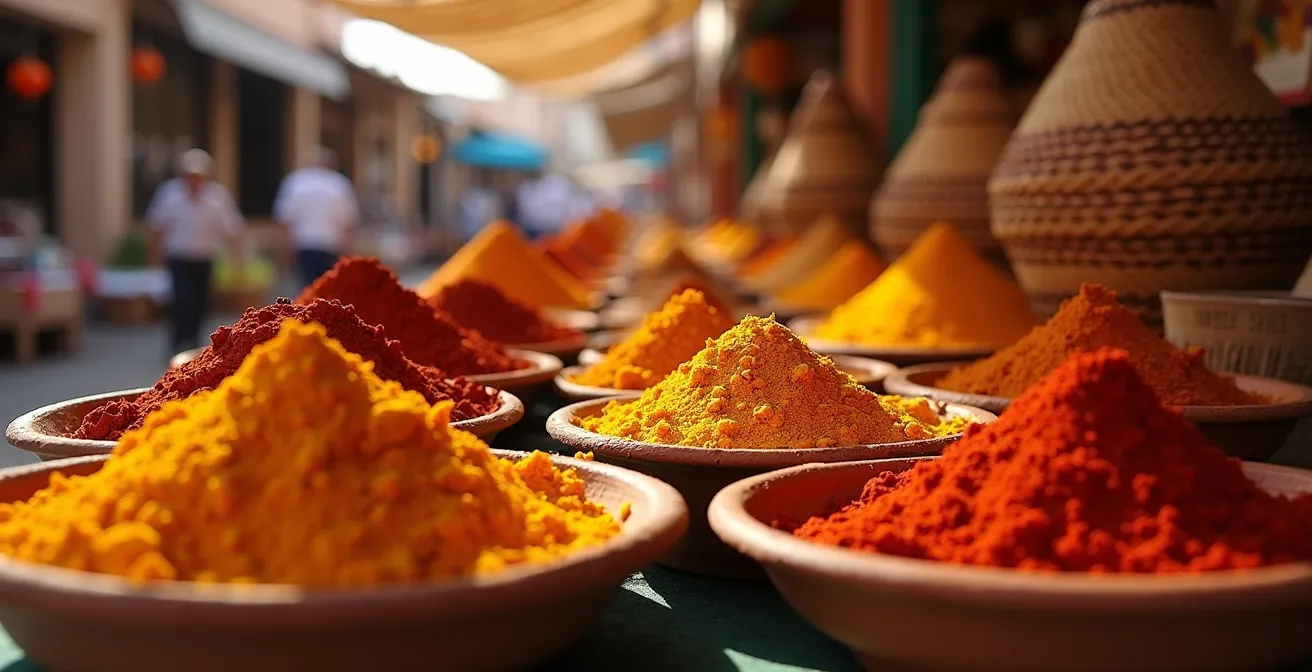
The secret to buying authentic ingredients in Marrakech isn’t aggressive haggling; it’s learning to engage in a sensory dialogue with the market itself.
- Authenticity is revealed through small imperfections, genuine materials, and a smell that can’t be faked—not through a perfect, uniform appearance.
- Respectful curiosity, from asking permission for a photo to gracefully declining a purchase, builds trust and leads to better experiences than confrontation.
Recommendation: Before buying, visit a state-run shop like the Ensemble Artisanal to calibrate your sense of fair price and true quality. This is your most powerful tool against the “tourist price”.
The air in the Marrakech souk is thick with a thousand stories. It’s a dizzying tapestry of smells—the sweet perfume of dates, the sharp tang of curing leather, the earthy depth of cumin and turmeric piled into perfect cones. For a food lover, this is paradise. But it’s also a place of uncertainty. The common advice you hear is a battle cry: “haggle hard,” “beware of scams,” “don’t get ripped off.” This approach turns a joyful exploration into a stressful confrontation.
But what if there’s another way? What if the key isn’t to fight the market, but to understand its language? The real currency here isn’t just the dirham; it’s knowledge, respect, and a well-trained set of senses. A true spice trader doesn’t just see a price tag; they see the subtle story of an item’s origin in its texture, its aroma, and the hands that crafted it. This guide isn’t about winning a negotiation. It’s about learning to read the market, to engage in a sensory dialogue that ensures the treasures you bring home are as genuine as the experience itself.
We will journey through the unwritten rules of the souk, from navigating social customs with grace to understanding the logistics of bringing your finds back to the UK. We will decode the difference between true craftsmanship and mass-produced replicas, and finally, we will tackle the ultimate prize: learning the time-honoured techniques to distinguish pure, fragrant saffron from its worthless imposters.
Summary: A Trader’s Journey Through the Souks
- The ‘Free Tea’ Tactic: How to Exit a Shop Without Buying a Rug?
- Hygiene at the Stall: Is It Safe to Sample Cut Fruit?
- Vacuum Packing: How to Get Pungent Cheese Through Airport Security?
- Grams vs Kilos: How to Avoid the ‘Tourist Price’ Math Error?
- Permission and Payment: Should You Tip for a Portrait?
- Authentic Craft or Mass-Produced Souvenir: How to Spot the Difference?
- Farm to Table: How to Visit a Cheese Producer Without a Tour Group?
- Spotting the Fakes: How to Tell Real Saffron From Dyed Corn Silk?
The ‘Free Tea’ Tactic: How to Exit a Shop Without Buying a Rug?
The glass of steaming, sweet mint tea is an iconic gesture of Moroccan hospitality. It is not, as many fear, a trap. Accepting it is a sign of respect, an entry into a social exchange, not a binding contract. The pressure you feel is often self-imposed, born from a misunderstanding of this ‘code of respect’. The key is to manage the interaction with grace and clear, polite boundaries from the outset. Think of it as a friendly conversation, not a high-stakes negotiation.
Your goal is to show genuine appreciation for the craft and the person, even if you don’t intend to buy. A compliment on the colour of a rug or a question about its origin shows you value the work. When it’s time to leave, a firm but warm “I need to think about it” is a universally understood and respected phrase. Rushing out nervously is what creates awkwardness. Instead, control the tempo of the visit by stating your time constraints upfront, browse with genuine curiosity, and depart with a smile and a “shukran” (thank you). This transforms a potentially stressful encounter into a pleasant cultural exchange.
- Accept the tea gracefully but set a time limit upfront (‘I only have 10 minutes, but thank you’).
- Compliment the products genuinely while browsing (‘These colours are beautiful,’ ‘The craftsmanship is incredible’).
- Ask about the story behind the items to show respect for the work and culture.
- Use the phrase ‘I need to think about it’ or ‘I must discuss with my family’ as a polite and final reason to depart.
- If pressed, exchange contact details and promise to return if you decide—it’s a polite way to conclude the conversation.
Hygiene at the Stall: Is It Safe to Sample Cut Fruit?
The sight of glistening dates, jewel-like piles of olives, and vendors pressing vibrant orange juice is a core part of the Medina’s appeal. But the question of hygiene naturally arises. Is it safe to indulge? The answer lies not in avoiding everything, but in using your senses to make smart choices. The most important indicator of food safety in a bustling market is not a certificate on the wall, but high turnover. Your best guide is the local population.
Look for the stalls that are busy, especially with Moroccans. A constant stream of customers means the food isn’t sitting around; it’s being prepared and sold quickly, ensuring freshness. For items like cut fruit or pastries, observe the vendor. Are their hands clean? Are the cutting surfaces wiped down? Are the products protected from flies? When it comes to juice, watching it being squeezed before your eyes is the ultimate guarantee of freshness. In the heart of the Medina, you’ll find countless stalls selling freshly squeezed orange juice, and the best ones have a mountain of oranges ready to go and a queue of thirsty patrons.
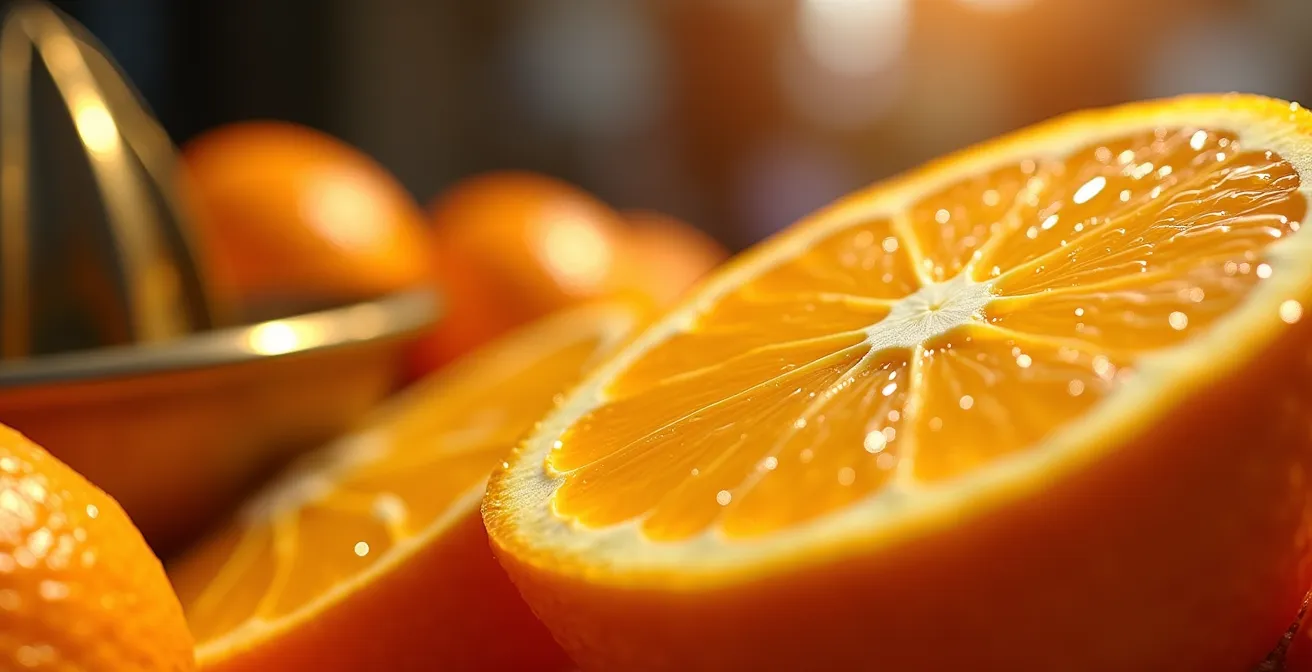
As you can see, the visual cues of freshness—like a pyramid of whole fruits waiting to be pressed—are powerful indicators. Trust what you see. If a stall looks clean, smells fresh, and is popular with locals, you can generally sample its offerings with confidence. Your senses are your most reliable guide to a safe and delicious market experience.
Vacuum Packing: How to Get Pungent Cheese Through Airport Security?
Bringing home the flavours of Morocco is a wonderful goal, but it requires some planning, especially when it comes to aromatic items like pungent goat cheese or potent spices. The secret weapon for any food-loving traveller is vacuum packing. Most larger food stalls in the souks, or dedicated grocers in the new town (Gueliz), offer this service for a small fee. It contains the powerful aromas that might otherwise attract unwanted attention from baggage handlers or security.
However, sealing your goods is only half the battle; you must also comply with your home country’s import regulations. For travellers returning to the UK, the rules are quite specific. While fresh fruit is generally prohibited, you are allowed to bring back a personal allowance of cheese and an unlimited quantity of dried spices. An expert tip from local spice trader Mustapha Bentaleb is to opt for complex spice blends: “If you are unsure about what to buy, go for the speciality called ‘Ras El Hanout’, which means, ‘Head of the shop’, where you get over 30 mixed spices to take home”. Getting this vacuum-sealed ensures its potent fragrance arrives intact in your kitchen, not dispersed in your suitcase.
Before you buy, it’s wise to be aware of the specific allowances. This table, based on information from sources like official UK government guidance and travel experts, clarifies what you can bring back from a non-EU country like Morocco.
| Product Type | Allowed into UK | Maximum Quantity | Packaging Requirements |
|---|---|---|---|
| Hard Cheese | Yes (from non-EU) | 2kg personal use | Sealed, labelled |
| Spices (dried) | Yes | Unlimited personal use | Sealed bags |
| Olive Oil | Yes | 1 litre duty-free | Original container |
| Fresh Fruit | No | N/A | N/A |
Grams vs Kilos: How to Avoid the ‘Tourist Price’ Math Error?
One of the most common points of confusion when buying spices or other goods by weight isn’t a deliberate scam, but a simple misunderstanding of scale. A vendor might quote you a price for a kilogram of saffron or cumin, a quantity far larger and more expensive than any tourist needs. This can lead to shock when the final price is calculated. The key is to take control of the unit of measurement from the start: always ask for the price per 100 grams.
This simple shift does two things: it gives you a realistic, comparable number, and it signals to the vendor that you are a savvy buyer. Have your phone’s calculator open and ready; this is seen as a sign of a prepared and serious customer, not an insult. To help visualize, remember that 100g of whole spices is roughly the volume of a large coffee cup. When it comes to haggling, be realistic. While some experienced hagglers report achieving prices as low as 25% of the initial asking price on crafts, this is less common with food items where margins are smaller. Aim for a discount of around 25-30% from the initial quote as a respectful and achievable goal.
Finally, always carry small denominations of dirhams. The classic “I don’t have change” line is a simple way to get you to overpay. Being able to produce the exact agreed-upon amount is the final step in a smooth and fair transaction. It shows you came prepared and respects the vendor’s time. This isn’t about suspicion; it’s about facilitating an easy and clear exchange for both parties.
Permission and Payment: Should You Tip for a Portrait?
The souks are a photographer’s dream, filled with cinematic light and compelling subjects. Artisans hammering metal, storytellers captivating crowds, and snake charmers in Djemaa el-Fna all present irresistible photo opportunities. However, pointing your lens is not a neutral act. In Moroccan culture, and especially in commercial spaces, a person’s image has value. The unwritten rule is simple but crucial: always ask permission before taking a close-up picture of someone.
You’ll find that most artisans are proud of their work and are often happy to be photographed, especially if you show genuine interest in their craft first. A smile and a gesture towards your camera is a universal language. If they agree, taking the photo becomes a respectful exchange. In these cases, a small tip is not just appropriate, it’s expected. Think of it as a payment for their time and cooperation. A tip of 10-20 dirhams (around £0.80 – £1.60), the price of a mint tea, is a considered and respectful gesture.
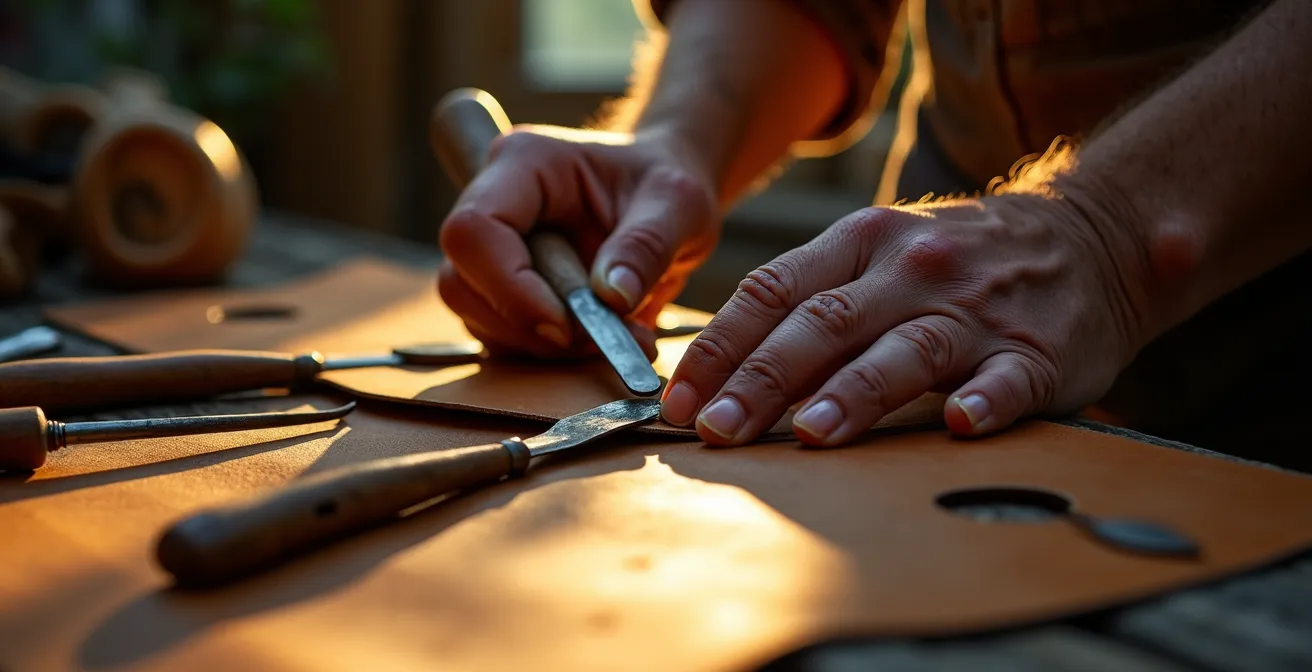
For more professional performers like the Gnaoua musicians or snake charmers, this is their livelihood. They expect payment and will often have a set price. For general street scenes taken from a distance, tipping isn’t necessary. But if your camera focuses on an individual and they become the subject of your art, the respectful ‘sensory dialogue’ we’ve discussed extends to this exchange. You are capturing a piece of their world; it’s only right to offer a small token of appreciation in return.
Authentic Craft or Mass-Produced Souvenir: How to Spot the Difference?
In the labyrinthine alleys of the souk, a beautiful leather bag could be the work of a master artisan or a factory-made import from overseas. Telling the difference is the ultimate test for a discerning shopper. Your most powerful tool isn’t haggling, but observation. The “artisan’s signature” is found in the very things a machine tries to eliminate: slight imperfections and unique variations.
An authentic handmade item will rarely be perfectly symmetrical. The stitching on a leather pouf might have a slight irregularity, or the pattern on a hand-painted ceramic bowl will show the unique trace of the artist’s brush. Mass-produced items, by contrast, are defined by their perfect uniformity. Look at a stack of ten ‘identical’ bowls; if they are truly identical, they are almost certainly not handmade. Also, trust your sense of touch and smell. Genuine leather has a rich, earthy scent that synthetics cannot replicate. Natural wool or silk feels different from polyester blends. An excellent preparatory step, as noted by the Tours of Distinction guide, is to ground your senses: “My first stop before heading into the souk was to visit a price fixed store like Ensemble Artisanal, a state owned store with fixed prices”. This gives you a crucial baseline for both quality and cost.
This table outlines the key differences to look for. Use it as a mental checklist when you’re examining a potential treasure.
| Feature | Authentic Handmade | Mass-Produced |
|---|---|---|
| Price Reference | Ensemble Artisanal fixed prices | 50-75% cheaper |
| Imperfections | Slight irregularities, unique patterns | Perfect uniformity |
| Material | Natural fibres, genuine leather | Synthetic materials |
| Source | Artisan workshops, cooperatives | Tourist area periphery stalls |
Farm to Table: How to Visit a Cheese Producer Without a Tour Group?
For the truly dedicated food lover, the ultimate experience lies beyond the city walls. Visiting an argan oil cooperative, an olive press, or a small-scale cheese producer in the Atlas foothills offers an unparalleled connection to the source. While many organised tours exist, arranging a direct visit allows for a more intimate and authentic encounter. It requires a little more effort but is deeply rewarding. The key is to leverage local knowledge and modern technology.
Your first point of contact should be your riad owner or manager. They often have personal connections with local producers and can recommend reputable cooperatives or family-run farms. Once you have a few names, a bit of digital detective work is in order. Use Google Maps to locate these places and see how far they are from Marrakech. This is crucial for arranging transport. Many Moroccans, including rural business owners, use WhatsApp for communication. A simple, polite message in English or basic French, explaining that you are interested in their craft and would like to visit and purchase their products, is often very well received.
When you arrange transport, be explicit with the taxi driver. Agree on a total price that includes the journey there, a specified waiting time (e.g., one or two hours), and the return trip. This avoids any misunderstandings later. This DIY approach not only gives you a unique story to tell but also ensures that your money goes directly into the hands of the producers, supporting the local rural economy in a meaningful way.
- Research local cooperatives through your riad owner’s personal recommendations.
- Use Google Maps to identify farms within a reasonable driving distance (e.g., 30-60km) of Marrakech.
- Contact farms directly via WhatsApp with a simple, polite message expressing interest.
- Frame your visit as a desire to purchase directly from the source, not just as a free tour.
- Arrange your taxi in advance, agreeing on a clear price for the round trip and waiting time.
Key Takeaways
- True market savvy comes from sensory awareness and respect, not aggressive haggling.
- Authenticity has a ‘signature’: look for unique imperfections and natural materials, not machine-like uniformity.
- Your best protection against ‘tourist prices’ is pre-visit research at a fixed-price store to calibrate your sense of value.
Spotting the Fakes: How to Tell Real Saffron From Dyed Corn Silk?
This is the final test, the moment where all your sensory training comes into play. Saffron is the world’s most expensive spice, and its high price makes it a prime target for counterfeiting. The fakes can be surprisingly convincing, ranging from dyed corn silk threads and safflower (a thistle with no flavour) to shredded paper or even horse hair. A vendor selling a large bag for a suspiciously low price is your first red flag. Real saffron is precious, and its price reflects that. Expect to pay £10-£30 per gram in a reputable UK shop, so a price significantly lower than that in the souk should be treated with extreme suspicion.
Beyond price, your senses are your definitive guide. Many authorities describe the smell of real saffron as simply ‘sweet’, but a more expert nose will detect something more complex. It’s a distinctive, luxurious aroma with notes of honey and fresh hay. It is sweet, but also husky and earthy. A chemical or non-existent smell is a sure sign of a fake. The visual and tactile clues are just as important. Real saffron threads (the stigmas of the crocus flower) are uniform in their deep red colour but have a distinct trumpet or flute shape, often with a lighter orange or yellow tendril at one end where they were attached to the flower. They should be dry and brittle to the touch; if the threads feel soft, moist, or oily, they may have been treated with oil or honey to add weight.
Your Saffron Authentication Checklist
- The Water Test: Place a few threads in a small glass of warm water. Real saffron will slowly, gracefully release a beautiful golden-yellow colour over 10-15 minutes, while the threads themselves remain red. Fakes will either bleed a harsh red or orange colour immediately or not colour the water at all.
- The Smell Test: Crush a thread between your fingers. Authentic saffron should release its signature sweet, honey-and-hay aroma. If it smells of nothing, or has a chemical or metallic scent, it is not real.
- The Touch Test: Genuine saffron threads are dry and brittle. If the product feels unusually soft, sticky, or moist, it has likely been adulterated with other substances to increase its weight and price.
- The Visual Test: Examine the threads closely. Look for the distinctive trumpet shape, with one end wider than the other. A pile of threads that are all perfectly uniform straight lines is likely safflower or another imposter.
- The Price Test: If a deal seems too good to be true, it almost certainly is. A vendor offering you a large quantity of “saffron” for just a few pounds is not offering you a bargain; they are offering you a fake.
Armed with this knowledge, you are no longer just a tourist; you are an engaged and respectful participant in the vibrant life of the souk. Your next trip to Marrakech will be transformed. It will be a journey of sensory discovery, confident exchanges, and the deep satisfaction of bringing home treasures that are truly authentic. Start planning your sensory adventure today.